














Listen and followApple PodcastsSpotifyYouTubeMore apps · Browse all episodes
“There is a frenzy of trying to use technology to re-establish the healing human connection in the doctor-patient interaction. These efforts range from advanced transcription of voice-to-record, scribes who do the data recording during a patient encounter, and so on. The IT department at NYU Grossman Medical School, where I teach, worked with the dominant and much-loathed electronic medical record to create a patient-focused dashboard for each doctor. The dashboard both improved quality of outcomes and reduced costs.
These attempts are useful, but they don’t address the root cause of this inhuman encounter: billing, the link of patient data to cash. In each of these tech improvements, the doctor is still forced by the money-people to massage the bill for the highest private insurance payments. There is a war across the screen — and like all wars, it’s about money. On one side, doctors are forced by the accountants to bill the most. On the other side, insurance people are striving to pay the least. No ‘program’ or ‘bot’ could do this job. It’s trapping doctors in the epidemic called burnout, moral injury, or just plain abuse. Forcing us to lie, to provide maximum payment. So long Hippocratic Oath.
I think the solution is obvious. Why are VA hospitals’ electronic medical record systems widely preferred to any of the other ones out there? Because they are not-for-profit billing machines. All across the U.S., each VA diagnosis and treatment has approximately the same reimbursement. No war across the screen. No Hippocratic hypocrisy.”
Samuel Shem is a psychiatrist.
He shares his story and discusses his books, the House of God and Man’s 4th Best Hospital.
Did you enjoy today’s episode?
Please click here to leave a review for The Podcast by KevinMD. Subscribe on your favorite podcast app to get notified when a new episode comes out!
Do you know someone who might enjoy this episode? Share this episode to anyone who wants to hear health care stories filled with information, insight, and inspiration.

Hosted by Kevin Pho, MD, The Podcast by KevinMD shares the stories of the many who intersect with our health care system but are rarely heard from.


Transcript
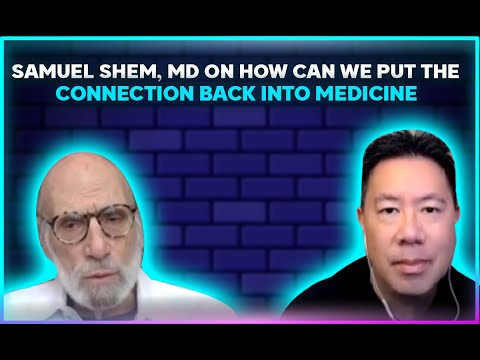
Kevin Pho: Hi, and welcome to the show, where normally we share the stories of the many who intersect with our health care system but are rarely heard from. Today we’re going to make an exception, because the majority of you already know my next guest, Dr. Samuel Shem. He is the author of The House of God and Man’s 4th Best Hospital. He wrote the KevinMD article “The evolution of the ‘doctor visit.'” Shem, welcome to the show.
Samuel Shem: Thank you, Kevin. You’re my hero.
Kevin Pho: We’ll get into your article and your books in a little bit, but first off, can you briefly share your story and your journey to where you are today?
Samuel Shem: Yeah. I had the worst story for becoming a writer. I went to Harvard. I was in a writing class, and I got below F as the ending grade. She said, “These papers are too terrible to mark. They’re below F.” So I didn’t write all through Harvard. I really wanted to be a writer, but I didn’t.
Luckily, you know, our lives just depend on whether a butterfly’s wing goes one way or the other. I happened to get a Rhodes Scholarship. I went to Oxford, and I figured this woman couldn’t get me now, so I started writing. I was also doing a PhD, but I decided I really wanted to be a writer, and that was what I was going to do. But it was the ’60s, 1969, and I got a draft notice from my board saying, “Report to go to Vietnam.” So I said, “Hey, I’ve got a choice: either Vietnam or Harvard Med.” So it was pretty easy.
But this was the real smart thing I did back then. I treasured being a writer. I hadn’t published anything, but I loved doing it, and I decided, OK, medicine is so broad that I can find something that I can make money at, as a paying job, and I’d somehow find a way to write. And lo and behold, that kind of worked, because I felt that if I had to write for money, it’d be Hollywood or TV or all that, and I didn’t want that. And so the dream job I found in Harvard Medical School was psychiatry, because as a writer, you learn about character, you hear great stories, and I don’t have to go into the afternoon. And I did that for years and years.
People probably want to know about The House of God, how I got to that. I had never tried a novel. I was doing other kinds of writing, plays and stories. And this is the important part: We were ’60s people, all of the interns that went into the hospital, and we were idealistic. We were really idealistic people who wanted to do medicine right. And we actually had the idea, from college and also in medical school, that if we stuck together and tried to do something that we thought was just, we could succeed. We put the voting laws on the books, and we ended the Vietnam War.
I didn’t realize it when I was reading The House of God, but it was a novel of resistance, of we who were, as I said, really idealistic people wanting to do humanistic medicine. And we went bam, right up against this big hierarchy that didn’t want to do that as a primary thing. It was mostly about money. And so, looking back, I realized this has always been the reason that I start a new book: It’s the awareness of injustice. And the injustice in this case was the medical training, and that gets me going.
And the other thing that happened is, after the book came out, The House of God, I was a purist. I was not going to do any appearances. Writers don’t talk, right? I did that for two years. I got a lot, and they couldn’t get me, because there was no email. And I took a pending two years of not saying a word about the book, and I got a letter in the mail. I opened it up, and it said, “I’m a doctor on call in a VA hospital in Tulsa, Oklahoma, and if it weren’t for your book, I’d kill myself.” And it just hit me right in the gut. It really did. And I started, and I’ve never, never refused an OK gig ever in all these 40 years or whatever it is.
And so I see myself now, I’m so old, you know, as someone who can say, “OK, what do you need to do? What have you got to do in your life?” Well, the thing that I talk about, right from the start, after that Tulsa thing, was staying human in medicine, the danger of isolation, and the healing power of good connection, period. Then you go on to what’s a good connection. A good connection is a mutual connection. If it ain’t mutual, it ain’t that good.
And so, to fast-forward, this is a very brief story, of course, all of this. Fast-forward: Harvard hated me when The House of God came out. I was on their faculty. They really did some pretty nasty stuff, but I don’t run on fear; I run on guilt. So I always wanted to write a real sequel to The House of God, but I was out of medicine. I was just a writer. And out of the blue, I got a call from NYU Medical School saying, “Hey, do you want to be a professor at NYU?” I said, “Well, why?” They said, “We want you to teach.” And I said, “What do you want me to teach?” And they said, “Well, we want you to teach The House of God.” So I did.
And once again, the butterfly’s little wing went the right way, because Harvard hated me for The House of God, and they wanted me to teach it. I’ve been teaching it for seven years now there. But for the first time in years and years, I was on the wards, right? I’m curious, you know. I really explored NYU. It’s a wonderful place, it’s terrific, I love it there. And what I saw the first day that I was on rounds, I saw two things about modern medicine, and it turned into Man’s 4th Best Hospital, the sequel.
But in the sequel, Roy Basch, the same narrator, says, “I have to write this book,” because it was a moment when medicine could go one of two ways: either more humane care, or toward money and screens, computer screens, which means money and money, because as we know, they’re mostly billing machines. What can I say? It’s a paralysis of our humanity, I think. And so, even at this great age, I jumped into this like a madman and wrote it in about, you know, two or three years, which is fast for me. And I can’t emphasize how just so happy I was to complete that trip from The House of God to Man’s 4th Best Hospital. And of course it came out at a bad time, with COVID coming out, but it’s doing OK. It’s doing OK.
Real physician voices, twice a week
Free, and one click to unsubscribe.
Kevin Pho: Tell me the main ways that medicine has changed. You mentioned a few ways, with screens and billing and the power of the almighty dollar, but tell me, what are some of the other ways that medicine has changed from writing the sequel to The House of God, and contrast that to when you wrote The House of God decades ago?
Samuel Shem: Yeah. Well, the lucky thing for us doctors is that the brutal hours have changed, and some people did say that, through the Libby Zion case, The House of God had some influence on that. So it’s not quite as hard a training process in the hospitals, which is very, very good, really, because, you know, when you’re that tired, you don’t care about anything.
And the problem with The House of God, why was it so bad? It was so bad that, you know, it was a big hierarchical system. The pressure came down, and we interns got isolated in three ways. We got isolated from each other. In the book, you know, everybody goes off, and one kills himself, one goes crazy. We get isolated from our authentic experience of the system itself, meaning, “I’m crazy for thinking that’s crazy,” and that is not a good place to be. And the third is, because of the time schedules, we are isolated from anybody outside the hospital.
One of the big culprits is the screens, the billing machines. You know, when Obama actually put in those screens, he did a good thing. He wanted to deal with data, so you could put it in and you could send it. The problem was that the for-profit insurance companies got their fingers into it, and every piece of data got a piece of money. And I’ll fast-forward to Man’s 4th Best Hospital, with the Fat Man. What to do about this, that, you know, we’re chained to these machines and stuff, and we don’t want to be, all those hours of the day? He said, “We’ve got to squeeze the money out of the machines,” like, say, the VA. You know, people are much happier with that.
And so let me just read a little from that article that you published so nicely, just an example of this 40-year trip in medicine, where, you know, we’ve pretty much got the control of the brutality fixed, but now we’re subject to all of these forces. The book is about, I have to say, Man’s 4th Best Hospital used to be Man’s 1st, so they got very upset. They need to call in somebody to help. They’re losing prestige and money. So they happen to hear about the Fat Man, who is a mega-wealth, mega-rich guy in Silicon Valley, right? He’s inventing a pill that will promote better memory in gomers. And so they say, “OK, come on, help us out, Fat Man. What do you want to do here? Anything you want to do.” And this would be my dream as well. I’m the Fat Man more than anybody else who ever lived. People claimed to be the Fat Man, but there wasn’t any; I was kind of it.
So he says, “What I want to do is have a public clinic leaning up against your great building, and I want to have a clinic to show how to put the human back in medicine, because if we can do it there, we get a lot.” And so he rounds up about five of his old guys, Chuck and Berry and Roy and Eat My Dust Eddie and Hacker Hooper. And that was my job in this book. That’s what my job was: the injustice and all this. And in the middle of the book, he gives a lecture on the six rackets of American health care: Follow the money. It took me a month to figure out how all these different things, these six things, are intertwined, all the way from the screens to, you know, taking over dermatology practices, the hedge funds, you know, and all of that.
And so what’s really changed is, you can go down to the level of the doctor, the doctor visit. And I’ll just read maybe a very short thing about it. Is that OK?
Kevin Pho: Yep.
Samuel Shem: Yeah. “Now your visit to your doctor has become satire. You walk in, lucky if you get eye contact, and sit across the desk. Your doctor is trapped, hunched behind a computer screen, back or shoulder to you. The doc asks a question, you answer, the keyboard goes click, click, the click faster and faster, on and on it goes. And you find yourself in the patient’s dilemma: Do I keep talking or wait for a break in the action? Usually, the next question is: Is he or she still listening or not? The new definition of a good doctor: one who can contort his or her body to touch-type while still making eye contact.
“As you keep waiting, two questions may enter your mind. What is he or she doing? What you don’t know is that your doctor is sitting there in front of the screen, seething, because he’s forced to sit in front of a screen, seething, instead of what he wants to do: to talk and listen and be your doctor. He spends at least six hours in front of the screen. This is the doctor’s dilemma. Why is he or she doing this? You might think she’s doing this because it will be better for your health care. It may not. It may be worse, worse for your care, and for sure worse for the care of your doctor. It is better only for the money. The health care industry machine was not primarily designed for care but for billing, to make as much money as possible. We doctors are caught in this mess. We’re not treating the patient; we’re treating the screen. And it’s not that your doctor wants to turn his or her back on you. It’s the health care industry that has turned its back on both you and your doctor.”
And, you know, I’m doing a lot of appearances and stuff, and now I’m doing them on Zoom, and that’s something that people really identify with. I don’t know how you feel. And in the end of the book, he gives his summary of what to do about it, and in the center of it is to squeeze the money out of the machines.
Kevin Pho: You’re absolutely right. I mean, primary care, myself. There is that competition that we have with the screen. It’s really that third actor in the room, and it demands so much attention. In medical school and residency, when we trained, we didn’t necessarily have that computer in the room, and now we have to have even special courses in terms of how we can connect with the patient but also leave that screen to the side. It’s just such an impediment.
Now, I’m also interested a little bit in your writing process. So where do you get these anecdotes and stories that you put into your novels, and how do you come up with the characters that populate them?
Samuel Shem: I’ll take that up in just a second, because what you said was very important. The thing that has kind of been taken away from us doctors who care about seeing patients is the “we.” Best doctors, it isn’t about “I” or “you”; it’s about “What are we going to do?” Right? That’s what we, in different ways, that’s what we say to our people. Doctors who use the “we”: “Well, what can we do about this?” Now, he’s got the decision, but the patient will then say, “I think we should do this,” and the “we” is concretized between them. And that’s the relationship that’s missing, and you can’t, it’s terribly hard to do. And connection comes first. That’s what people say: What can you do about any of this? Connection comes first.
The writing process, well, you know, it’s kind of wonderful and mysterious, and each person has to find out how to do it on his or her own. I take it seriously. That’s why I can write such funny books. I take it seriously. As I said, I’m just starting, you know, I’m just sort of in the middle of this new book, which is set in COVID. I have to get juiced up to do this. So I’m walking along thinking, you know, maybe, I think, “Hey, you know what? This isn’t just, somebody’s got to write about it. I guess it must be me,” as I said before. And so if I don’t have that fire, I can’t do it. I can’t do it, especially getting older. This has been the hardest book, because I’m not as energetic as I was, frankly. Because if you have something you really want to write about, it will carry you. It will carry you; you don’t have to carry it. And you get your characters and you get your story after you get that fire, and then they stay with you.
You know, I went through, after The House of God, a period where I got quite depressed. You know, the second novel is difficult. And I said, “Well, why am I writing?” And what I came to, my wife said I spent a year in the bathtub thinking, you know. But what I came to is the only reason to write seriously, you know, trying to make something good, is if you can’t not. If you can’t not.
Now, here’s the other key to everything I’ve done, which I never would have thought: Up until The House of God, I didn’t think I could write funny. I wasn’t writing anything funny. You know, young writers take themselves too seriously. And what happened was the thing that got our small group of interns through was humor, laughing, this gallows humor, in all different ways, you know, the book. And what I realized is, this is so bad, so brutal, this is so bad and brutal that at least the beginning has to ride on humor, or else nobody’s going to be able to read it. So if you look at how The House of God goes, it’s sort of funny and funny and funny, you know, about the Runt. You know, he puts a pill on his hamburger and he munches it down, and I say to him, “What’s that?” He says, “Valium, vitamin D. I’m very nervous. And I’m putting it on all my patients.” And I said, “You’re putting all your patients on Valium?” “Yeah, they’re all very nervous having me as their doctor,” which was true.
Oh, that’s true, the way The House of God came around. And this is something for aspiring writers to think about. After the year of The House of God, our core group of interns got together and drank and smoked, and it was very, very funny. I taped it, I wrote something about it, and that’s what started the book. I wasn’t planning to read a book, but things happened that I did. You know, so writing is a little bit mysterious.
I think there are two kinds of writers, actually. That might be helpful to find out earlier rather than later, if you’re trying to do it. I think there are fiction writers and non-fiction writers. You’ve either got a fiction brain or a non-fiction brain.
Now, Man’s 4th Best Hospital, that was a big thing to take on, you know. I mean, it’s one thing to do an internship, but this. But it was a great joy getting these people back, Roy and Berry and the Fat Man, you know. It was just a total joy to write about them. And if it’s possible, I was even more forced by the system to say, “I’ve got to get this right. You know, I’ve got to get this right.” And I think I did.
Kevin Pho: We’re talking to Samuel Shem. He is the author of The House of God and Man’s 4th Best Hospital. Samuel, one of the things that you mentioned during this interview was that we as physicians were becoming more isolated, not only from our patients but from other clinicians as well. And I see that every day in primary care. We don’t go to the hospital anymore; we have hospitalists. And sometimes we don’t even see the consulting specialist that we send patients to. Now, through your writing career, what are some things that you’ve learned? What are some tips that you could share with the medical students and physicians listening to this podcast on how we can get that humanity back, and how we can reconnect not only with our other colleagues but with our patients as well?
Samuel Shem: I’ve devoted my life to that, I think, writing about it, not just in fiction, but writing about it. In some ways, it’s elegantly simple, how we can survive in this kind of atmosphere. It really is. As we’ve just seen with our previous president, America rewards the self, right? It’s a very self-centered culture, really, if you look at things historically. And that permeates, of course, into medical training and being a doctor. You know, we’re taught, “Make the decision,” you know. And there’s a lot more attention being paid to having help when you do those things, making all that, but it’s really a self system. There’s a profound self, male system that runs at everything, really.
What I, with my wife, did for a long time was work on a psychological program of shifting the measurement of healthy growth in a person. Psychological growth is not the self; it’s the quality of the connections, the quality of the emotions and caring and all of that stuff. So what really helps in this atmosphere now is to start using the word “we.” For instance, the example I give is surgeons. The old patriarchal surgeons in the old days would say, “I’ve done the test. I’m going to operate on you.” That’s an I-you. Now we have, “I’ve done the test, and you can get a second opinion.” That’s still I-you, right? What if the surgeon said, “We’ve done the test. Let’s talk about what we’re going to do”? “We’ve done the test. Let us talk. We’re going to.” There are three we’s in that sentence. What is the patient going to reply? Guaranteed, the patient will say, “Well, I think we should,” and “we” gets concretized in the middle of the room between these people.
And what’s the reason that surgeons get sued the most? They’ve done studies. The patient says, “I didn’t have a relationship with him.” And actually, that’s going further now to other kinds of doctors. So, as I said before, connection comes first. It’s the new law, one of the new laws: Connection comes first, in Man’s 4th Best Hospital. Because, say you’re seeing a new patient: If you’re not connected, you’re not going to get the story. If you’re connected, you’re going to get all of the story, right?
And then the corollary, law number two of Man’s 4th Best Hospital, is basically nobody gets it right. Think of your marriage. You know, you’re always screwing it up, right? Well, in marriage, I did a lot of marriage stuff, you know, as a psychiatrist. The marriages that work are the ones when you’re going along and you hit a disconnect, as everybody does, you always do, sometime or other. The people who hold the vision that there is a “we” here someplace go through the disconnect to a better connection. And in fact, you can use these words. In fact, you can say, “We are in a disconnect,” and all of a sudden, that makes a difference to people. Try it. All of a sudden, we’re not gone; we’re just having a little trouble, you know. I teach this at NYU, all of that.
Man’s 4th Best Hospital, I think one of the best things that I was able to do in it, if you don’t mind my saying so, is Berry, who was Roy’s girlfriend at that time in The House of God. Now she is brought in to the Fat Man’s clinic, because she astonishes the Fat Man in one gathering early in the book, a sort of picnic, sort of challenging the fact that, and this is true, he’s a great leader in the traditional sense, but it’s top-down leading. He’s empathic, and she says something to him about, “Well, do you ever have, you know, empathic stuff, or stuff that you really respond to equally or mutually, that comes up from below?” And in The House of God, that man was just perfect, right? And in this book, it’s much more, because it’s much more real. He’s much more a real character, and there’s a lot. And Berry actually joins the clinic, which is great.
I have to say one other thing. One of the things that I felt quite bad about in The House of God was that there wasn’t parity among men and women, right? There was only one woman in my class of internships, out of 16. In this zeitgeist, I’m being attacked now by women for The House of God and the way women were in The House of God. And, you know, my only response is, “Well, yeah, but that’s the way it was.” You know, that’s the way it was. But I’m happy that in Man’s 4th Best Hospital, women will be happier to read it, probably. They said this in my class, that by the time the book ends, there is parity between women and men in the Fat Man’s clinic. So I’ve come along. But it’s a problem that writers have: If you write what’s true 40 years ago, you can be hated for it, for, you know, what goes on now.
When I make appearances now, I was in Europe before COVID, I’m making appearances as well as in the United States, they introduced me very often: “Well, this is his second novel. He’s written another novel.” People thought I was dead, because this is the burden I carry, you know. I mean, I’ve been writing all the way along. I mean, Janet and I wrote a wonderful, forgive me, it’s called wonderful too. It ran a year off, a play called Bill W. and Dr. Bob, about the founding of Alcoholics Anonymous. But the novel that in some ways I’m most proud of, and I’ve been reading it lately for pointers about how to write this new one, how did I ever write that one, it’s called The Spirit of the Place. It’s a doctor novel, but it’s in a different style, about sort of me going back to my hometown, joining the old doctor there. So it’s about the old medicine anew, and that’s the best book I’ve written, I think.
Kevin Pho: And my final question, Shem: What is your take-home message that you want to leave with the KevinMD audience?
Samuel Shem: Stay connected. Stick together. I mean, I would just say stick together. And I’ve said a lot about connection, and I would just tell a little anecdote to Kevin’s audience. And this has to do with, let’s drag a little politics in here, because that’s the other thing: You can’t bury your head in the sand if you’re a doctor, because we are not getting what we need or want. I have high, high hopes for the Biden transition. I really do. I really think finally we will get more just health care.
But the little anecdote: Somebody told me once, a doctor told me this once. He said, when, in the old days, because we don’t go out anymore, but in the old days, when you went out, you went out to a theater, and someone falls down on the stage, does the cry go out, “Is there an insurance executive in the house?” No, no. We are the workers. We do the work, you know. That’s the crazy, this drives me crazy: Without us, there’s no medicine. And doctors, unfortunately, are terrible about sticking together as a political force, and we’ve got to do something. That’s my only wish, actually. I can’t do it, but I’m trying to get other people to do it.
So, you know, you’re a great guy. I just want to say that. I don’t know if people realize how much you do. I don’t know how you do it. Maybe you can send me a pill or something. But it’s really wonderful for me to connect, and, you know, I hope maybe we’ll do something together at some point. Really, what you’re doing, I mean, you know, your reputation led me to you, by all these great doctors I know, and they, you know, they said, “Hey, deal with him.”
Kevin Pho: Well, I really appreciate that. Shem, thank you so much for sharing your stories and wisdom, and I really appreciate you being on the show.
Samuel Shem: Thank you. Thank you, Kevin.
Listen and followApple PodcastsSpotifyYouTubeMore apps · Browse all episodes