Listen and followApple PodcastsSpotifyYouTubeMore apps · Browse all episodes
“When my colleagues and I visited high-performing primary care clinics across the country, we sought insights to inform a new model for providing the most efficient and high-quality care. Here’s how we’re practicing in Primary Care 2.0.”
Megan Mahoney is a family physician and member, board of governors, The Doctors Company and TDC Group of Companies.
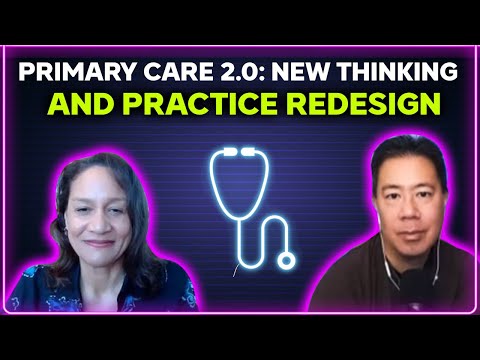
She shares her story and discusses her KevinMD article, “Primary Care 2.0: new thinking and practice redesign.”

The Podcast by KevinMD is brought to you by the Nuance Dragon Ambient eXperience.
With so many demands on their time, physicians today report record levels of burnout. Burnout is caused by many factors, one of which is clinical documentation. Studies indicate physicians spend two hours documenting care for every hour spent with patients.
At Nuance, we are committed to helping physicians do what you love – care for patients – and spend less time on clinical documentation. The Nuance Dragon Ambient eXperience, or DAX for short, is an AI-powered, ambient clinical intelligence solution that automatically captures patient encounters securely and accurately at the point of care. Physicians who use DAX have reported a 50 percent decrease in documentation time and a 70 percent reduction in feelings of burnout, and 83 percent of patients say their physician is more personable and conversational.
Rediscover the joy of medicine with clinical documentation that writes itself, all within the EHR.
VISIT SPONSOR → https://nuance.com/daxinaction
SUBSCRIBE TO THE PODCAST → https://kevinmd.com/podcast
RATE AND REVIEW → https://kevinmd.com/rate
FOLLOW ON INSTAGRAM → https://www.instagram.com/kevinphomd
FOLLOW ON TIKTOK → https://www.tiktok.com/@kevinphomd
GET CME FOR THIS EPISODE → https://earnc.me/5xrHDO
Powered by CMEfy.
Transcript
Kevin Pho: Hi, and welcome to the show. Rate and review at KevinMD.com/rate. Subscribe at KevinMD.com/podcast. Today on the show, we have Megan Mahoney. She’s a family physician, and she’s on the board of governors at The Doctors Company, a longtime KevinMD supporter. We’re going to talk about her KevinMD article, “Primary Care 2.0: new thinking and practice redesign.” Megan, welcome to the show.
Megan Mahoney: Thank you. Thank you for having me.
Kevin Pho: So we’ll get into your article in a little bit, but first off, briefly share your story and journey to where you are today.
Megan Mahoney: Sure, thank you. I’ve been in primary care as a family physician for 20 years, mostly in the Bay Area, but I also spent several years in Nairobi, Kenya. I was primed for a career in academic and community medicine because of my parents. My father was a civil rights and community activist, and my mother served as the president of a historically Black university. I have led primary care and population health innovations in many settings: in HIV clinics, in prisons, and in rural Kenya.
Now I serve as the chair of the Department of Family and Community Medicine at the University of California, San Francisco. I’ve taken this position at a time of crucial transformation in primary care, and I see this as an opportunity to harness the many learnings that can come from an academic department to give a critical voice in this unfolding primary care transformation.
Primary care is one of the largest aspects of the health care system. We have nearly 500 million visits to primary care physicians each year, and over half of all physician visits are with primary care physicians. Investing in a robust primary care physician pipeline across the country will have a positive impact on quality of care, lower costs, better patient outcomes, and also better outcomes for the workforce. And this time, I think it will be different.
Real physician voices, twice a week
Free, and one click to unsubscribe.
Kevin Pho: All right. And as you know, and as my listeners know, I’m a primary care physician myself, certainly interested in hearing about all the reforms and changes in primary care we could make. But before we get into that, we have a lot of medical students who also listen to the show, and I also like to ask primary care physicians on the show: Why do you love primary care? Why primary care? Why should medical students consider primary care?
Megan Mahoney: Yeah, thanks for asking that. I went into primary care because I wanted to be my family’s physician. I wanted to be my community’s physician. I had this idea of walking in the neighborhood and seeing somebody who I could help in clinic. I’ve been in academic medicine, and that definitely has played out, where I’ve been able to take care of colleagues on a longitudinal basis. I’ve been able to help them in their time of need, so even when they are facing a very medically complex issue, I’m there to walk along that journey with them.
I also love taking care of multiple generations in a family, and in one case, I have a family with four generations in it that I take care of. So we provide care from cradle to grave. We’re there at the beginning and at the critical end of life, and for all the issues that come up. I just like to be that companion, that captain, that champion for my patients. That’s what I love about primary care.
Kevin Pho: So as you know, there are a lot of challenges that prevent primary care physicians from achieving that vision. Before talking about your article, tell me about some of the obstacles that primary care physicians face today.
Megan Mahoney: Sure. I think recently we saw in the general media a study that came out about physician burnout, and we have a very high rate of physician burnout, unfortunately. In the most recent survey, up to 63 percent of physicians attested to at least one sign of burnout, and among family physicians and primary care physicians, the rate was among the highest. So we are confronting a widespread burnout issue. I think it’s because we haven’t really been able to develop those care models yet that will support primary care physicians to do their best work and to work in teams where all of the team members are practicing at the top of their license.
On top of it, there’s a deluge of data that’s coming. We love these patient messages, especially during the pandemic, when we were really serving as a lifeline during a time when people were confused. They had a lot of questions, there were a lot of different sources of information, and many people went to their trusted family physician or primary care physician in that time of critical need. But in primary care, we’re seeing just so many messages come in, so many different streams of data come in, that we’re managing, and that is the time when we need to make technology work for us, as opposed to being a victim of all of that data.
And so it’s about building the right team to address the new way in which primary care is practiced, so that we can offer those video visits. I love seeing my patients in their home and with their family, and I love being able to review their medications right in front of the camera with them. There are so many advantages in the way that we practice primary care at this time. It’s just that the organizations need to catch up to really support primary care.
And then there’s a macro issue around economics. Primary care physicians are not being paid as much as other specialties at this time, and that is improving slowly through CMS, but it’s not addressing the workforce shortage that we currently have. We currently need around 15,000 physicians to serve underserved areas throughout the country, and over the next 10 to 15 years, we’re facing a shortage of 48,000 physicians. That’s going to be really hard as we start thinking about how chronic disease is becoming more prevalent, how we think about the different ways in which we want to help our aging population, and then also the ways in which we want to effectively address social determinants of health. So this is very critical at this point, and I do think that those serve as barriers, but they’re all surmountable. They’re all things that we can address.
Kevin Pho: So let’s talk about some of your solutions, which you discussed in your KevinMD article titled “Primary Care 2.0: new thinking and practice redesign.” Talk about how the article came together.
Megan Mahoney: Sure. Well, as a primary care physician, the article was inspired by one of my patients, who I referred to in the article as Ruby. Ruby is a 79-year-old woman who comes from the same area in Tennessee that my mom is from, and I describe her care experience in an innovative primary care model that I hope illuminates several principles that have informed this new thinking in primary care and practice redesign.
When I was serving as the president of the medical staff at Stanford Health Care, I was invited to give a talk about transformation in primary care. In preparing for that talk, I conducted an assessment of what primary care looks like now, and I looked at analyses that helped me understand what it’s going to look like in the future. I’m also thinking about, since we were talking about medical students, how we need to design medical education and residency training to help prepare this future generation of primary care physicians, because we’re really at the vanguard of health care transformation, and in many ways, primary care is front and center. So that’s what’s inspiring my team and me and my work right now.
In the article, I explore aspects of Ruby’s care. One aspect is how the patient messages and the asynchronous care have become too much of a good thing. I compare primary care physicians’ work to Lucy and Ethel in the classic chocolate factory sketch from I Love Lucy, where providers are enjoying having these bonbons of messages coming through on the conveyor belt. We enjoy interacting with our patients in this way, and we want to tend to each and every one of them deliberately and in a dedicated way. However, the flow of the messages, if you think about the metaphorical conveyor belt, has sped up during the COVID pandemic, and it’s just become so evident that a team is required to triage and handle the messages so that the primary care physicians don’t become overwhelmed.
So for Ruby, I have many examples, and for many other patients. It turns out in larger studies that these tech-enabled connections enable us to provide longitudinal care. They’ve been associated with a reduction in hospitalization rates and in visits to the emergency room, because they’ve allowed us to provide more proactive and prompt care. We are able to give better access to our patients. But I do want to stress that we need to ensure that technology is working for us in order to sustain the physician workforce and its wellness.
Kevin Pho: Yeah, so take us into the workflow. Take us into the office of the ideal primary care practice. You mentioned Ruby, the case study in the article, so take us into that practice and paint us a picture of how that would actually go.
Megan Mahoney: Sure. So I would see Ruby in practice, in person or through a video visit, and I would establish care and understand her medical history. In this case, she was being seen in a different state, and she was just coming in to primary care on my panel. At that time, I enlisted her daughter to help her get on an iPad, and with that iPad, we were able to connect her to a blood pressure cuff. She started to weigh herself every day. She initially was struggling with the technology, but with our team and with her daughter’s help, we were able to get her to be one of our most active users. So she was sending in her blood pressure measurements, she was sending me messages, and I was even able to titrate her hypertension medications, all virtually, all through this asynchronous connection.
One time we noted, and it was actually the cardiology nurse who noted this, that her blood pressure was actually increasing, and there were some changes. We were wondering what was going on, because she had been previously very well controlled. So the cardiology nurse reached out to her and called her, and it turns out she was developing a pneumonia. I was able to order a chest X-ray, and I was able to talk to her, all virtually. This was all during the COVID pandemic. She didn’t have COVID; we identified that she had influenza pneumonia, and we were able to treat her as an outpatient. If we had not been able to detect the change in her blood pressure, I don’t know if we would have been able to intervene in time to prevent a hospitalization.
So I feel really good about these new ways of providing care. These new modalities are extremely important, and we’re just seeing that this is going to lead to a reduction in the cost of care, which we know is a major issue. This is primary care at its best.
Another way that I was able to help her is by having these electronic connections, these e-consultations with specialists. While the cardiologist never saw her face to face, I was able to receive the cardiologist’s expertise and their recommendations, and then I was able to implement them on behalf of the patient. So through that means, the e-consult is also a way of providing superpowers to primary care physicians, so that we can do what we need to do with our patients and provide them the best care.
Kevin Pho: Now, not all primary care practices are as well resourced as UCSF. So what about some of those primary care practices that perhaps have staff shortages, that can’t fill their staff, not enough nurses, not enough medical assistants, and they’re barely keeping up? What kind of ideas can they implement in a practice that doesn’t have as many resources?
Megan Mahoney: Yeah, so I’ve been very impressed with how far we’re able to go in team-based care with our medical assistants. The partnership between the primary care provider and a medical assistant is crucial. Our medical assistants were trained to be health coaches. They were able to respond to a number of those messages that come in, for making appointments, for teeing up prescription refills. There are a number of tasks that a medical assistant can really help with that will then lead to a reduction in the burden on the primary care provider.
We hear time and time again that once the medical assistant is empowered to provide this higher level of care, once they’re empowered to practice at the top of what they’re able to do, they get more satisfaction and gratification out of their job. But you have to be cautious, because I’ve seen it many times that once the medical assistant is more empowered to do direct primary care, they end up wanting to go into nursing, they end up wanting to go to medical school. I’ve seen that time and again, and of course I’m overjoyed and so happy for them, but that is what happens: They become more proficient in providing health care.
Kevin Pho: So what’s the path forward? How do we get from where we are now to what you describe? Is it purely macro forces that would change and perhaps better finance primary care? Is there anything an individual primary care clinician can do?
Megan Mahoney: Yeah, so I do think that, as an individual primary care clinician, the one thing that I want to convey is that a lot of times in the media, and I even mentioned it earlier, we hear about physician burnout, and we think about physician resiliency, and we think about self-care, and all of those things are very important. But what I’ve learned is that physicians are actually incredibly resilient. This is not a resiliency deficit that we’re dealing with. In fact, in many studies, you’ll see that physicians on average are more resilient than the general workforce.
So if we think about that not being the problem, we must look at organizations and think about ways in which organizations can be more resilient, whether it’s empowering physicians in leadership positions or looking for more clinician voices in organizations. Physicians can also think about developing more quality improvement opportunities in their clinic, getting them engaged so that they’re having some control over their work environment to improve their situation.
Of course, remuneration is incredibly important, so we don’t want to lose sight of that: advocating for having a salary that is what you would see in the market in the area, and understanding that the role of primary care is slightly different. It’s not procedural-based. It’s not about trying to increase the volume of visits. It’s really about preventative care. It’s really about trying to see as many people as possible in a population health way, so that you’re taking care of a population, as opposed to the sick care model that we’re used to, where we see people when they’re sick. So it is a shift in the orientation, but I do believe that because of the rising health care costs, we are at a tipping point, and we will need to start thinking about investing in primary care so we do get the long-term cost-saving gains that are so critically needed at this time.
Kevin Pho: So the trend I’m seeing now is that, unfortunately, more physicians are trending towards specialty and leaving a void, and advanced practice providers like nurse practitioners and physician assistants are filling that primary care void. So in your ideal model, what do you envision the role of nurse practitioners and physician assistants to be?
Megan Mahoney: It’s a great question, and it’s a very important observation. Absolutely, we’re facing a primary care physician workforce shortage. There’s no doubt about that. So how do we collaborate with advanced practice providers so that they are empowered to provide the care? I have analyzed many different models, and the way that I’ve seen it work most effectively is when an advanced practice provider is able to contribute as an independent practitioner alongside a physician. And again, in this team-based care model, we’re all taking advantage of everyone’s expertise on the team. Sometimes a nurse practitioner will have lengthy experience in podiatry or in oncologic care, and they’re on your team, and so we all can learn from each other in that format.
And then again, the primary care physician is there to help an APP with something that’s very medically complex, where our medical training is more appropriate in assisting. So that’s how I’m sort of seeing it: Everybody is working together. Maybe we share a panel. Maybe there is some restratification of the patients so that more medically complex patients go to a physician. There are a lot of ways that a model can work, and it really depends on the local context and the patient population that a practice is serving.
Kevin Pho: We’re talking to Megan Mahoney. She’s a family physician, and she’s a member of the board of governors at The Doctors Company. We’re talking about her KevinMD article, “Primary Care 2.0: new thinking and practice redesign.” Megan, what are some of your take-home messages that you want to leave with the KevinMD audience?
Megan Mahoney: Thank you. Primary care serves as the cornerstone of the patient-physician relationship, helping to reduce health disparities, influencing patient engagement, and improving health outcomes. Investing in primary care and the primary care pipeline is essential for expanding access to care and improving quality of care. The time is now to make reforms that secure primary care’s central role in the health care system.
Kevin Pho: Well, thank you so much for sharing your time and insight. Thanks again for being on the show.
Megan Mahoney: Thank you.
Listen and followApple PodcastsSpotifyYouTubeMore apps · Browse all episodes