Subscribe to The Podcast by KevinMD. Catch up on old episodes!
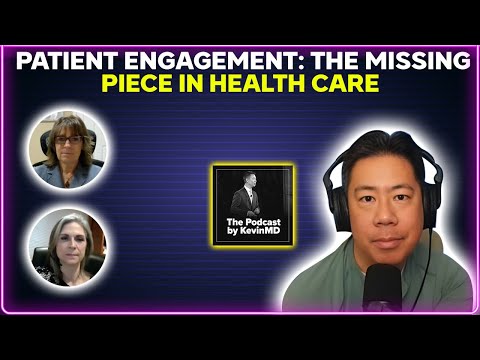
Join health care executives Susan Montminy and Marlene Icenhower as they discuss the critical topic of patient engagement in health care. In episode, Susan and Marlene explore the impact of patient engagement on provider satisfaction and health care outcomes. They share their expertise on communication strategies, understanding patients’ goals, and managing treatment expectations.
Susan Montminy and Marlene Icenhower are health care executives.
They discuss the KevinMD article, “8 tips to engage patients, improve outcomes, and increase provider satisfaction.”
Read the white paper: A Dose of Insight — The Importance of Patient Engagement: From Noncompliance to Activation

Our presenting sponsor is Nuance, a Microsoft company.
Together, Microsoft and Nuance are leveraging their rich digital technology and advanced AI capabilities to tackle some of health care’s biggest challenges. AI-driven technology promises to revolutionize patient and provider experiences with clinical documentation that writes itself.
The Nuance Dragon Ambient eXperience, or DAX for short, is a voice-enabled solution that automatically captures patient encounters securely and accurately at the point of care. DAX Copilot combines proven conversational and ambient AI with the most advanced generative AI in a mobile application that integrates directly with your existing workflows.
Physicians who use DAX have reported a 50 percent decrease in documentation time and a 70 percent reduction in feelings of burnout, and 85 percent of patients say their physician is more personable and conversational.
Discover AI-powered clinical documentation that writes itself. Visit https://nuance.com/daxinaction to see a 12-minute DAX Copilot demo.
VISIT SPONSOR → https://nuance.com/daxinaction
SUBSCRIBE TO THE PODCAST → https://kevinmd.com/podcast

ADVERTISEMENT
RECOMMENDED BY KEVINMD → https://kevinmd.com/recommended
GET CME FOR THIS EPISODE → https://earnc.me/NPWwRA
Powered by CMEfy.
Transcript
Kevin Pho: Hi, and welcome to the show. Subscribe at KevinMD.com/podcast, and get CME for this episode by clicking on the CME link in the show notes. Today we welcome Susan Montminy and Marlene Icenhower. They’re both health care executives, and they co-wrote the KevinMD article “8 tips to engage patients, improve outcomes, and increase provider satisfaction.” Susan and Marlene, welcome to the show.
Susan Montminy: Thank you, Kevin.
Marlene Icenhower: Kevin, good to be here.
Kevin Pho: So I’m going to ask each of you just to briefly share your story and journey. Susan, why don’t you go first.
Susan Montminy: Oh, sure, thank you. So I’m a lifelong learner, and my nursing career really began in a traditional role in a hospital setting at the bedside. And Kevin, this led to nursing leadership roles, including areas of radiation oncology, employee health, quality, and safety.
And from there I morphed into this legal, regulatory, and patient safety-focused work. And here’s where my passion and understanding for both patient and clinician care and support, and how they intersect with the importance of systems that our clinicians are working in, the need for them to really be intuitive, easy to work in, all to reduce the risk of error and improve patient safety.
So you can say everything I do as a risk management leader is with that goal in mind. The two, employee and patient support, really can’t be separated. You’ve seen it written, if you take care of your employees, they’ll take care of your patients.
Kevin Pho: And Marlene, why don’t you briefly share your story and journey.
Marlene Icenhower: Sure. So mine is a little different from Susan’s, but we ended up in the same place, so it’s unusual.
So I started my professional career as a registered nurse working at a teaching hospital, and then somehow, probably too much 1980s television, right, I got really interested in the legal profession. So I went to law school and worked my way through law school as a nurse. And when I graduated I joined a medical malpractice defense firm, and for many years I tried medical malpractice cases, and eventually ended up in health care risk management.
Right now I’m the senior risk specialist at Coverys, and I work with our West Coast policy holders, helping them navigate some of the thorny risk issues that they face in our organization.
Kevin Pho: Perfect. Now, both of you co-wrote the KevinMD article “8 tips to engage patients, improve outcomes, and increase provider satisfaction.” So Susan, why don’t we start with you. Tell us what this article is about.
Susan Montminy: Sure. I’ll give you some background of how it all came together.
As Marlene mentioned, we work in the medical malpractice and risk management space, and we’re so cognizant of the fact that when patients are dissatisfied with their care, they can disengage. And then that disengagement affects the patient’s ability to manage their care, comply with their treatment plan, all leading to poor outcomes. And then poor outcomes combined with that dissatisfaction with care, this can lead to malpractice claims.
So at the same time, we understood that these are just overall trying times for clinicians, still recovering from the burden of the COVID-19 pandemic, burnout being a real concern. So this idea for the Dose of Insight report, the importance of patient engagement, which led to the KevinMD article, came to be. It was really our goal, Kevin, to offer data-driven insights and then targeted solutions into this area, to increase patient engagement and clinician satisfaction.
So I stepped back from this a little bit and ask the listeners to remember a time, the joy that we felt when we knew that something that we did to help a patient help them meet their health care goal, or better manage and understand their disease. Let’s face it, it’s just a really, really good feeling. So I guess you could say we wanted to offer ways for clinicians to rediscover that joy in their work, to really connect back to that good feeling.
From that, we then analyzed five years of closed malpractice claims, and we looked at lack of patient engagement as a significant factor in many of the cases in this alleged medical error. And some of the signals that emerged from that data analysis: 71 percent of patients had at least one comorbidity, the most common were diabetes and smoking. 60 percent of the cases began in an office, clinic, or surgical setting. And 34 percent of the cases, and an overall 65 percent of the indemnity paid, involved high injury severity or death.
So really, targeting solutions to increase that patient engagement, as a beginning in the office, clinic, and surgical settings, with those patients with multiple comorbidity, might be a really good place to start.
Marlene Icenhower: And I’ll add a little bit more background to that. We offer a consultation phone line that’s answered in real time. Our policy holders call when they have difficult issues that they need help with. One of the frequent inquiries that we get on that consultation line from office-based providers is on this very, very topic.
The story that usually emerges is that providers will describe a strain or a conflict that’s arisen in the physician-patient relationship. And a lot of times the conflict that arises results in the patients not adhering to treatment plans or recommendations. And by the time providers call us, they feel like they have no alternative really but to discharge the patient from practice, which is obviously a last resort.
And when we pick up these calls on the phone line, you can really hear the stress and the angst in the caller’s voice. It’s a really stressful situation, this lack of patient engagement, for everybody involved, for the patient and for providers. So in the end, this was a really hot topic for our office-based providers, and this paper was a way to address that issue and give some inexpensive tips for increasing engagement. It’s really worth a read.
Kevin Pho: So Marlene, let me follow up on that. What are some of the common reasons that may lead up to lack of patient engagement, to the point where a provider would want to discharge them from the practice?
Marlene Icenhower: Yeah, so a lot of times it’s lack of communication, not properly setting expectations.
In the paper we sort of outline different phases of the physician-patient encounter where you can intervene to increase engagement. I think in the article we listed about eight tips, but they really do fall into three phases. So in a nutshell, here they are.
Prior to the encounter, before you ever see the patient, it’s really important to set ground rules up front. So make sure that patients understand their rights, but also their responsibilities too. Make sure that you’re giving clear instructions before the appointment, let patients know what to expect at the appointment and how to prepare.
Then during the encounter, really important to hone your communication skills, right? That bedside manner is really important during the visit. So encourage conversation by active listening. Make sure that you’re using plain language to tell the patient what’s going to happen in the visit and what their treatment plan is.
Sometimes it’s really important to communicate really directly with patients, especially when non-adherence is an issue. But remember that with the advent of the Cures Act, that patient portals now give patients the opportunity to look at your documentation and see your visit notes almost in real time. And the language that you use in those notes can really make a difference. So be mindful of the language that you’re using to write notes, and make sure that it’s kind and positive.
Participating in health care, as we know, takes a lot of resources, and participating actively. So things like childcare, lack of transportation, some folks just don’t have access to these resources. So during that first encounter it’s really important to understand and uncover any kind of social barriers that might pose problems down the road.
I think in our health care experience, I think we’ve all encountered patients whose treatment goals don’t include things like smoking cessation or not eating carbs, right? So our patients also tend to have unrealistic expectations about outcomes. So again, it’s really important to set the stage at the outset of the relationship and make sure that you understand the patient’s goals and priorities, and also manage expectations.
And then finally, after the encounter, when conflicts arise, which they do, which sometimes is what prompts people to call us for help, it’s really important to take the time and sit down and have an honest, compassionate conversation with the patient. It shows them that you’re listening and that you’re trying to address their concerns. A lot of times just this one simple face-to-face conversation is all it takes to get the relationship back on track.
Kevin Pho: So Susan, let me ask. I think what Marlene outlined sounds great. What are the common reasons that prevent clinicians from attaining all those goals that Marlene articulated?
Susan Montminy: Yeah, well, I think that would be organizationally specific. But some of the reasons, Kevin, could just be maybe focusing more on the technology and the skills and the knowledge and all of that, and not really stepping back and empathizing and walking through that patient journey that Marlene just talked about, as a patient. We’ve all been patients and we know what it feels like, looks like, and sounds like, and we understand the language that’s being spoken.
I really love, Marlene, that you brought out the plain language piece. Because I think sometimes focusing back on those basics, Kevin, forming the relationship with the patient and coming to shared decision-making, the goals might be a little bit different from what the physician and clinician feels is the right treatment plan. What are the patient’s goals, and then bringing those together and aligning them?
So the reason, probably, I’m sure one of the biggest reasons, is time. But if leaders could help make the time to really look at that environment and what does it feel like to be a patient before the encounter, during the encounter, and after the encounter, those efforts would go a long way. Walk a mile in my shoes, if you will.
Kevin Pho: So Susan, let me follow up on that, because you do mention time. And of course, you don’t need me to say that a lot of clinicians are just burdened with administrative pressures to see more, electronic medical record burdens, checkboxes to click off. And I’m sure every clinician who’s listening to this can really understand and empathize with that time element. So how can clinicians thread that needle and do those things that you suggested to increase patient engagement, in a setting where time and pressure to do more and see more is at a premium?
Susan Montminy: Yes. And so I’m going to bring it out in a bubble, and I’m going to bring in the leaders, because the clinicians, to your very valid point, are the ones that have to work within that system. You remember I mentioned systems at the beginning of our conversation.
So bringing the leaders in and sharing this concern, showing them this report. Hey, data shows that patient engagement is a really important thing for us to focus on. I’m finding that I’m just not having that time to do that. What can you do to create a culture that frees me up to be able to speak to that patient during the encounter time?
Things like Marlene just said, setting the expectations up front, getting patients connected into the patient portal, and having office staff and leadership support. How can we communicate with that patient outside of that small encounter? All of these things help a patient feel listened to and cared about. Even something as simple as the chair that they’re sitting in in the waiting room can matter.
So, having a conversation that this is important. We are busy, we are busy taking care of the patients. What can we do to bring that out broader, bringing our office staff, and bringing our communication that happens before and after the encounter, so that there’s this smooth communication, which leads to that patient feeling really listened to, heard, and understood.
Kevin Pho: And Marlene, is there any data suggesting that increased patient engagement can make a measurable impact when it comes to risk reduction and patient outcomes?
Marlene Icenhower: Sure, and I think that’s what you’ll see in the report, right? Is where we looked at 6,000 claims over five years, and that link became really clear. When patients aren’t engaged, bad things happen. You have to be engaged to have a good outcome. So I think that’s what the report shows.
Kevin Pho: Marlene, is there a case study, it could be hypothetical or real life, where you implemented some of these suggestions, a clinician or institution took them up and made a measurable impact in terms of their patient engagement? Tell us a success story.
Marlene Icenhower: Boy, I think that they happen all the time all over the country, particularly in response to consultation line calls, right? So we’ll hear the story from the provider, and we’ll talk to the provider about, well, maybe you need to have a conversation. Have you explored why it is that they’re not showing up for appointments, things like that? And then they’ll call back and let us know that it worked.
And at the heart of the, as providers call it, the non-compliance or the non-adherence, is, sometimes they will see a financial concern or an inability to get to appointments that the patient might just be embarrassed to talk about.
But in the paper, we have several case studies in the paper where non-adherence and non-engagement led to really devastating results. For example, not following up on wound care that results in amputations, things like that. So the link is really clear, and the tips that we give are really actionable, on a really granular level.
Susan Montminy: Thank you, just want to build on that. Thanks, Marlene, so true.
And when we put these reports together, Kevin, we call them signal intelligence. And our goal in offering these to the health care community is to take them and have conversations within their individual organizations, to see if these signals resonate with them, because some organizations might already be doing this really great. But I love your question. We would be thrilled if somebody did research taking our claims data and did some research within their own organization to see how that helped.
Kevin Pho: OK, so I’ve got each of you. Like, I’m a primary care physician myself. What would you say is the highest yield tip that an individual clinician can implement to make the most impact on patient engagement? Susan, why don’t you go first.
Susan Montminy: Oh, sure. Get back to basics. Recognize the importance of shared decision-making. Focus on conversation, that active listening, looking for those body language cues that might indicate that either someone isn’t understanding what you’re saying, or it needs further clarification. And remove any barriers to that achievement, like Marlene mentioned earlier, those social determinants of health that might be getting in the way. All wrapped in a little bit of kindness.
I always love the quote by Maya Angelou that states, I’ve learned that people will forget what you said, they might forget what you did, but they’re never going to forget how you made them feel. And that rings true in the medical malpractice world. Patients are less apt to sue if they really like their clinician, if they have felt heard and they felt like they mattered to you.
Kevin Pho: And Marlene, share your highest yield tip for the clinicians listening to you, to really impact that patient engagement.
Marlene Icenhower: I would say, to remember that patients who are not engaged generate a lot of stress, and they take up a lot of time that you really don’t have.
The good news is that lack of patient engagement isn’t a lost cause. There’s something that you can do about it that’s inexpensive, that’s easy to implement, and that, like Susan said, is just basic communication.
When you invest time and energy up front to engage patients, you really do reap dividends on the back end in terms of your job satisfaction, less burnout, and most importantly, less claims.
Kevin Pho: We’re talking to Susan Montminy and Marlene Icenhower. They’re both health care executives and co-authors of the KevinMD article “8 tips to engage patients, improve outcomes, and increase provider satisfaction.” And I’m going to end off with each of you sharing your take-home messages to the KevinMD audience. And Susan, why don’t we start with you.
Susan Montminy: OK, thank you so much. Yeah, takeaway. Please look at the Dose of Insight report. It’s our gift to you. It includes targeted solutions to help you identify those vulnerabilities that are within your own organizations. Bring them to your leaders.
As you’ve heard throughout our time together, this patient journey, if you can just target it, improve it, we really believe this will help improve clinician satisfaction, patient outcomes, reduce the incidence of burnout, and reduce malpractice claims.
Kevin Pho: And Marlene, what are your take-home messages?
Marlene Icenhower: I would echo what Susan said, and encourage listeners to take a look at the report. And it’s really worth it to devote time in the beginning for the reward in the end.
Kevin Pho: And I’ll include a link to the report in the show notes. Thank you both of you for coming on the show and sharing your perspective, time, and insight.
Susan Montminy: Our pleasure.
Marlene Icenhower: Thanks, Kevin.