Recently, my mother was told by her doctors that her high blood pressure was a concern and that she needed to make dietary changes and eat foods lower in sodium. Seemed simple. To my mother, what was clear was the need for significant dietary change to stay below 2,300 mg of sodium, the recommended limit by the American Heart Association. Sure, she would make sure to not eat food overpowered by saltiness, but when readily apparent signals and cues would not result in diet change, her dietary choices would remain unchanged. Reduced sodium intake recommendations are ever-prominent for many patients struggling with hypertension. Are there better ways to deliver it? The direction to simply cook, as opposed to being told to monitor diet to consume less sodium, could offer a potential solution.
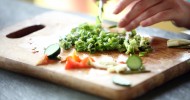
When cooking, I started observing the quantities of salt I used, changing to low-sodium salt or alternative ways to make food savory for my mother. In my own experience as a home cook, the mere seeing of ingredients gets me to think further about their value to me. I would consider nutritional metrics like fat content, starchiness, and sodium level. Handling what a real tablespoon of salt feels like certainly conjures thoughts about daily sodium intake. Beyond sodium, working directly with ingredients forces me to think about what they mean beyond their culinary value. Rinsing leaves of lettuce while prepping a salad reminds me of the food pyramid’s leafy greens dietary requirements. Seeing the fat on a steak rendering down allows me to imagine the buildup of cholesterol in blood vessels.
All of this to say, cooking could have notable benefits beyond what are the typical takeaways. Namely, a consideration and mental accounting of personal health choices. We are visual learners; perhaps seeing and feeling can be an added level of convincing power that health providers can use to convince patients about changing dietary habits, a topic in health care now being widely discussed.
In addition to telling someone to eat healthier or avoid certain foods, those in the medical field can help empower patients to try cooking. This helps people discover an agency over their medical decisions, as opposed to feeling confined by prescribed restrictions. The benefits of nutritional programs or guidance which include cooking instruction have indeed been discussed and provide great options for additional patient education. I think it also offers insight into what empowers people to make health and lifestyle choices.
Real physician voices, twice a week
Free, and one click to unsubscribe.
Of course, cooking is not a small feat. It requires planning, time, effort, and patience. I argue that despite these things, it can be well worth it when it comes to public health. As it stands, restriction and reduction can be seen as an imposition when it comes to health recommendations. Thus, cooking, an act in which one can control every step of the process, restores power to the patient. The medical specialty of psychiatry has taken advantage of this concept coining the term positive psychiatry, which emphasizes agency and intentional activities as yielding therapeutic value. It does so because people like to feel as involved as possible in their own health.
This visual and pragmatic accompaniment to standard patient education I believe holds significant value. Medicine in general works to help people become more in touch with their own anatomy. At its best, people take what data they can gather and make and adhere to changes accordingly. There is a national push to inform the population about the food we eat, with a new recommendation from Health and Human Services Secretary Robert F. Kennedy Jr. that medical schools provide nutritional education to student doctors.
It is clear that there is a collective revamping of health conscientiousness with information everywhere and at our fingertips. I think that cooking can function as an important example of how to get people thinking about tangible and actionable health moves that should be taken advantage of. It may be hard to convince the public to opt out of lifestyle habits and routines. Now, when one is able to physically hold, observe, and examine that which should be given more attention, this second look could be the difference between simply understanding the changes one should make and action to enact those steps.
Oliver Power is a medical assistant.