If you think one word inside a medical expert report cannot break a case, look at what happened in Kline v. Zimmer. A defense expert testified about possible alternative causes of a plaintiff’s injury, not probable ones. That single word, possibly, is the reason opinions like his are routinely challenged. Across multiple jurisdictions, courts have held that an expert who testifies in possibilities is offering no evidence at all.
In civil litigation, a medical expert is required to state opinions to a reasonable degree of medical probability or, in some jurisdictions, reasonable medical certainty. The legal definition is straightforward. More likely than not. Greater than 50 percent. Courts across the country have held that testimony rooted in what could have happened, rather than what probably did happen, fails to meet this threshold.
This is the language standard that turns a clinical observation into legal evidence. Without it, your opinion is a guess in a white coat.
Yet most clinicians writing expert reports still hedge. They write could have, may have, it is possible that. They are protecting themselves the way they would inside a chart note, where defensive hedging is a virtue. Inside a medical expert report, defensive hedging is the thing that gets the entire report struck.
Real physician voices, twice a week
Free, and one click to unsubscribe.
The case that changed California law
In 2022, the California Court of Appeal decided Kline v. Zimmer, Inc. The court held that the requirement of proving causation to a reasonable medical probability applied only to the party bearing the burden of proof, usually the plaintiff. That meant a defense expert could testify about possible alternative causes of a plaintiff’s injury without being held to the same standard.
The result was an asymmetry. Plaintiff experts had to clear the probability bar. Defense experts could float theories that were merely possible, a stroke with no supporting evidence in the record, an alternative mechanism with no clinical basis, and present them to a jury as though they carried the same weight.
The Consumer Attorneys of California sponsored Senate Bill 652 to override the Kline decision. Governor Newsom signed it into law on July 13, 2023. Effective January 1, 2024, new Evidence Code Section 801.1 requires that every expert testifying about medical causation in California, plaintiff or defense, must support that opinion to a reasonable medical probability. An entire state codified what many clinicians still do not understand. Possibility is not probability. One is admissible. The other is not.
Why this word problem costs cases
Here is the part most clinicians miss. When you write the patient may have suffered a cervical strain from the impact, you have not written an expert opinion. You have written a clinical impression. Opposing counsel will move to strike. The judge will likely grant the motion. The attorney who retained you will pay your invoice, lose your opinion, and quietly stop returning your calls.
The damage is rarely a single trial. An expert report is a permanent work product. Once submitted, it circulates among attorneys and future clients in a way that cannot be corrected. Your name now travels with a report that did not survive scrutiny. The next attorney who looks you up sees that report. The first attorney does not refer you. Compare these two sentences from real expert reports.
WEAK: The delay in administering antibiotics could have contributed to the patient’s septic shock.
STRONG: It is my opinion, within a reasonable degree of medical probability, the failure to administer broad-spectrum antibiotics within 1 hour of the documented sepsis criteria was a substantial contributing factor to the patient’s progression to septic shock.
The first sentence is inadmissible in most jurisdictions. The second is the standard.
The four words that protect you
The four words are reasonable degree of medical probability. For nurses, swap medical for nursing. They sit in front of every causation opinion you write, without exception. They are not decoration. They are the legal hinge on which the admissibility of your entire report turns.
This is one of the foundational principles inside the C.L.E.A.R. Method, the attorney-informed framework I developed to help licensed clinicians write expert reports that attorneys trust, request, and refer. Most expert witness training teaches you how to get into the room. The C.L.E.A.R. Method teaches you what to do once you are there.
The lesson
In 2014, a group of delivery drivers sued Oakhurst Dairy in Maine for unpaid overtime. The case turned on a single missing Oxford comma in the state’s overtime exemption law. The statute listed the activities that disqualified workers from overtime pay: the canning, processing, preserving, freezing, drying, marketing, storing, packing for shipment or distribution of perishable foods. Without a comma between shipment and or distribution, the language was ambiguous. Did “packing for shipment or distribution” describe one activity, or two? The drivers distributed product but did not pack it. In 2017, the First Circuit ruled the ambiguity had to be construed in the drivers’ favor. The dairy settled in 2018 for $5 million. The Maine legislature went back and replaced the commas in that statute with semicolons.
One missing comma. $5 million.
A single word, in the wrong sentence, can cost a clinician her credibility, her referral pipeline, and the case she was retained to support.
If you are writing expert opinions and you are not yet writing inside the standard, your work is already vulnerable. The fix is not complicated. It is precise. And it is the difference between an opinion an attorney can use and an opinion that will be argued out of evidence before trial.
Tracy Liberatore is the founder of the National Expert Academy and a pioneer of the C.L.E.A.R. Method, an expert report-writing framework developed within a working medical-legal firm. A former physician assistant with ten years of clinical practice, she later earned her law degree with valedictorian honors and spent the next decade founding and operating Med Legal Pro, where she trained and placed clinical experts for attorneys handling medical malpractice, personal injury, and nursing home negligence cases nationwide.
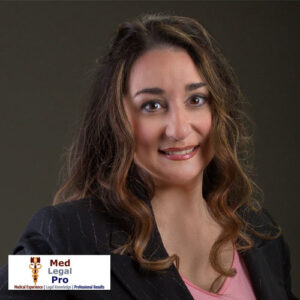
She is the author of From Medicine to Law: Creating Winning Legal Teams with Medical Expertise and the host of the Statutes & Stethoscopes podcast. Her writing includes work on why accomplished clinicians may struggle in expert witness roles, the future of medical legal consulting, medical errors, and attorney concerns about medical records. Her work has been featured in USA Today, MSN, and CEO Feature.
Tracy now trains licensed clinicians to write expert reports attorneys trust, request, and refer. She shares insights through her personal LinkedIn, as well as the platforms for National Expert Academy and Med Legal Pro.