Next month, thousands of resident physicians will begin their journey toward U.S. board certification. They will spend countless hours studying clinical guidelines, refining their diagnostic skills, and learning the intricacies of patient care.
According to the 2026 National Resident Matching Program (NRMP) Match results, international medical graduates (IMGs) remain an essential component of the U.S. physician workforce. Of the 9,682 IMG applicants who matched this year, 6,733 were non-U.S. citizen IMGs, and 2,949 were U.S. citizen IMGs.
For many non-U.S. citizen IMGs, however, another curriculum receives far less attention. It cannot be found in textbooks. It is not discussed during orientation. It never appears on board examinations. Yet it may influence a physician’s success just as much as medical knowledge. It is the curriculum of culture and communication.
The education we expect
When I came to the United States, I expected to learn about a new health care system. I anticipated adapting to electronic medical records, mastering documentation requirements, and learning American practice patterns.
Real physician voices, twice a week
Free, and one click to unsubscribe.
When I started my internal medicine residency in Brooklyn, New York, in July 2006, I was both excited and apprehensive about the next steps. Like many international physicians, I had worked tirelessly to get there. The journey had required years of study, examinations, applications, interviews, and sacrifice.
Yet as I sat through orientation during the final week of June, preparing for July 1, I believed my biggest challenge would be clinical medicine. I was wrong. As my first rotation unfolded, I quickly realized that I was not fully prepared for the nuances of American culture. I was prepared for the clinical learning curve. What I was not prepared for was the cultural learning curve.
The culture shock I never saw coming
One of the most surprising lessons I learned had nothing to do with medicine. It had to do with communication. More specifically, it concerned how communication is interpreted. Coming from a culture where spoken words often carry a strong expectation of commitment, I tended to take language literally.
I frequently heard phrases such as:
- “Let’s get together sometime.”
- “I’d love to help.”
- “Keep me posted.”
- “We should collaborate.”
- “Feel free to reach out anytime.”
To me, these statements sounded straightforward. If someone wanted to get together, I followed up. If someone offered help, I reached out. If someone expressed interest in collaboration, I attempted to schedule a meeting.
Many times, nothing happened. Emails went unanswered. Meetings never materialized. Promising conversations simply faded away.
Initially, I wondered whether I had done something wrong. Was I too eager? Too direct? Too persistent? Had I unknowingly violated some professional norm? Over time, however, I realized I was encountering something many international professionals experience but rarely discuss.
Understanding performative politeness
Years later, I came across a phrase that helped me understand what I had experienced: performative politeness. It is not necessarily dishonesty, nor is it malicious. Most people who communicate this way are genuinely kind and well intentioned. Rather, it reflects a communication style that prioritizes social harmony, minimizes discomfort, and avoids direct rejection.
Sometimes phrases such as “Let’s connect sometime” are intended as expressions of goodwill rather than concrete commitments. The intention is positive. The interpretation, however, may differ dramatically depending on one’s cultural background.
For individuals raised in cultures where words are closely tied to obligations, the disconnect can be confusing. The challenge is not language. The challenge is context.
Medicine’s hidden curriculum
Residency teaches medicine. But residency also teaches an unwritten curriculum, a hidden curriculum. It includes learning:
- How professional relationships are built.
- How mentorship develops.
- How networking works.
- How feedback is delivered.
- How disagreement is expressed.
- How trust is established.
- How influence is developed.
- How opportunities emerge.
These lessons rarely appear in residency manuals. Yet they profoundly shape careers.
Many physicians begin residency believing that hard work alone determines success. Hard work is essential. Clinical competence is essential. But they are not always sufficient. The ability to navigate culture and communication matters too.
The cost of misunderstanding
For non-U.S. citizen IMGs, cultural misunderstandings can create unnecessary frustration. Some physicians may mistakenly interpret indirect communication as dishonesty. Others may become discouraged when anticipated opportunities fail to materialize. Some begin to question themselves.
I know because I did. Looking back, I realize that much of my frustration came not from bad intentions but from differing assumptions. The same words carried different meanings for different people.
Once I understood that reality, many interactions suddenly made sense. I stopped taking certain things personally. I learned to seek clarification. I learned to distinguish between enthusiasm and commitment. Most importantly, I learned to appreciate that communication styles vary across cultures.
Why this matters for new residents
Every July, a new class of residents enters American hospitals. Many arrive with impressive academic credentials and strong clinical foundations. Yet some of their greatest challenges will not involve interpreting EKGs, managing sepsis, or preparing for board examinations. Their challenges may involve understanding people, communication, expectations, and culture. The sooner trainees recognize this reality, the easier their transition becomes.
The difference between politeness and respect
Over the years, I have come to appreciate both direct and indirect communication styles. Each has strengths. Direct communication provides clarity. Indirect communication can preserve relationships and reduce conflict. Both serve important purposes.
What concerns me is not politeness itself. Politeness is valuable. Respect is essential. The challenge arises when politeness creates expectations that cannot be fulfilled.
Sometimes the kindest response is not “I’d love to help.” Sometimes it is “I don’t have the capacity right now.” Sometimes the most respectful response is not “Let’s definitely connect.” It is “Thank you for thinking of me, but I cannot commit at this time.”
Clarity may feel uncomfortable in the moment. Ambiguity often creates greater disappointment later.
A message to non-U.S. citizen international medical graduates
If you are beginning residency this year, expect culture shock. Some of it will occur at the bedside. Some of it will occur during rounds. Some of it will occur during the overnight call. But much of it will occur during ordinary conversations.
Stay curious rather than judgmental. Observe before concluding. Listen before reacting. Give yourself grace as you adapt.
Remember that your medical training is only one part of your professional development. You are also learning how to navigate people, institutions, and culture. That learning process deserves just as much patience as learning medicine itself.
The real lesson
Medicine may be a universal profession. Human behavior is not. As physicians, we spend years learning the language of disease. We learn physiology, pathology, pharmacology, and evidence-based medicine. Yet many of us receive little formal instruction in the language of culture. Perhaps that should change.
For many international medical graduates, one of the most important lessons learned during residency has nothing to do with medicine at all. It is learning how people communicate, how cultures differ, and how meaning often extends far beyond the words that are spoken.
That lesson may never appear on a board examination. But it may be one of the most valuable lessons residency can teach.
This essay is cited in the KevinMD record on immigration and medicine.
Chinyelu E. Oraedu, also known as Dr. Yel’Ora, is an academic hospitalist and nocturnist based in Stamford, Connecticut, with more than 17 years of experience in night shift medicine. She currently serves as a per diem nocturnist at Stamford Hospital in Stamford, Connecticut, and MidHudson Regional Medical Center in Poughkeepsie, New York. Board certified in internal medicine, she earned her medical degree from the University of Nigeria and completed her residency at SUNY Downstate. She previously served as an adjunct professor at Quinnipiac University.
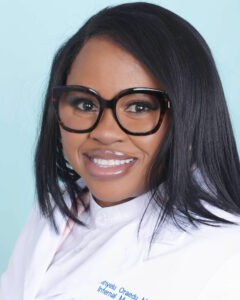
Dr. Oraedu is the founder of the Dr. Yel’Ora Night Shift Hub, a lifestyle and obesity coaching program focused on improving the health and well-being of night workers. Her work translates the science and lived experience of circadian disruption into storytelling and practical wellness strategies for shift workers. She is a media contributor on circadian health, coauthor of Thriving After Burnout, a compilation of burnout stories from 50 U.S. female physicians, and the former host of The Night Shift Lifestyle Show. Her current scholarly work includes a pilot night shift quality improvement study examining job satisfaction among night shift workers.
She shares insights on night shift wellness through LinkedIn and Instagram.