Health insurance companies have always been ambivalent about treatment of cigarette smokers. Tobacco-related disease accounts for roughly 8 percent of U.S. medical spending, while smoking cessation is among the most cost-effective interventions in medicine. Yet the economics look different from the perspective of an individual insurer. Treatment of tobacco use generates costs today, while many of the savings from avoiding hospitalizations, and preventing cancer and other tobacco-related diseases, accrue years later. Because members frequently move among health plans, the insurer that pays for cessation treatment may not be the insurer that ultimately benefits from the avoided medical costs. This mismatch between the timing of investment and return has historically weakened insurers’ incentive to invest aggressively in smoking cessation.
The landscape for people who smoke cigarettes has been evolving rapidly due to shifts in the regulatory environment that support new ways of delivering nicotine, new approaches for measurement of tobacco use and tobacco treatment, and new forms of treatment. The prevalence of cigarette smoking in the U.S. has fallen to 9 percent, an extraordinary decline considering that just a few decades ago more than 40 percent of adults smoked. There is now a window of opportunity for health insurers to accelerate the decline in cigarette smoking, thereby avoiding substantial medical expense. This would create a profit for health insurers and their investors as well as add years of life to those who currently smoke cigarettes.
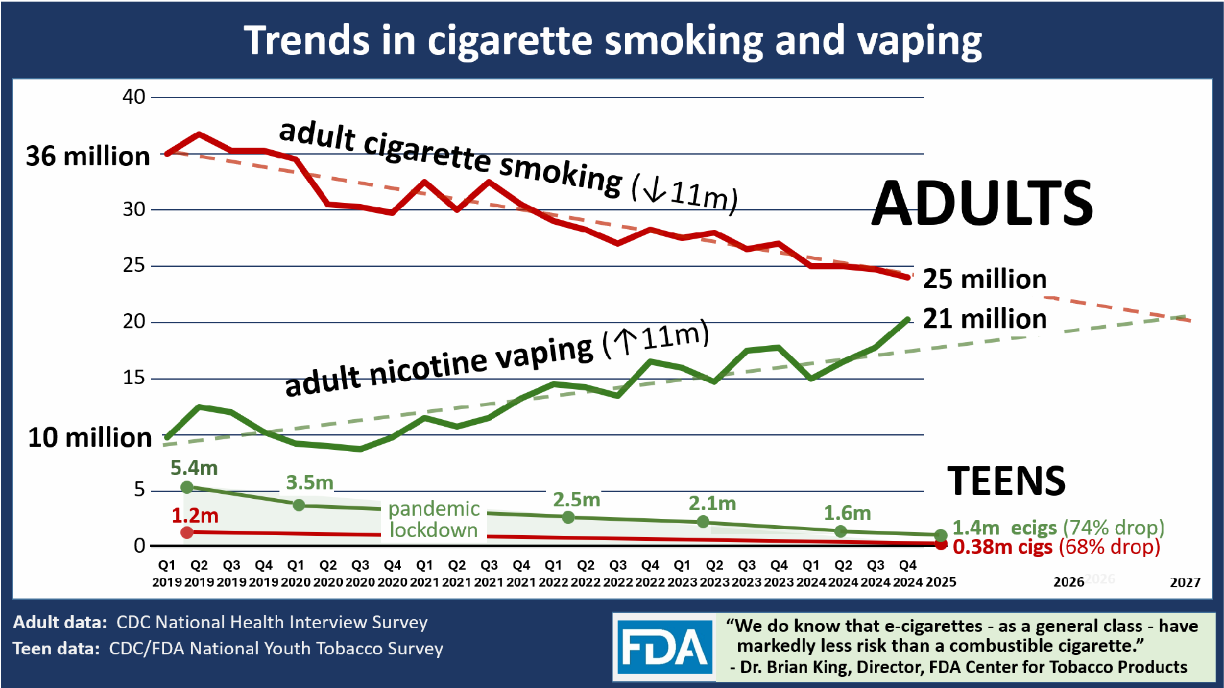
Notwithstanding the rapid decline in prevalence, there remain 25 million adults who smoke daily in the U.S. Figure 1, below, shows recent trends in use of cigarettes and e-cigarettes by adults and teenagers. Teen smoking and vaping have been declining. While the total number of adult nicotine users has remained constant, an increasingly large fraction is now using e-cigarettes. The decline in cigarette use has not been consistent across all demographics: Younger adult tobacco users have quit or shifted to vaping. However, the prevalence of smoking among people over the age of sixty-five has remained constant over the last 15 years. The most recent Surgeon General’s Report details how cigarette smoking has become increasingly concentrated in populations already experiencing health disparities, including people with lower incomes and educational attainment, American Indian and Alaska Native populations, people with behavioral health conditions, rural populations, and workers in certain manual and service occupations. In these populations, tobacco-related disease drives a disproportionate share of medical expenses.
Although almost all health plans have been required to include full coverage for the treatment of smoking, without cost sharing, since the implementation of the Affordable Care Act in 2010, smoking cessation has not been a priority for health insurers. The dramatic declines in smoking since the first Surgeon General’s Report on smoking have not been due to medical interventions. The National Health Interview Survey, an annual study of thousands of people in the U.S., consistently shows that fewer than half of cigarette smokers recall receiving advice or assistance in quitting smoking in the prior year. Among those who make quit attempts, fewer than 7 percent used both medication and counseling, which is the standard of care. This may partially explain the high relapse which makes quitting so frustrating for smokers.
Real physician voices, twice a week
Free, and one click to unsubscribe.
Tobacco treatment has been established as one of the most cost-effective treatments in medicine, yet overall physician performance in the treatment of tobacco remains poor. Physicians complain that they lack the time or skill to help patients quit and that reimbursement rate for their time spent counseling is low. Recent efforts to improve tobacco treatment by physicians have focused on systems change. With half of medical practices now engaged in some form of value-based payment arrangement, the economic value of any improvement in the health status of the patients is shared by the practice and the insurer. Thus, any improvement in clinicians’ performance also serves the economic interest of the health insurer.
The cost of treatment has been reduced, and a return on investment (ROI) can be measured in the first year
The cost-benefit equation for tobacco treatment has been substantially altered by the availability of generic forms of Chantix (varenicline). Varenicline is the preferred medication for tobacco treatment with quit rates 50 percent better than other FDA-approved medications. As a brand-name drug, the monthly cost was over $300. The current cost of the generic version varenicline is under $20. A Pfizer-sponsored study modeling smoking cessation using Chantix and the economic gains from cessation showed a positive ROI by year 4 for commercial and Medicaid plans and by year 3 for Medicare. As the main driver for the cost of treatment was medication, shifting to generic medication brings the crossover close to year one for all lines of business. The ROI calculations for tobacco treatment in most previously published articles should also be adjusted in the same manner. Another economic model was tested by the Center for Tobacco Research and Intervention at the University of Wisconsin. By adding trained counselors to a staff model HMO, a net return of $3.50 per member per month (PMPM) was obtained in the first year. The key element in this approach was the hire of trained counselors, an enhancement suggested by the systems change literature.
The cost of treatment is even lower if cigarette smokers try to quit using electronic cigarettes. A recent guideline published by a working group within the Treatment Research Network of the international Society for Research on Nicotine and Tobacco outlined the use of e-cigarettes and advocated for their use as first-line agent equivalent in value to FDA-approved medications. As with other medications, there is a significant role for counseling, which has been shown to double the effectiveness of any treatment. This type of counseling is currently available at no cost from a national telephonic network of certified tobacco treatment specialists. The volume of calls nationally is quite low because physicians do not routinely refer their patients who smoke cigarettes to the quitline. As e-cigarettes are not approved by the FDA for smoking cessation, there is no cost to the health plan.
Another reflection of the changing landscape for tobacco products and the medical risks they generate comes from the life insurance industry. While many people use nicotine regularly, the risks to people who smoke cigarettes are substantially higher. Evaluations for life insurance should distinguish among these risks.
Beyond cessation: What about tobacco harm reduction?
Harm reduction has long been an important public health strategy. Seat belts reduce motor vehicle fatalities, medications such as methadone and buprenorphine reduce opioid-related harm, naloxone prevents overdose deaths, and syringe service programs reduce the transmission of HIV and viral hepatitis. While each of these interventions generated significant controversy during its adoption, the debate surrounding tobacco harm reduction has been unusually intense. Public health organizations such as the World Health Organization have emphasized the risks of nicotine initiation, particularly among adolescents and young adults, and have expressed concern about the population-level effects of emerging nicotine products. Harm reduction proponents place greater emphasis on the health of current smokers, arguing that large reductions in disease burden could be achieved if smokers who are unable or unwilling to quit nicotine completely switched from combustible cigarettes to substantially lower-risk alternatives.
The scientific rationale for tobacco harm reduction makes the argument that cigarette smoke is by far the most harmful aspect of tobacco use. Most smoking-related morbidity and mortality arise from exposure to the toxic products of combustion rather than from nicotine itself. A complete switch from smoking to other forms of nicotine delivery would be less harmful. This distinction has led researchers to describe nicotine products as existing along a continuum of risk (see Figure 2), with combustible cigarettes at the highest-risk end and complete abstinence at the lowest. Between these extremes lie a variety of noncombustible nicotine products. E-cigarettes and nicotine pouches are described by the FDA as substantially less harmful than combustible cigarettes. The FDA has reviewed only a small fraction of the alternative nicotine products being sold in the U.S., and this introduces another set of unknowns as the contents of these products are unclear.
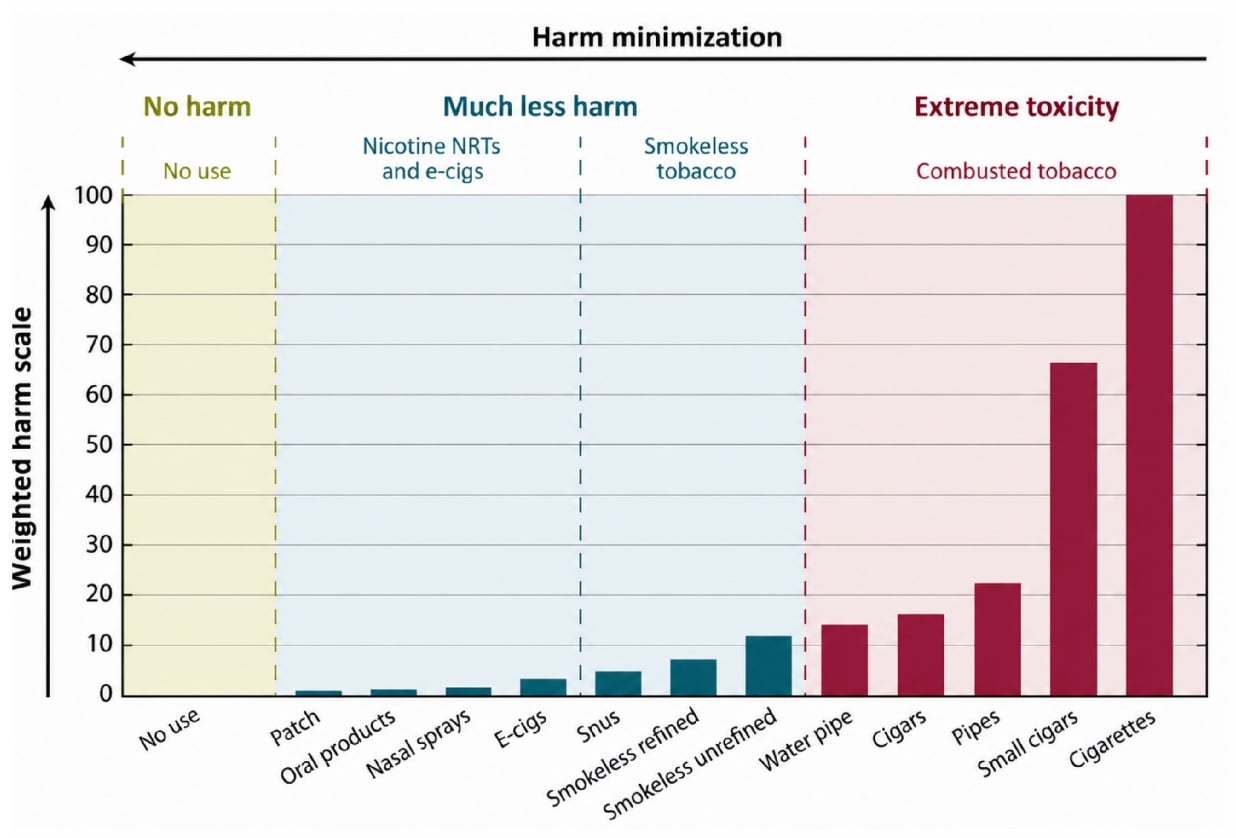
No nicotine product is entirely free of risk, and the long-term effects of currently available products are unknown. However, the evidence suggests that smokers who switch completely from combustible cigarettes to noncombustible nicotine products are likely to reduce their exposure to many of the toxicants responsible for smoking-related diseases. Although the magnitude of the resulting health benefit continues to be studied, most experts agree that complete substitution is likely to be considerably less harmful than continued cigarette smoking.
What are the risks to health plans that support tobacco harm reduction?
Health insurers are reluctant to engage in controversial topics that attract attention to their organizations. Public health authorities and professional societies have taken conservative positions about tobacco harm reduction: They argue that nicotine is harmful in any form and that any deviance from this position can be seen as encouraging young people to use nicotine or even smoke cigarettes. The FDA has taken a more nuanced view which acknowledges the harm of nicotine but accepts that electronic cigarettes and nicotine pouches present lower levels of risk. The FDA is responsible for all tobacco products and has authorized some of the many products available. At present forty-eight of the thousands of e-cigarette brands have been authorized for sale. Fifty of the many nicotine pouches have been authorized for sale under the Modified Risk Tobacco Product protocol (MRTP). MRTP products can be marketed with a statement saying that their use “instead of cigarettes puts you at a lower risk of mouth cancer, heart disease, lung cancer, stroke, emphysema, and chronic bronchitis.” While most electronic cigarettes and pouches seem to have similar characteristics, over 70 percent of the nicotine products currently sold have not been approved for sale by the FDA. Health plans might choose to avoid any statement that places them out of step with professional societies and public health associations or supports the use of an illegal product.
Public health officials have struggled with vaping. For young people, vaping may represent the start of a lifetime of nicotine dependence. Early exposure to nicotine may cause lifelong damage to the maturing brain. As a result of these well-known risks, sale of any nicotine product to anyone under the age of twenty-one is prohibited by federal law. Nonetheless, tobacco product marketing is targeted at the youth market. This is especially true for nicotine pouches, which are being advertised to young people as a tool to enhance athletic performance and concentration. For older smokers, vaping may be a path to complete cessation or harm reduction, either of which would result in a reduction in future medical expenses.
Is there a role for Modified Risk Tobacco Products?
MRTP presents a different type of opportunity: The debates about tobacco harm reduction center around relative risk. Every study of electronic cigarettes shows that they are far less harmful than combusted cigarettes, but the MRTP classification goes one step further. MRTP products have demonstrated to the FDA that they are beneficial to public health and can be marketed with a claim that the risk of certain tobacco-related diseases is lower. Should health insurers educate all current cigarette smokers about MRTP products? There would appear to be little downside to communicating about MRTP in the context of advising cigarette smokers to quit.
A new HEDIS measure makes tobacco treatment more visible
The National Committee for Quality Assurance (NCQA) has introduced a new measure, Tobacco Use Screening and Cessation Intervention (TSC-E), as a Healthcare Effectiveness Data and Information Set (HEDIS) electronic clinical data measure. Beginning with Measurement Year 2026, the measure provides health plans with a much better mechanism for assessing both tobacco screening and cessation intervention. Screening is an important first step as data from electronic medical records show that clinicians do not routinely capture tobacco use. Regular reporting of treatment rates will help give doctors feedback on their performance and identify areas for improvement.
Tobacco treatment has historically suffered from poor visibility. TSC-E begins to change that by measuring both whether tobacco use was assessed and whether identified tobacco users received a cessation intervention. Better measurement should also expose variation, and medical practices that perform poorly would receive valuable feedback.
A comprehensive tobacco risk-management program
The many changes in the landscape for tobacco treatment and tobacco harm reduction may prompt health plans to implement comprehensive programs for tobacco risk management. Starting with identification of tobacco users, health plans could facilitate all phases of treatment and follow-up. For those unable to stop smoking or unwilling to try, harm reduction may provide an alternative pathway to better health outcomes.
The first and preferred goal remains complete abstinence from tobacco and nicotine. A consistent application of evidence-based treatment for all cigarette smokers is a reasonable first step.
One of the main roles of health insurers is educating their customers about ways to improve their health. Information about the full range of tobacco cessation options and tobacco harm reduction products. There is extensive misinformation that can be corrected. For example, 20 percent of consumers use multiple sources of nicotine. They need to understand that any health benefit that comes from switching requires complete cessation of cigarette smoking. People who use these products should be encouraged to use only those with FDA authorization.
Physicians need help in maximizing their performance and making a transition to systems-based approaches. Health insurers are well positioned to support them. The use of the new HEDIS TSC-E measure can be used to provide clinicians with feedback and would be especially valuable if tied to incentives. Given the considerable number of senior citizens who continue to smoke cigarettes, adoption of incentives for TSC-E performance by the Centers for Medicare & Medicaid Services (CMS) would lead Medicare Advantage plans to further improve their outreach to people who smoke cigarettes and their doctors. If most health plans adopt this type of approach, any migration of cessation benefit to other plans is equaled by new members who recently quit smoking.
For health insurers, cigarette smoking remains one of the largest preventable contributors to health care spending. Accelerating the treatment of tobacco through a risk management approach would allow health plans to improve the lifespan and quality of life of their members and enhance the bottom line.
Conclusion
Tobacco harm reduction occupies an uncomfortable space in American health care policy. For health insurance companies, the opportunity to create value for the customers, shareholders, and those who pay the premiums is readily apparent. This must be balanced against the reputational risk of engaging in controversial public health debates.
Complete smoking cessation should remain the preferred outcome for every cigarette smoker. Counseling, medications, quitlines, and clinical interventions deserve far greater investment and utilization than they currently receive. For the millions of smokers who have failed to quit repeatedly, harm reduction strategies seem like a reasonable approach and may ultimately become an important complement to traditional cessation programs.
Edward Anselm is a board-certified internist with a long-standing focus on public health, tobacco control, and preventive care. He earned his medical degree from the Chicago Medical School at Rosalind Franklin University and completed his internal medicine residency at Montefiore Medical Center in New York. Over the past three decades, Dr. Anselm has served in senior leadership roles across clinical, corporate, and managed-care settings, including chief medical officer positions at HIP Health Plan of New York, FidelisCare, and Health Republic Insurance of New York.
Recently retired from his role as medical director at Aetna, Dr. Anselm continues to teach at the Icahn School of Medicine at Mount Sinai as a clinical assistant professor. His current work focuses on strengthening reimbursement pathways for tobacco cessation and preventive services, helping clinicians integrate evidence-based care that improves patient outcomes while supporting practice sustainability. His research has been published in the American Journal of Accountable Care, the American Journal of Preventive Medicine, AJPM Focus, and Health Affairs Forefront, including articles on tobacco control in accountable care, underbilling of cessation services, and the financial and quality benefits of treating tobacco use as a clinical priority.
Dr. Anselm’s educational and policy work is shared through EdwardAnselmMD.com and The Anselm Nicotine Prescription, with professional updates available on LinkedIn.