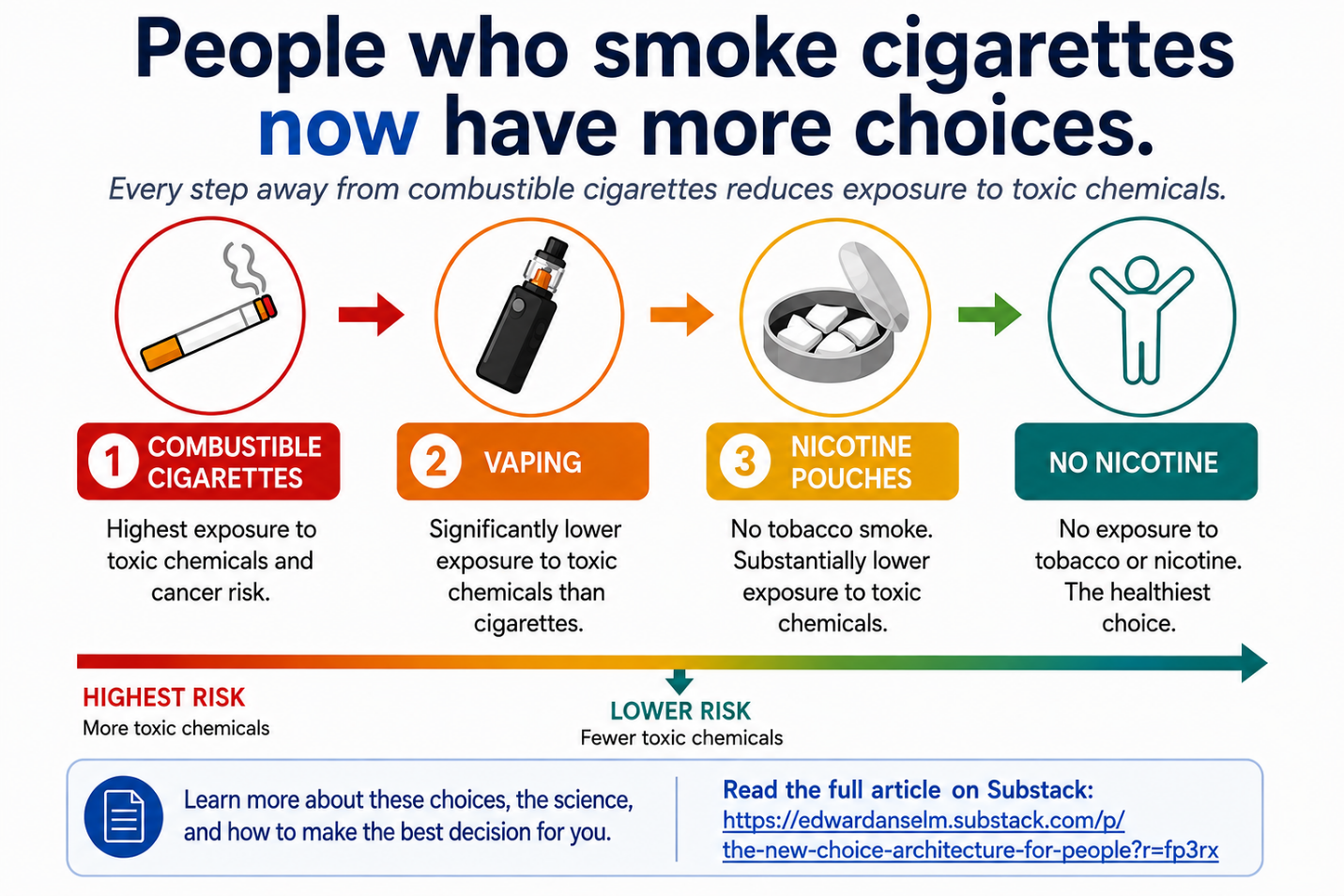
Until recently people who smoke cigarettes were presented with a simple choice: continue smoking and worsen the risk and severity of tobacco-related disease or make another quit attempt. The doctor would ask, “Do you believe that you are ready to quit smoking?” Both doctor and patient would be relieved when the answer was “no.” The doctor was given back some valuable time he could use for other issues, and the patient was spared another long lecture on how to quit.
A new type of conversation with your doctor is now possible and the subject is tobacco harm reduction. Over the last few years over six million adult cigarette smokers have switched to vaping. Is vaping less harmful than smoking? The Centers for Disease Control and Prevention (CDC) says that vaping is safer than smoking, but it is not completely safe. The FDA and many experts say yes. The World Health Organization and most public health authorities, which are focused on the future health of young people, say no. The information necessary for you to decide about what is important for you is available.
Another type of tobacco harm reduction product is a brand of nicotine pouch called ZYN. On June 30, the FDA granted Modified Risk Tobacco Product (MRTP) authorization for several ZYN nicotine pouch products. The agency authorized the company to state in its marketing materials: “Using ZYN instead of cigarettes puts you at a lower risk of mouth cancer, heart disease, lung cancer, stroke, emphysema, and chronic bronchitis.” There are two clarifications: The reduction in risk can only be attained by complete substitution of ZYN for cigarettes. This marketing statement does not apply to other brands of nicotine pouches or all ZYN products.
A few additional points about harm reduction. The FDA is responsible for all tobacco products and has authorized some of the many products available. If you select a product that is not FDA authorized, you do not know anything about the true chemical composition. This is especially true of synthetic nicotine products, none of which are authorized. The FDA list of authorized nicotine products is available.
The landscape for smoking cessation has also shifted. The Society for Research on Nicotine and Tobacco has released a paper that reviews the value of electronic cigarettes for smoking cessation. E-cigarettes, which are accepted as treatment of tobacco use in England and New Zealand, are now recommended as a first-line treatment for smoking cessation, especially for people who express a preference for e-cigarettes. As with other medications, counseling is strongly advised as it doubles the effectiveness of any treatment. Some people who try to quit using e-cigarettes may become dependent on them as a source of nicotine. That is not a bad outcome, compared to the risks of continued smoking.
Many smokers have never received comprehensive tobacco treatment despite decades of evidence demonstrating that counseling and medication work better together than either alone. Varenicline, combination nicotine replacement therapy, state quitlines, tobacco treatment specialists, and structured follow-up remain dramatically underused. Every smoker deserves the opportunity to receive evidence-based treatment before concluding that quitting is impossible.
Over the past decade, researchers have demonstrated that many smokers who insist they are “not ready to quit” are nevertheless willing to make meaningful changes. Some will accept a prescription for medication to see whether it reduces cravings. Some are willing to make a practice quit attempt without committing themselves to permanent abstinence. These experiences often increase confidence, reduce anxiety about quitting, and improve your own assessment of your ability to quit. What begins as a small experiment frequently becomes the first step toward lasting change.
The new choice architecture for people who smoke cigarettes asks three questions rather than one:
- Are you ready to make your best quit attempt?
- Are you ready to lower your risk?
- Would you be willing to try something?
People who smoke cigarettes should inform themselves about their options and have these conversations with their doctors. This broader choice architecture also acknowledges that smoking cessation is rarely a single event. More than fifty-six million Americans have successfully quit smoking, and most required multiple attempts over many years before achieving permanent abstinence. Relapses are not evidence of failure. They are part of the natural history of nicotine dependence. Every quit attempt provides experience, teaches new coping strategies, and increases the likelihood of success in the future.
Help is available to find a change strategy that meets you where you are.
Many of the sources of information on tobacco harm reduction have conflicts of interest; some are clearly selling their product; some not-for-profit groups are funded by the tobacco industry; and some are adhering to international guidelines that focus on the future health of young people rather than adults who smoke cigarettes. The role of nicotine products in tobacco harm reduction is debated worldwide. The Anselm Nicotine Prescription and I endeavor to provide information useful to adults who smoke cigarettes.
Edward Anselm is a board-certified internist with a long-standing focus on public health, tobacco control, and preventive care. He earned his medical degree from the Chicago Medical School at Rosalind Franklin University and completed his internal medicine residency at Montefiore Medical Center in New York. Over the past three decades, Dr. Anselm has served in senior leadership roles across clinical, corporate, and managed-care settings, including chief medical officer positions at HIP Health Plan of New York, FidelisCare, and Health Republic Insurance of New York.
Recently retired from his role as medical director at Aetna, Dr. Anselm continues to teach at the Icahn School of Medicine at Mount Sinai as a clinical assistant professor. His current work focuses on strengthening reimbursement pathways for tobacco cessation and preventive services, helping clinicians integrate evidence-based care that improves patient outcomes while supporting practice sustainability. His research has been published in the American Journal of Accountable Care, the American Journal of Preventive Medicine, AJPM Focus, and Health Affairs Forefront, including articles on tobacco control in accountable care, underbilling of cessation services, and the financial and quality benefits of treating tobacco use as a clinical priority.

ADVERTISEMENT
Dr. Anselm’s educational and policy work is shared through EdwardAnselmMD.com and The Anselm Nicotine Prescription, with professional updates available on LinkedIn.