A record kept catching on the same fragment of music. A few notes, a crackle, a pause. Then the melody struggled forward, only to break again. On October 16, in a theater in Taipei, that uneven sound seemed more honest than any polished speech about the courage of family caregivers.
I was onstage, playing the older brother of Xiao-Rui, an eight-year-old girl in a family-caregiver drama called One Day, We Will. I had entered the production thinking about dialogue and timing. Instead, I found myself listening to what happened between the lines: the seconds in which a family does not know what to say, and the silence that follows a question no one is ready to answer.
Two sentences stayed with me. “I’m afraid.” And, “I don’t know why. I’m just so tired.” They sound almost embarrassingly simple. They are also the sentences many people who care for someone they love learn not to say.
Fear in caregiving rarely announces itself as fear. It arrives disguised as a second check of the medication box, an unanswered call, or the decision not to leave home even when another relative says everything is fine. It is the thought that a parent might fall while you are in a meeting. It is the calculation, at 2 a.m., of how many hours you can sleep before you must be useful again. It is anger at a situation you did not choose, followed immediately by shame for feeling angry. I used to assume the warning signs would be obvious: tears, missed shifts, a dramatic collapse. But exhaustion can coexist with exceptional competence. Someone can hold a job, remember every prescription, and smile at hospital staff while nearing a breaking point. The very skill that keeps a household afloat can hide the danger.
Real physician voices, twice a week
Free, and one click to unsubscribe.
Onstage, the record could stop. In a real household, the schedule usually cannot. Meals must be prepared. Appointments must be kept. Workplaces expect an employee; hospitals expect a responsible family contact; an older relative needs a familiar face. The same person is expected to be all three. When that person finally says, “I’m exhausted,” the answer is often an affectionate but dangerously incomplete “Stay strong.”
The scale is no longer a private family matter. AARP and the National Alliance for Caregiving estimated that 63 million U.S. adults provided ongoing care in 2025, close to one in four adults. That number is American, but the predicament crosses borders. In Taiwan, where the population is aging rapidly, families confront the same collision between longer lives and finite human energy. We have learned to speak fluently about aging populations. We remain strangely hesitant to ask what sustained caregiving does to the person performing it.
I work at the intersection of health care management and community healthy-aging efforts. I hear well-intentioned professionals ask, “Who will take the patient home?” That is an essential question. But there is another: “Who will take care of the person taking the patient home?” An emergency contact is not automatically an emergency plan. A name typed into a discharge form tells us almost nothing about that person’s health, working hours, financial limits, or ability to lift someone safely.
Consider the familiar hospital discharge. A patient receives medication instructions, a follow-up date, and a warning list of symptoms that require urgent attention. The family caregiver may receive those same papers while quietly worrying about the stairs at home, the night shift tomorrow, or whether anyone can come if the patient becomes confused after midnight. We call the handoff complete because information has changed hands. Yet information is not capacity. A safe plan requires both.
Clinicians do not have to become social workers to recognize this gap. They can ask one plain question before discharge: “What part of this plan feels impossible for your family?” They can assess caregiver strain, meaning the physical, emotional, and financial burden of providing ongoing care. They can verify that the proposed care tasks match the caregiver’s actual abilities, give clear instructions for seeking help, and identify a backup person or service. Respite care (temporary relief provided by another trained caregiver) should be presented as part of responsible care, not as evidence that a family has failed.
These measures need institutional support. If no one is paid to make a follow-up call, if referral services are unavailable at night, or if respite is unaffordable, a compassionate conversation can become one more broken promise. Hospital managers should ask whether they track caregiver needs after discharge, not merely whether a discharge occurred. Policymakers should ask whether long-term care benefits can be accessed before a household reaches a crisis. And health systems should stop assuming that unpaid love is an infinitely renewable clinical resource.
I also spend time with community strength and balance programs for older adults. Some sessions begin with something as ordinary as an elastic exercise band. The goal is not to turn every older adult into an athlete. It is to preserve functional ability: the practical capacity to stand, walk, think, and do the things that matter in daily life. Age-related loss of muscle strength and mass, often called sarcopenia, can make small tasks increasingly difficult. Thoughtful exercise and appropriate nutrition may help people maintain strength, while social connection gives them a reason to return. None of this replaces respite, home support, or clinical care. It simply reminds us that keeping one person more independent may also protect someone else’s sleep.
There is a traditional way of speaking about five blessings in the circles where I work: Recognize what we have, cherish it, protect it, create good for others, and pass that good forward. I think about those verbs differently after this performance. To cherish a caregiver is not to admire endurance from a safe distance. To protect a caregiver is to make rest possible. To pass kindness forward is to build a system in which asking for help does not require a confession of defeat.
Perhaps the most important clinical question is not whether a family loves enough. Most already love past the point of exhaustion. It is whether our health system has designed a place for that love to breathe. Can a physician ask about a caregiver’s fear without treating it as a distraction from the patient? Can a hospital call a discharge successful when the family member accepting responsibility has no realistic way to carry it out? What would our quality measures look like if they counted the sleep, safety, and dignity of caregivers too?
The record in the theater kept trying to find its next note. I wanted the music to continue. I also wanted, for once, someone to be allowed to stop it, sit down, and say the words that so many people swallow: “I’m afraid. I’m tired.” Not so that we could applaud their honesty and move on, but so that another voice could answer, without judgment, “You don’t have to do the next part alone.”
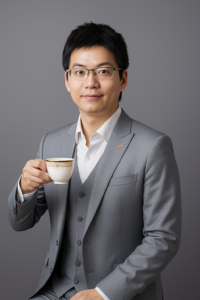
Gerald Kuo, a doctoral student in the Graduate Institute of Business Administration at Fu Jen Catholic University in Taiwan, specializes in health care management, long-term care systems, AI governance in clinical and social care settings, and elder care policy. He is affiliated with the Home Health Care Charity Association and maintains a professional presence on Facebook, where he shares updates on research and community work. Kuo helps operate a day-care center for older adults, working closely with families, nurses, and community physicians. His research and practical efforts focus on reducing administrative strain on clinicians, strengthening continuity and quality of elder care, and developing sustainable service models through data, technology, and cross-disciplinary collaboration. He is particularly interested in how emerging AI tools can support aging clinical workforces, enhance care delivery, and build greater trust between health systems and the public.