













At a bank counter in central Taiwan, a man in his sixties tried to break a time deposit and withdraw 1 million New Taiwan dollars. He believed a stock-investment team would manage the money for him. Bank staff became concerned and called the police.
The disturbing detail was not the amount. Police had already intervened the previous week when the same man encountered a fraudulent investment scheme. The scammers contacted him again, drew him into another messaging group, and nearly persuaded him to hand over his savings. On November 3, Taiwan’s National Police Agency described how bank staff and officers stopped this second attempt.
Two days later, on November 5, Taiwan’s benchmark stock index fell 1,374 points. On Wall Street, the Nasdaq dropped about 5.5 percent, its steepest daily decline in more than a year. The red numbers were impossible to ignore. But one of the most important losses in a market panic cannot be displayed on a trading screen: an older person’s sense of safety.
I work with community healthy-aging programs in Taipei and study health care management. We talk about blood pressure, balance, nutrition, medication, and the effort required to stay independent. I have come to believe that financial fear belongs in those conversations, too. A market shock can threaten two things at once: the resources that make older age secure, and the emotional stability needed to make decisions about those resources.
Real physician voices, twice a week
Free, and one click to unsubscribe.
The first threat is familiar. A retiree sees years of savings shrink in a day. A family begins to recalculate rent, caregiving costs, or the ability to pay for help at home. Even those who have not sold a single share may experience the loss as immediate.
That distress is not imaginary. Research using Taiwanese health care data has linked higher stock-market volatility with higher emergency and outpatient spending among people receiving care for depression or hypertension. A study of American retirees also associated cumulative stock-related wealth shocks with higher blood pressure and other markers of physiological strain. These are observational findings, not proof that one bad trading day causes illness. They nevertheless challenge the idea that financial news stays outside the clinic.
The second threat receives less attention. Fear creates an opening for someone who promises certainty.
A stranger in a messaging app claims to know how to recover losses. A supposedly exclusive investment group shares impressive screenshots. A reassuring voice says that the market’s fall is an opportunity, but the money must be transferred today. The pitch may look like financial advice. Often, what is being sold is relief from uncertainty.
The timing deserves care. We do not know that this week’s market plunge caused any particular scam. Fraud was already a serious problem before the sell-off. But periods of financial anxiety can make urgent promises especially tempting, and the warning signs are recognizable: guaranteed returns, secrecy, pressure, unfamiliar accounts, and requests to move money outside established financial institutions.
The scale is startling. In an October 2026 report, the U.S. Federal Trade Commission (FTC) said adults aged 60 and older had reported about $3 billion in fraud losses for 2025. Reported investment-scam losses alone exceeded $1 billion, up 42 percent from the previous year. The agency also noted an important nuance: Older adults did not report losing money to fraud at a higher rate overall than younger adults. What often differed was the size of the loss.
This matters because the wrong response is to label older people gullible or automatically incapable. Financial exploitation does not prove cognitive impairment. Intelligent, independent adults can be deceived by organized criminals who study emotion, social trust, and the appearance of authority. Shame after a loss may then prevent the person from telling family members or asking for help.
For clinicians, the practical question is not, “Which stocks do you own?” It is, “Have money worries changed how you sleep, eat, take medication, or feel about your future?” A patient reporting insomnia, palpitations, headaches, worsening blood pressure, or anxiety may be carrying a financial story that never appears in the medical record. These symptoms still deserve proper medical assessment; chest pain, for example, must never be dismissed as merely stress.
There is also room for one compassionate follow-up: “Has anyone pressured you to send money or promised to recover an investment loss?” Ask privately when appropriate. Listen without ridicule. With the patient’s consent, offer to connect them with a trusted family member, social worker, bank fraud team, or reporting service. In the United States, the FTC accepts reports at ReportFraud.ftc.gov. In Taiwan, people can call the 165 anti-fraud hotline.
Families need a different kind of conversation. “You should not be investing at your age” is likely to produce silence, not safety. A better question is, “If someone asks you to transfer money urgently, can we agree to verify the request together through an independent number?” A voluntary pause before an unfamiliar transfer protects decision-making without taking away dignity. Banks can make trusted-contact arrangements easier. Community centers can teach people to recognize impersonation and fake investment groups without turning every class into a lecture about vulnerability.
Health systems cannot prevent every market crash or financial crime. They can prevent some of the isolation that makes both harder to endure. A physician can notice distress. A nurse can ask about sleep. A social worker can offer a safe route to report coercion. A family can make it possible to disclose a mistake without being humiliated. These are small acts, but they create time to make a better decision.
I keep returning to the man at the bank counter. A teller and police officers did not restore the market or promise him a profitable investment. They interrupted a dangerous transaction and gave him another chance to keep control of his future.
That is also a health care lesson. When markets fall, we count points, percentages, and dollars. We should also count the sleepless nights, the untreated anxiety, and the people who are too ashamed to ask for help. Financial protection is not separate from healthy aging. Sometimes, protecting a person’s health begins by making it safe to say, “I am frightened about my money.”
The opening bank episode is based on a publicly issued Taiwan police report; the person described is not identified from the author’s own clinical work. This essay is commentary, not individualized financial or medical advice.
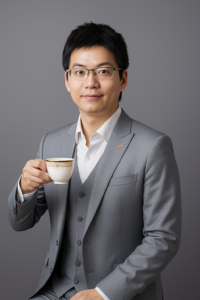
Gerald Kuo, a doctoral student in the Graduate Institute of Business Administration at Fu Jen Catholic University in Taiwan, specializes in health care management, long-term care systems, AI governance in clinical and social care settings, and elder care policy. He is affiliated with the Home Health Care Charity Association and maintains a professional presence on Facebook, where he shares updates on research and community work. Kuo helps operate a day-care center for older adults, working closely with families, nurses, and community physicians. His research and practical efforts focus on reducing administrative strain on clinicians, strengthening continuity and quality of elder care, and developing sustainable service models through data, technology, and cross-disciplinary collaboration. He is particularly interested in how emerging AI tools can support aging clinical workforces, enhance care delivery, and build greater trust between health systems and the public.