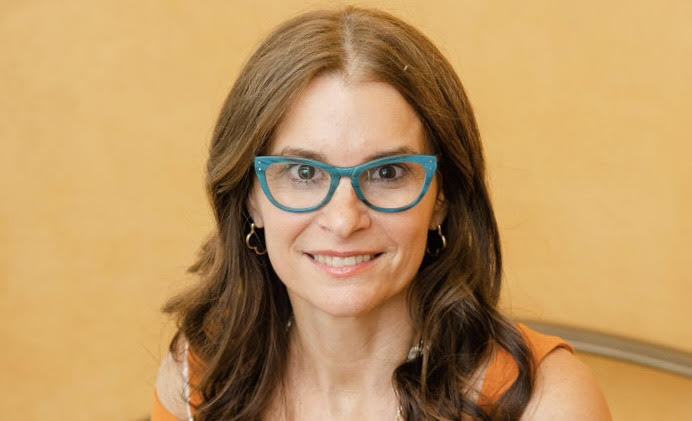
Lianne Mandelbaum, PT, is a physical therapist and a leading advocate for airline safety measures to protect food-allergic passengers. She is president of No Nut Traveler, a food allergy nonprofit, and airline correspondent for Allergic Living. She has published 18 essays on KevinMD since December 2015 and has been a guest on The Podcast by KevinMD twelve times. Her argument, from the boarding gate to the television screen, is that food allergy is a disability and a medical emergency, and that treating it as an inconvenience or a joke puts lives at risk.
This spotlight is part of a series on subscribers to the KevinMD enhanced author page.
Her first essay, in December 2015, was about invisible disabilities and the looks people give a handicap sticker. She published one essay in 2017, one in 2018, two in 2020, one each in 2021, 2022, and 2023, six in 2025, and four so far in 2026. Five of the 18 concern air travel and the rules that govern it, from epinephrine in airline medical kits to a federal ruling on boarding. Eight respond to jokes and portrayals of food allergy in comedy, drama, and celebrity posts. The rest cover food allergy deaths, teenagers, dining out, and the gaps in food allergy education. Her son has a peanut allergy, and he appears in many of them. Her episodes usually follow an essay, and she ends each with take-home messages for the KevinMD audience.
Lianne Mandelbaum at a glance
18essays on KevinMD
12podcast episodes
December 2015writing on KevinMD since
11questions answered below
Questions Lianne Mandelbaum answers
- Why do food-allergic passengers hide their allergy from airlines?
- What did an airline tell her when she asked for a simple announcement?
- How consistent are airline policies for passengers with food allergies?
- Does a mild reaction predict a mild one next time?
- What did the March 2026 Department of Transportation ruling change for preboarding?
- Should epinephrine on airplanes depend on the airline?
- Can a flight attendant’s assurance that an airline meal is safe be trusted?
- Why does she object to food allergy jokes in comedy and television?
- Does Benadryl treat anaphylaxis?
- How can restaurants make dining safer for people with food allergies?
- What should teenagers with food allergies learn before they leave home?
Why do food-allergic passengers hide their allergy from airlines?
Because they fear the response, Mandelbaum argues. In “Flying with food allergies: Combating misconceptions and advocating for safety,” March 2025, she reports that in a global study from the Center for Food Allergy and Asthma Research at Northwestern University, 31 percent of travelers with food allergies at least sometimes “choose not to disclose their allergy,” and that more than 12 percent were removed from a flight or denied boarding after disclosing it. Passengers, she writes, are forced to choose between speaking up and “staying silent and risking their lives.” She calls that not just a customer service issue but a public health concern.
What did an airline tell her when she asked for a simple announcement?
In the same March 2025 essay, Mandelbaum describes the day her son, then eight, waited at a gate while three children tossed peanuts in the air and pushed the dust toward him. She asked the gate agent for a brief announcement and worked up the chain of command until a manager told her, “just do not get on the plane.” She writes that it was no longer just about her son, and that this was the beginning of No Nut Traveler.
How consistent are airline policies for passengers with food allergies?
They are not consistent, she argues. In “Navigating the uncertainty of food allergies in air travel: a call for compassion and change,” February 2025, she cites the Northwestern findings that 70 percent of surveyed passengers were promised accommodations that were not honored and that over 98 percent experience significant anxiety when flying. A child’s or adult’s safety, she writes, can depend on the mood and education of a particular flight crew, and “a lack of standardized procedures and training continues to leave allergic passengers vulnerable.”
Does a mild reaction predict a mild one next time?
No, Mandelbaum says. In the February 2025 essay she writes that “A mild reaction once does not guarantee a mild reaction in the future,” and that “no medical test currently exists” to tell who will have a severe reaction. In “We need more awareness of food-allergic kids,” January 2020, she adds that the most important prescription from an allergy diagnosis is an auto-injector, with the instruction to “always carry it on your person,” and that “teens are at the highest risk” of life-threatening reactions.
What did the March 2026 Department of Transportation ruling change for preboarding?
It drew a line between allergens, Mandelbaum argues. In “How the new DOT ruling on food allergies threatens air travel safety,” March 2026, she writes that DOT Order 2026-3-9 acknowledges that severe food allergies are disabilities but “restricts preboarding protections to passengers with nut allergies.” She calls that “an arbitrary line between life-threatening conditions that carry identical risks,” and notes that the complaint behind the order, filed in November 2022 by advocacy organizations including No Nut Traveler after Southwest Airlines denied preboarding to passengers with food allergies, covered all life-threatening food allergies.
Should epinephrine on airplanes depend on the airline?
No, Mandelbaum argues. In “Epinephrine on airplanes should not depend on the airline,” September 2026, she examines a Federal Aviation Administration proposal to replace the required medication list with a performance-based standard covering nine life-threatening conditions. The proposal, she writes, “doesn’t clearly require epinephrine in every kit,” and it does not specify an auto-injector, doses for infants and children, or the number of doses. She cites a Northwestern survey of 4,704 food-allergic travelers in which roughly 1 in 12 reported an in-flight reaction and only about half of those were reported to a crew member or airline. Her ask to physicians, who might one day answer a call for a medical professional on board, was to file public comments by October 5, 2026: “Epinephrine must be required, not suggested.”
Can a flight attendant’s assurance that an airline meal is safe be trusted?
Not always, she argues. In the same September 2026 essay, she relays an account shared with No Nut Traveler of a July 2026 Alaska Airlines flight from Iceland on which a twelve-year-old and an unrelated adult, both with tree nut allergies, reacted to the same pasta salad after a last-minute catering substitution added cashew oil to the dressing and the allergen information was never updated. Restaurant-style airline meals in the United States are not required to carry the labeling that packaged grocery food does, she notes, so crews are “relying on catering information they have no way of knowing is incomplete.”
Why does she object to food allergy jokes in comedy and television?
Because the jokes teach classmates and colleagues that bullying with allergens is acceptable and embolden airlines and restaurants to brush off safety requests, Mandelbaum argues. In “Why Hollywood’s allergy jokes are dangerous,” September 2025, she tells the entertainment industry to consult allergy experts before portraying anaphylaxis and to “Stop mining medical trauma for laughs.” In “When TV shows use food allergy as murder,” December 2025, she turns to a thriller series in which an allergy is used as a murder method with no consequence, and writes that “Food allergy is not a plot device.” She wrote about the same problem in August 2017, after an HBO comedy special joked about peanut allergies on planes.
Does Benadryl treat anaphylaxis?
No, she writes, and a Hulu comedy taught the opposite. In “Why a Hulu comedy’s food allergy myths are dangerous,” June 2026, she says a character who swallows an antihistamine and later collapses is presented as a joke, and states that “Benadryl is not a treatment for anaphylaxis.” Antihistamines may ease symptoms, she adds, but they do not reverse airway swelling and do not replace epinephrine, which is the first-line treatment.
How can restaurants make dining safer for people with food allergies?
By telling customers what is in the food, she argues. In “What one diagnosis can change: the movement to make dining safer,” June 2025, she backs California’s ADDE Act (Senate Bill 68), which would require restaurants to list the top nine allergens on their menus, as the United Kingdom and European Union already do. The bill, she writes, should also be “seen as a business opportunity,” because a person with a food allergy rarely dines alone, and the diagnosis can give that one person a silent veto over where a whole group eats.
What should teenagers with food allergies learn before they leave home?
The habits of self-advocacy, and they must be taught, Mandelbaum argues. In “What Avarie’s death in Rome teaches us about the gaps in food allergy education,” April 2025, she writes about a student who had told a restaurant about her tree nut allergy, carried three auto-injectors, and still died, and says such deaths are the result of “systemic failures that continue to cost lives.” Asking the right questions and checking for cross-contact are “habits that must be practiced to become second nature,” she adds, and too many patients are never referred to an allergist or given the talk about ordering food. The KevinMD record on children’s health collects what physicians say about teenagers.
Real physician voices, twice a week
Free, and one click to unsubscribe.
Questions on this page · All spotlights
Lianne Mandelbaum on The Podcast by KevinMD: She first came on the show in December 2020 to talk about food allergy jokes, and she has returned eleven times: celebrity attacks on children with food allergies in October 2021, jokes again in October 2022, food allergy deaths in June 2023, air travel in March 2025 and May 2025, Avarie’s story in June 2025, dining in August 2025, movies in November 2025, food allergy as a weapon in February 2026, the Department of Transportation ruling in May 2026, and airline medical kits in September 2026. Her take-home messages are practical. In December 2020 it was that “we can fly safely as food-allergic patients.” In March 2025 she said “don’t take the airline meal.” In August 2025 she asked listeners to “turn on their listening skills.” In September 2026 she reminded physicians that a passenger who is having a first reaction “may not be carrying their own medication.”
About the KevinMD enhanced author page: This spotlight exists because Mandelbaum’s author page is an enhanced author page: her photo, biography, affiliations, and links on one page that ranks for her name and that ChatGPT, Perplexity, and Google’s AI read when someone asks who she is. The same branded attribution appears at the end of every article she has published, so each essay listed below points back to a page she controls. Subscribers get three things the free track does not:
Publish in 1 to 3 days. Free-track articles wait 5+ weeks, and the wait keeps growing. Subscribers skip the line.
Get a guaranteed podcast slot. Free slots fill within hours and the waiting list runs into the hundreds. Subscribers are guaranteed a spot.
Control your Google and AI identity. Your KevinMD author page is one of the highest-ranking results for your name. Make it represent you, in your words.
Enhanced author page
Upgrade your author page
The enhanced author page is $99/month or $999/year.
Cancel anytime for any reason, and your author page will revert to the standard attribution.
Have questions before you subscribe? Contact Kevin.
Everything Lianne Mandelbaum has written for KevinMD:
- “Behind a handicap sticker is an untold story.” December 2015
- “Food allergies are frightening, not funny.” August 2017
- “When your first food allergy reaction takes place in the air.” March 2018
- “We need more awareness of food-allergic kids.” January 2020
- “Food allergies are not funny.” July 2020
- “When celebrities attack children with food allergies.” May 2021
- “Food allergies are a growing public health concern, not a joke.” March 2022
- “Food allergy tragedies: the reality that haunts us.” February 2023
- “Navigating the uncertainty of food allergies in air travel: a call for compassion and change.” February 2025
- “Flying with food allergies: Combating misconceptions and advocating for safety.” March 2025
- “What Avarie’s death in Rome teaches us about the gaps in food allergy education.” April 2025
- “What one diagnosis can change: the movement to make dining safer.” June 2025
- “Why Hollywood’s allergy jokes are dangerous.” September 2025
- “When TV shows use food allergy as murder.” December 2025
- “How the new DOT ruling on food allergies threatens air travel safety.” March 2026
- “Why a Hulu comedy’s food allergy myths are dangerous.” June 2026
- “Food allergy stigma and the names on a memorial slide.” July 2026
- “Epinephrine on airplanes should not depend on the airline.” September 2026
Lianne Mandelbaum on The Podcast by KevinMD:
- “Food allergies are not funny.” December 2020
- “When celebrities attack children with food allergies.” October 2021
- “Food allergies are not a joke.” October 2022
- “Empathy and awareness: Unveiling the hidden dangers of food allergies.” June 2023
- “Compassionate solutions for food allergies in air travel.” March 2025
- “Misconceptions about food allergy safety in the skies.” May 2025
- “Avarie’s story: Confronting the deadly gaps in food allergy education and emergency response.” June 2025
- “Putting food allergy safety on the menu.” August 2025
- “Why mocking food allergies in movies is a life-threatening problem.” November 2025
- “Weaponizing food allergies in entertainment endangers lives.” February 2026
- “DOT ruling protects peanut allergies but not eggs, sesame, or milk.” May 2026
- “Food allergies are treated differently, airline by airline.” September 2026