Residents, attendings, and the physicians who remember training writing on KevinMD about residency: intern year, duty hours, supervision and autonomy, pay and unions, having a family during training, mistreatment, the Match for international medical graduates, and what physicians say should change about how residents are trained. Many contributors write anonymously, and many write while still in training. For a maintained record of what residents and attendings have said about residency itself on KevinMD since 2004, from intern year through the end of training, attributed by author and date and organized by question, see Residency: what residents and attendings say, in their own words. For what international medical graduates have said about the Match, visas, and being foreign in American medicine, see Immigration and medicine: what physicians say about immigrant doctors and immigrant patients, in their own words. The board exams that follow training, and the fight over maintenance of certification, are on Board certification: what physicians say about the boards and MOC, in their own words. Medical school itself is a separate record.
Medical residents take on a variety of responsibilities. Some are clear, upfront, and obvious: the responsibilities they have been training for since entering medical school. Coming up with a treatment plan and carrying it out is first and foremost their…
Medical residents take on a variety of responsibilities. Some are clear, upfront, and obvious: the responsibilities they have been training for since entering medical school. Coming up with a treatment plan and carrying it out is first and foremost their raison d’etre, and they put an enormous amount of effort into it. However, they also acquire a host of other duties. They run interference for attendings. They coordinate with nursing. …
In 1968, Rosenthal and Jacobsen introduced the concept that expectations in the classroom can positively or negatively affect students. This phenomenon was dubbed, “The Pygmalion Effect.” Since then, there has been controversy surrounding the topic. Other authors have argued that…
In 1968, Rosenthal and Jacobsen introduced the concept that expectations in the classroom can positively or negatively affect students. This phenomenon was dubbed, “The Pygmalion Effect.” Since then, there has been controversy surrounding the topic. Other authors have argued that the data was insignificant or inconclusive. From my own personal experience, having been in school for over ten years, I believe that the concept carries validity. Furthermore, I believe that …
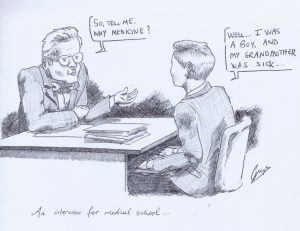
I was recently interviewed on a podcast and was asked the simple question, "Why are you in medicine?" In retrospect, that's the exact question I silently ask myself in frustration and exhaustion a little bit too often while I'm in…
I was recently interviewed on a podcast and was asked the simple question, “Why are you in medicine?” In retrospect, that’s the exact question I silently ask myself in frustration and exhaustion a little bit too often while I’m in the hospital. In those moments I recognize that I feel burnt out. In those moments if someone told me that I had to repeat intern year in order to finish …
You’ve probably heard this story before: a young physician, who has spent all of his or her life succeeding and building goals, stumbles into a career without meaning or enthusiasm. Indeed, my story about burnout is much like the rest.…
You’ve probably heard this story before: a young physician, who has spent all of his or her life succeeding and building goals, stumbles into a career without meaning or enthusiasm. Indeed, my story about burnout is much like the rest.
Like so many before me, I entered into a career in medicine motivated and eager to change the world through the care of my patients. I grew up in a family …
A resident suffering from depression drinks too much and sleeps through a hospital shift the next morning. Another resident walks out of a patient room in the midst of a panic attack. As family medicine educators, how do we best…
A resident suffering from depression drinks too much and sleeps through a hospital shift the next morning. Another resident walks out of a patient room in the midst of a panic attack.
As family medicine educators, how do we best handle these health concerns in our residents?
The pendulum in medical training can swing in two directions. At one end, residents are indoctrinated into a macho mentality, where the need for self-care …
It’s every emergency resident’s dream to be part of a big procedure: The rush of a heart-pounding, adrenaline-filled moment of slamming in a chest tube, "criching" someone or being part of the big show — a thoracotomy. The holy grail.…
It’s every emergency resident’s dream to be part of a big procedure: The rush of a heart-pounding, adrenaline-filled moment of slamming in a chest tube, “criching” someone or being part of the big show — a thoracotomy. The holy grail. Cracking a chest, performing intracardiac massage, cross-clamping the aorta. A last-ditch effort to pull a patient away from the clutches of the grim reaper. A typical level-one center hums to …
Do you want your surgeon to work back-to-back overnight 12-hour shifts and then perform brain surgery on you the next morning? There’s currently no regulation prohibiting this kind of dangerous scheduling in medicine. Physicians are human. Like truck drivers or…
Do you want your surgeon to work back-to-back overnight 12-hour shifts and then perform brain surgery on you the next morning? There’s currently no regulation prohibiting this kind of dangerous scheduling in medicine.
Physicians are human. Like truck drivers or airline pilots, their fatigue can lead to dangerous consequences for those around them. A recent study showed that even mild sleep deprivation causes the same levels of impairment …
“I lift things up and put them down.” This quote is from a commercial for Planet Fitness I have seen in the past. It portrays a bulky body builder on a tour of the gym premises. There is no real…
“I lift things up and put them down.”
This quote is from a commercial for Planet Fitness I have seen in the past. It portrays a bulky body builder on a tour of the gym premises. There is no real communication with the tour guide since he keeps saying that he lifts things up and puts them down, irrespective of what the tour …
College → medical school → residency → fellowship. The journey to becoming a doctor sometimes feels like climbing a never-ending ladder. The process started for me as an undergraduate when I was seventeen years old and will go on well…
College → medical school → residency → fellowship. The journey to becoming a doctor sometimes feels like climbing a never-ending ladder. The process started for me as an undergraduate when I was seventeen years old and will go on well into my thirties. I am still climbing. Each level of ascension is drastically different in both your skill set and responsibilities to your patients. The variation from one stage to …
How many times have you heard resident physicians say that they do not have time to exercise and get in shape? When looking at the numbers, it's hard to blame them. An 80-hour work week is enough to make anyone…
How many times have you heard resident physicians say that they do not have time to exercise and get in shape? When looking at the numbers, it’s hard to blame them. An 80-hour work week is enough to make anyone realize that time is a precious commodity.
Take away six-to-eight hours for sleep each day, plus a couple of hours for eating, showering and studying, and you are left with approximately …
It’s that time of year again, the dreaded, yet exciting, residency application season. Year after year, we have learned that securing a residency position extends beyond competitive scores. It involves planning, networking and putting your best foot forward to prove…
It’s that time of year again, the dreaded, yet exciting, residency application season. Year after year, we have learned that securing a residency position extends beyond competitive scores. It involves planning, networking and putting your best foot forward to prove you are the perfect “match” for a program. To avoid having shock and stress of an unexpected scramble, we wanted to share five tips, which extend beyond some of the …
My intern gazed blankly at her notes from the day. “You OK?” I asked. Her face was quivering with restrained tears as she turned to me, “I don’t think I helped anyone today.” This was not the first time, nor…
My intern gazed blankly at her notes from the day.
“You OK?” I asked.
Her face was quivering with restrained tears as she turned to me, “I don’t think I helped anyone today.” This was not the first time, nor would it be the last time, that I had heard those words from a resident physician.
Medical training is no joy ride. How could it be? First, there is the intellectual challenge of …
As an attending and educator, I give a lecture to the residents each year about stroke syndromes. In the lecture, I use mnemonics, pictures, and associations, so that the trainees can retain the information in non-traditional ways and have fun…
As an attending and educator, I give a lecture to the residents each year about stroke syndromes. In the lecture, I use mnemonics, pictures, and associations, so that the trainees can retain the information in non-traditional ways and have fun learning what could be otherwise dull material. When I talk about the internal carotid artery stroke syndromes, I bring up the possibility of “the good, the bad and the ugly” …
As a second-year family medicine resident, wife of a nurse and mother of an almost-two-year-old, the feeling of just not being enough has a suffocating hold on me some days. Non satis. Sounds like a pretty good gig when I…
As a second-year family medicine resident, wife of a nurse and mother of an almost-two-year-old, the feeling of just not being enough has a suffocating hold on me some days. Non satis. Sounds like a pretty good gig when I talk with others outside the medical profession and friends from home. Training to be a doctor? Great. Happily married to an amazing man who’s taking time off work to raise …
Approximately 300-400 physicians commit suicide annually. Given that a typical doctor has about 2,300 patients under his or her care, that means more than a million Americans will lose a physician to suicide this year. In a study of six…
In a study of six medical schools, almost seven percent of students said they had thought of ending their lives in the last two weeks. In another recent study, 29 percent of residents …
One of the most difficult situations for a parent is one in which your child is sick. To be in a situation where you cannot control how the child responds to interventions is very challenging. Under normal circumstances, you follow…
One of the most difficult situations for a parent is one in which your child is sick. To be in a situation where you cannot control how the child responds to interventions is very challenging. Under normal circumstances, you follow your normal daily routine: up in the morning, breakfast, get dressed, off to school or daycare or activities for the day, a nap in the afternoon, pick up from school …
In my first year in the hospital, as a third-year medical student, there was one refrain I often heard from physicians and staff alike: This is a hospital, not a hotel. It was an expression of the frustration engendered by…
In my first year in the hospital, as a third-year medical student, there was one refrain I often heard from physicians and staff alike: This is a hospital, not a hotel. It was an expression of the frustration engendered by “needy patients,” those who were upset that their breakfast was late or that the room was too hot or that they couldn’t speak with the physician just this second. Often, …
It’s 5:50 a.m. and my alarm is buzzing. It’s been going off intermittently since 5:30 a.m. Even though I really don’t need to be out of bed until 6:00 a.m., I’ve lived with myself long enough to know my biggest…
It’s 5:50 a.m. and my alarm is buzzing. It’s been going off intermittently since 5:30 a.m. Even though I really don’t need to be out of bed until 6:00 a.m., I’ve lived with myself long enough to know my biggest vice is the snooze button.
I roll out of bed and get ready for the day — blue scrubs, messy bun, enough makeup to feel like I tried, freshly clean teeth …
At the beginning of this year, I bought a ukulele. I started intern year at a sprint, like anyone does, arms full of hope which was quickly extinguished, lost in an atmosphere so devoid of hope that all of it…
At the beginning of this year, I bought a ukulele. I started intern year at a sprint, like anyone does, arms full of hope which was quickly extinguished, lost in an atmosphere so devoid of hope that all of it flew out of my arms to settle into places so far in between it might as well have been floating in the vacuum of space.
In his famous novel, Moneyball, Michael Lewis illustrates the phenomenon of professional baseball scouts focusing on all the wrong characteristics when looking at players. He describes how scouts focus on fastball velocity as a way to compare pitchers, despite the…
In his famous novel, Moneyball, Michael Lewis illustrates the phenomenon of professional baseball scouts focusing on all the wrong characteristics when looking at players. He describes how scouts focus on fastball velocity as a way to compare pitchers, despite the lack of correlation between fastball speed and the quality of a pitcher. As it turns out, the most important factor in a pitcher is deception, not a high-velocity fastball. The …