Listen and followApple PodcastsSpotifyYouTubeMore apps · Browse all episodes
“The data are remarkable and promising, though beyond the numbers is a bigger picture. Each data point represents a life – a mother, uncle, grandparent, loved one, friend. Technological advances in image guidance and therapeutic delivery are allowing us to extend life – and quality of life – for patients who previously thought they were facing sudden death. Seeing these patients celebrate another birthday, travel somewhere new, and achieve major milestones is humbling and what drives my work every day.
I believe these improved survival findings are just the tip of the iceberg. With MRI-guided radiation therapy, we’re changing the paradigm in the treatment of pancreatic cancer, and I venture to guess that through continued awareness, research and innovation, I may be fortunate enough to present findings that rival even these someday soon.”
Michael Chuong is a radiation oncologist.
He shares his story and discusses his KevinMD article, “How MRI-guided radiation therapy is changing the paradigm in pancreatic cancer.”
Reflect and earn 1.0 AMA PRA Category 1 CME for this episode.
Did you enjoy today’s episode?
Please click here to leave a review for The Podcast by KevinMD. Subscribe on your favorite podcast app to get notified when a new episode comes out!
Do you know someone who might enjoy this episode? Share this episode to anyone who wants to hear health care stories filled with information, insight, and inspiration.

Hosted by Kevin Pho, MD, The Podcast by KevinMD shares the stories of the many who intersect with our health care system but are rarely heard from.


Transcript
Kevin Pho: Hi, and welcome to the show, where we share the stories of the many who intersect with our health care system but are rarely heard from. My name is Kevin Pho, founder and editor of KevinMD. Today on the show we have Michael Chuong. He is a radiation oncologist, and he wrote the KevinMD article “How MRI-guided radiation therapy is changing the paradigm in pancreatic cancer.” Michael, welcome to the show.
Michael Chuong: Hi, Kevin, thanks for having me. It’s really exciting to be here and to share some of what we’ve been doing to hopefully advance the outcomes for patients with pancreas cancer.
Kevin Pho: We’ll get into your article in a little bit, but first off, can you share your story and journey to where you are today?
Michael Chuong: I’m a radiation oncologist, like you mentioned, here at Miami Cancer Institute. I’m a specialist in terms of radiation therapy for gastrointestinal cancers, especially liver and pancreas cancer. I’m also the medical director and oversee clinical research for our department here as well, and I have been here for about five to six years, since the cancer center opened.
Real physician voices, twice a week
Free, and one click to unsubscribe.
Kevin Pho: I don’t have very many radiation oncologists on the show. What are some challenges that face the field today?
Michael Chuong: Sure, it’s a great question. Radiation therapy has evolved tremendously over the last several decades, and as a technology-based field, as technology has advanced, our ability to treat patients has expanded. Some of the limitations, where the benefit really lies, are in three different buckets, I would call them.
One is that any state-of-the-art radiation therapy today is basically done using scans that are done before treatment to help position the patient, but those scans can have some suboptimal quality, and those are based on CT scans, OK? So that’s one. A CT scan is something where the detailed soft-tissue anatomy sometimes is not well seen.
Number two is that the imaging that’s done before treatment to ensure no millimeter precision and accuracy is something that is not able to be done while treatment’s being delivered. So it’s done before, but not during, and that leads to some uncertainty.
And then third, but not least, the radiation therapy that’s delivered to patients, typically on consecutive days and potentially over many weeks, is basically the same carbon-copy treatment delivery plan, if you will, over all of those same days. The modification of this plan to account for changes between each day and in the internal anatomy is something that’s not able to be done in real time or quickly. That does limit the radiation therapy that can be done in terms of the safe doses that can be used, especially for tumors, for example, near the bowel, which is very sensitive to radiation.
Kevin Pho: You have a platform now. Is there anything about radiation oncologists or radiation oncology, any misconceptions, that you’d like to clear up?
Michael Chuong: I think one is that we all sit in dark caves in the basement somewhere. But no, radiation therapy is something that actually is one of the most utilized forms of treatment for cancer patients. In fact, about two-thirds of all cancer patients have an indication to receive radiation therapy. That could be palliative, but the majority of patients will receive potentially curative radiation therapy, either before or after surgery, or even, in some cases, just the radiation itself can be curative.
Kevin Pho: All right. Let’s transition now into your KevinMD article. It’s titled “How MRI-guided radiation therapy is changing the paradigm in pancreatic cancer.” Now, for those who didn’t get a chance to read your article, can you just walk my audience through it and share the story of why you decided to write it?
Michael Chuong: Sure, absolutely. The article really focuses on some recent work that we put together at Miami Cancer Institute, along with colleagues at Henry Ford in Detroit as well as Acibadem University in Turkey, really focusing on this new, state-of-the-art type of radiation therapy called MRI-guided radiotherapy. It’s really transforming how radiation is delivered, period. The analogy I would use is how immunotherapy has transformed the medical oncology world, or how robotic surgery transformed surgery. It really fundamentally changes how radiation is delivered.
Going back to the three limitations I mentioned before with the state of the art as of today with CT guidance: MRIs, if you’re able to use them to direct your radiation, inherently give you much better soft-tissue contrast, and you’re able to see much better. Two, there’s an ability to now continuously image the patient with MRI in real time throughout the course of treatment, so you can see very fine changes in the internal anatomy and actually account for those changes. One example is for pancreas cancers. As you breathe, your pancreas actually moves, and the tumor moves. If you’re trying to deliver millimeter-precise radiation, being able to know where your tumor is at any given time, and actually turn the beam on and off when the tumor moves in and out of the right position, becomes game-changing. It allows you to give a significantly higher dose.
And then with that third limitation I mentioned before, where before you normally would give a carbon-copy kind of treatment each day over many days or many weeks, the MRI-guided platform allows us to basically get a new image each day, look at the changes in the anatomy, and actually, in real time, in just a few minutes, change the treatment completely, so that the doses are safe to the organs nearby and safe doses are given to the tumor.
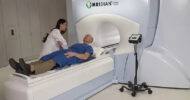
Using this technology, and we were one of the first centers in the country to begin treating with something called the MRIdian Linac, which is a device that of course uses MRI to guide radiation, we have been exploring significantly higher doses of radiation to pancreas tumors that are not resectable, with the goal of achieving better long-term outcomes. Better being, of course, tumor control and potentially longer survival, and doing that safely.
This is a paradigm that typically is done as an outpatient in five consecutive days. It’s non-invasive, there’s no anesthesia, no IVs or anything. It’s all completely non-invasive, millimeter-precise treatment that delivers what’s called an ablative dose. It’s a dose that has effects potentially, maybe, as good as surgery, and certainly higher than what is done on any other platform. In fact, the doses that we have been giving have actually been upwards of twice as high as what you could safely give using other machines or other technologies.
The data that we included in the article basically summarized an analysis that we did with the other institutions I mentioned of almost 150 patients with unresectable pancreas cancer who received this ablative MR-guided radiation therapy, and we looked at how they did in the long term. With long-term follow-up, what we saw was really tremendous. It was really exciting that patients seemed to do much, much better.
And what does that mean? Historically, with standard doses of radiation, the median survival for these patients is somewhere probably in the 12-month range or 13-month range. What we saw in our almost-150-patient series was a median survival of 26 months. I mean, that’s more than a doubling of what we would expect otherwise. The other exciting outcome we saw was that the two-year survival with standard radiation doses is somewhere around the 20 percent range. That’s been replicated over many studies over many years. In our analysis, we saw that it was actually over 50 percent. So again, representing potentially a doubling in what can be achieved in terms of long-term survival.
Despite these high doses that we’ve been doing and the tremendous outcomes we’ve seen, patients have tolerated this very well. Even patients in their 80s and 90s are routinely treated with these high doses. Because they are so precise, and those doses are delivered just to the tumor, patients really don’t have major side effects at all. In fact, most patients really just have mild side effects, if any, to the point where we have a pretty large and growing international presence, where patients will travel quite great distances for this type of treatment. Patients will come in, get their treatment, and leave the next day, potentially on a plane back to Asia or wherever they came from. In our study, we showed that major, severe side effects were extremely uncommon with this.
Kevin Pho: Just to give us some context, before the advent of MRI-guided radiation therapy, how was pancreatic cancer traditionally or conventionally treated?
Michael Chuong: That’s a great question. Outside of MR-guided radiation therapy, CT scans are what guide a lot of radiation therapy, including that for pancreas cancer. There are five-day regimens using CT guidance that are routine at many centers. However, the dose that’s delivered per day and the cumulative dose are significantly less than what we have been delivering using MRI guidance. It’s not because that dose is effective; that’s really just because that’s the safe dose that can be given. There are other regimens over many days and many weeks. Another common regimen, again using CT guidance, is a regimen over about five to six weeks, but those outcomes are, again, not, those outcomes could obviously be improved upon.
Kevin Pho: Tell me, what kind of pancreatic cancer patients would be suitable for MRI-guided radiation therapy?
Michael Chuong: That’s a great question. And to that point, not every single pancreas cancer patient probably benefits from MRI guidance. The real question would be: Where does this high dose matter in terms of improving at least the local control that might translate into survival? And that’s probably in patients who, one, don’t have distant metastases in different parts of the body, who really have a confined tumor in the pancreas itself that cannot be removed by surgery.
Surgery as of today still is the gold standard for pancreas cancer, but the fact is only about 15 percent of patients with pancreas cancer at diagnosis have resectable disease, with the majority of the others just having large tumors that are encasing some of the major vasculature and simply cannot be resected. So it’s really those patients who have non-metastatic, localized but advanced tumors that probably benefit the most from this.
Kevin Pho: Can you give us a sense of how often this treatment is being used? How many medical centers across the country are using MRI-guided radiation therapy for pancreatic cancer?
Michael Chuong: This ablative type of MR-guided radiotherapy is something that is at a small but growing number of centers in the U.S. and also worldwide. That in part is because the adoption of this technology obviously was initially small. But to give you a sense, we were the second center in the United States to start treating with this particular machine, in 2018. And the number of centers worldwide now, I think, is somewhere in the 40 to 50. So it’s a small number, but it is growing.
Most MR-guided centers do have a high utilization of this technology for pancreas cancers, just because it’s almost built to treat these types of tumors that need higher doses than you could safely give otherwise, and tumors that move, that type of thing. So it is still a limited type of resource in a way, in terms of what’s available geographically. It is growing, but fortunately, if patients do need to travel outside of their backyard, this regimen is pretty quick, and it’s pretty well tolerated. Most patients are home within a week.
Kevin Pho: Any downsides or cost considerations that we need to consider when referring patients for potential MR-guided radiation therapy?
Michael Chuong: In terms of cost, this is categorized as SBRT. Stereotactic body radiation therapy basically describes radiation therapy in five days for these pancreas cancers. So in terms of cost, this is covered by insurance, just because it is delivered in five days. There’s not actually a cost differential based on how much radiation you give, though. As I mentioned before, the five-day regimen using CT guidance is something that is routine. It’s part of standard of care for inoperable pancreas cancers. So there really are not any real major barriers to insurance authorization for this type of treatment, despite the much higher doses.
And in terms of any downsides to patients? I would say not really any downside to patients. The treatment process itself, as I mentioned before, is pretty straightforward and pretty easy for patients to get through, in that there’s no anesthesia. It’s completely non-invasive. Patients come in and go back to work and go golfing the same day, or that type of thing. So there’s really not a downside from that standpoint.
Patients do need to be candidates to have an MRI, both from not having incompatible implanted devices, a hip replacement or something like that, and most devices nowadays are MRI compatible. There’s also the claustrophobia element of having an MRI scan. The treatment machine that we’ve been using is just like any other MRI scanner. It’s a narrower bore than a CT scanner, so there are claustrophobia concerns that some patients may have.
One interesting and really helpful part of our system is that the patients actually will see a screen when they’re in the machine. There’s actually a mirror system where they actually see a monitor outside the room of their MRI in real time, so they actually will see what’s going on. In fact, what’s really interesting is that the system is so advanced it actually automatically will track where their tumor is and show the patient this as they’re moving. There’s basically a target area that they need to get their tumor into based on their breathing, and that turns the machine on and off itself. It actually helps engage the patients and helps the time go by faster. And these claustrophobic patients, who otherwise may have had a lot of difficulty with the treatment, are just so engaged in this that I’ve actually never had a patient who’s been claustrophobic and not been able to get their treatment.
Kevin Pho: We’re talking to Michael Chuong. He’s a radiation oncologist, and he wrote the KevinMD article “How MRI-guided radiation therapy is changing the paradigm in pancreatic cancer.” So, Michael, what do you see as the pathway of MRI-guided therapy in the near future?
Michael Chuong: MRI guidance, I think, is something that is transforming and will transform the treatment of pancreas cancer, but also potentially all other cancers that need radiation therapy. When it comes to pancreas cancer specifically, the data that we’ve generated, and others have generated as well, pointing to significantly improved survival has now sparked a lot of interest in exploring this aspect, especially prospectively.
Fortunately, we are now pursuing a phase three randomized trial in locally advanced pancreas cancer patients exploring this, randomizing patients to chemotherapy alone versus chemotherapy plus ablative radiation therapy. This will be an international trial looking to accrue about 300 patients, and hoping to really confirm that there is a significant benefit for these patients with the addition of this treatment. Potentially, that means that long-term survival is possible for pancreas cancer patients, despite a historically poor prognosis.
Kevin Pho: And if people wanted to read more or research more about this technology, what kind of resources can you recommend?
Michael Chuong: I think if you just do a web search for ablative radiation therapy or MRI-guided radiation therapy, that’s probably a starting point. The technology that we use at our center is something called the MRIdian Linac. It’s made by the company, so there are a lot of good resources there as well. And also, there have been a number of publications. If you wanted to do a PubMed search on MRI-guided radiotherapy, we at MCI and many others have started publishing pretty provocative and encouraging outcomes for patients with this.
Kevin Pho: And my final question, what are some of your take-home messages that you want to leave with the KevinMD audience?
Michael Chuong: I think the take-home message would be that MRI guidance is something that really is a paradigm change in radiation oncology. It really is expanding who we can treat and how aggressively we can safely treat patients. The ability to safely deliver ablative doses of radiation, especially for tumors that are not operable, really, I think, is going to transform how we think about radiation, and most importantly, what the outcomes for patients might be. Potentially, unresectable tumors might actually become curable at the end of the day, if we’re able to leverage the technology appropriately.
Kevin Pho: Michael, thank you so much for sharing your time and insight, and thanks again for being on the show.
Michael Chuong: Thanks so much for having me.
Listen and followApple PodcastsSpotifyYouTubeMore apps · Browse all episodes