




Listen and followApple PodcastsSpotifyYouTubeMore apps · Browse all episodes
“My lifelong quest to become a healer — over 40 years as a family physician, scientist, and researcher with the National Institutes of Health, the World Health Organization, the Walter Reed Army Institute of Research, and the Department of Defense — has led me to conclude that the best way to forge the strongest, most effective doctor-patient partnership is not to limit my questions to ‘What’s the matter with you?’ in an attempt to make a medical diagnosis. Instead, we must attempt to get to the root of our patients’ health and well-being goals by asking: ‘What matters to you in your life?'”
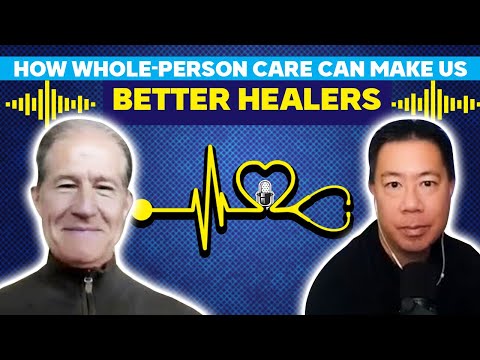
Wayne B. Jonas is a family physician.
He shares his story and discusses his KevinMD article, “How whole-person care can make us better healers.”

The Podcast by KevinMD is brought to you by the Nuance Dragon Ambient eXperience.
With a growing physician shortage, increasing burnout, and declining patient satisfaction, a dramatic change is needed to make health care more efficient and effective and bring back the joy of practicing medicine. AI-driven ambient clinical intelligence promises to help by revolutionizing patient and provider experiences with clinical documentation that writes itself.
The Nuance Dragon Ambient eXperience, or DAX for short, is a voice-enabled, ambient clinical intelligence solution that automatically captures patient encounters securely and accurately at the point of care. Physicians who use DAX have reported a 50 percent decrease in documentation time and a 70 percent reduction in feelings of burnout, and 83 percent of patients say their physician is more personable and conversational.
Rediscover the joy of medicine with clinical documentation that writes itself, all within the EHR.
VISIT SPONSOR → https://nuance.com/daxinaction
SUBSCRIBE TO THE PODCAST → https://kevinmd.com/podcast
RATE AND REVIEW → https://kevinmd.com/rate
FOLLOW ON INSTAGRAM → https://www.instagram.com/kevinphomd
FOLLOW ON TIKTOK → https://www.tiktok.com/@kevinphomd
GET CME FOR THIS EPISODE → https://earnc.me/zxfcDq
Powered by CMEfy.
Transcript
Kevin Pho: Hi, and welcome to the show, where we share the stories of the many who intersect with our health care system but are rarely heard from. My name is Kevin Pho, founder and editor of KevinMD. Rate and review the show at kevinmd.com/rate. Subscribe at kevinmd.com/podcast. In today’s show, we welcome back Wayne Jonas. He’s a family physician. His KevinMD article is titled “How whole-person care can make us better healers.” Wayne, welcome back to the show.
Wayne B. Jonas: Thank you. Great to be back, Kevin.
Kevin Pho: We’ll get into the article in a little bit, but for those who didn’t get a chance to listen to our first episode together, just briefly share your story and journey to where you are today.
Wayne B. Jonas: Sure, happy to. So I’m a family physician, and have been for the past 35 years, perhaps a little more. Most of that time was spent in the military, where I took care of soldiers and their families and retirees, veterans, etc. And actually, I still do that. I still see pain patients in the military clinic, and I still teach residents and students who are learning in the military.
As part of my journey, I had the great opportunity to run the Office of Alternative Medicine and help turn it into the center for integrative health that it is today, run a World Health Organization traditional medicine center, and then was supported by the Samueli Foundation for 20 years to do research in the area of healing traditions.
In that process, I got exposed to something that I really originally went into family medicine for, which is to take care of the whole person. But I realized there were many healing traditions that were doing it much better than we were, because we’ve lost this idea of keeping a healer in the hustle and bustle of all the technology and the time constraints of trying to cure. Now, cure is important. You want to do that. But we need to regain why many of us went into becoming physicians in the first place, and that’s to be healers, along with the treatment component. So that’s my background, and that’s what I try to do.
Real physician voices, twice a week
Free, and one click to unsubscribe.
Kevin Pho: So give us an example of how other cultures have taken that healing role better than we have, because what you’re saying is completely right. There are just so many obstacles, right, that interfere with our healing of the patients. There are so many time constraints. What are some other cultures that do it better than us, in your view?
Wayne B. Jonas: I think many cultures and many traditional healing systems actually get to know the person outside of what we normally count as medical areas: the social and emotional life, and the mental and the spiritual components of the person. What matters to the individual is part and parcel of what they do in talking to the patient. That doesn’t mean they don’t go about diagnosing and trying to do things in their own way in those areas, but they don’t do that only. It’s not just about “What’s the matter with you?” It’s getting to know who you are as a person.
And so the bottom line that I learned from these approaches, and actually our system has done this too and embeds it in certain types of disciplines, and I think in the past, before we got so embedded in the economic drivers around treatment, we were doing this too. Originally in medicine, if you go back to Hippocrates, this is a key tenet: attending to the social, emotional, spiritual, lifestyle, and behavioral aspects of a person, not just giving them the treatment or the herb. And so I learned a lot of that from multiple other cultures, and we can bring that back into our system too.
Kevin Pho: And you talk more about that in your KevinMD article. It’s titled “How whole-person care can make us better healers.” Now, for those of you who get a chance to read your article, just walk my audience through it and share the story of why you decided to write it.
Wayne B. Jonas: Yeah, I wanted to illustrate how this process can be done right now, in a normal, overall practice. And this story is actually about someone fairly typical. It’s what I see in my practice. This is a service member who had chronic pain, who came into the residency program, into our pain clinic, with chronic back pain. But he had multiple other problems too, mainly psychological problems. He had PTSD from his deployments in the war, he had depression, he had anxiety, and he came in actually asking whether we could give him CBD. He wanted some kind of a cannabinoid.
After the resident suggested we change his psychotropic, I then used a set of tools to ask him what was the most important thing in his life, to get him outside of the medical framing and say, “What’s important to you?” And what emerged from that discussion was that he was extremely isolated. He was embedded at home by himself and his cat, and his wife would come home and support him in the evening, but he didn’t get out. He didn’t go to therapy, he didn’t go to groups, etc. He didn’t have very many friends.
And that led to an honest conversation with him about his history of adverse childhood experiences, how the exposures in the war exacerbated that, and how that made him essentially a social isolator. What he needed was a way to become aware of how to actually break that component, and he was willing to start journaling. He started journaling about his traumas, about his childhood experiences, and about his experiences in the war. Eventually that began to give him the courage. He didn’t share it with anybody; he just wrote it for himself. But that gave him the heart to begin to see a counselor, which then got him into group therapy, and he really started his healing journey at a much deeper and more fundamental level than simply taking CBD oil or changing his mental health medication.
Kevin Pho: Now, how difficult was it for you to get this patient to open up?
Wayne B. Jonas: Yeah, there’s a process for doing that. In fact, there’s even a science for doing that. It’s often called health coaching, or behavioral change science. We know a lot about it, but we don’t use it very much. It involves motivational interviewing. It involves asking and listening to the patient to identify what drives them and what motivates them. It’s shifting from patient-centered care, where they’re automatically in the health care system, to person-centered care, finding out what’s important to them. And if you listen to that, they will tell you. Actually, you’ve got to structure the dialogue and the visit that way, and you have to give them the time and the support to do it. It can’t just be about “What’s the diagnosis? What am I going to hand you?”
It’s actually remarkably rapid if you use the right tools, and the tools I used were originally developed within the VA, the Veterans Administration, and we’ve cultivated and created those tools to make them easier to use outside of that system. I use a questionnaire called the Personal Health Inventory, which is how I learned about his isolation and the areas that he was willing to go into. And then I had what I call an integrative health visit, using a set of tools called the HOPE notes and a set of resources that could be brought to him in those areas.
So I can do this. If I don’t know the patient, it takes me a little longer than 20 minutes. But if I do know them, and they’re coming in with a chronic illness, and I’m not worried about their diagnosis, I’ve already done the SOAP note, right, I know the medical treatment on that, and now I want to bring the healing components and empower them in that process. These are the tools and the mindset that can make that happen within routine practice.
And so we did all of this within about 30 minutes. Now, he had to come back, right? It wasn’t a magical cure, but that’s all right. He’d been coming back for a long time to get his medications and to get treatments and all that kind of stuff, but now he was coming back really to address something that was for him. He was in the driver’s seat in terms of doing that. So that really got him onto the right path, when previously he’d been told, “Hey, go to counseling, do this, do that,” but it never was connected to him personally and what was important to him. So that’s where motivational interviewing and the techniques to help people move into behavioral change come along, and there’s a whole science to that. You just have to learn them, and you need to bring them into the practice.
Kevin Pho: How long did you know this patient before he opened up to you like that?
Wayne B. Jonas: That’s the first time I met him. The first time I met him. This is the remarkable thing about some of these tools. If you ask a patient what’s important to them and you let them write it down, it’s not a checklist. It’s hard to say, “OK, pick out of these five things what your life is all about,” right? And then you use that to open a dialogue where you listen. And it is remarkable, the honor and the privilege that patients give us as physicians in revealing those kinds of deeper things when they think you’re really sincere and you’re hearing them, and you’re not just typing on your computer and that kind of thing. So listening is a key component, and developing methods and the patience to do that, so you don’t interrupt the patient in the first seven seconds.
Kevin Pho: Give us an example of some of the questions that you ask this patient to get them to open up, because I’m sure a lot of primary care physicians who listen to this podcast want the same thing, but they’re just so limited by the time crunch. It’s much easier just to send them to a counselor or write for CBD oil. What are some examples of questions that you ask in the examination?
Wayne B. Jonas: Yeah, over the last few years, we have consolidated a set of tools that make this easier to do, and also some tools to learn how to do that. We just finished a learning collaborative where we were able to refine these. I give all my patients now something called the Personal Healing Inventory. You can get it off my website. You can get a guide and some of the resources that it then brings up, so that you can actually provide these kinds of things.
We’ve just finished a learning collaborative with clinics all over the country doing this and testing this out and redesigning, putting it into the electronic medical record. Many of them have done so, so they can just pop it in and the patient can do it there. It takes the patients generally about 10 minutes to fill this out, and then it becomes the center of the discussion, the dialogue. So it makes it much more rapid and much easier to do within that process.
Kevin Pho: I’ll ask you later in terms of how listeners can find that program, but without doing the whole CME and giving it all away, what are some examples of specific questions that you would ask from that program?
Wayne B. Jonas: Yeah, so one of the key things that I have in the questionnaire, in the PHI, is “What gives you joy? What do you live for?” And they handwrite it in. That’s very important. So there’s an introduction on the first part of the PHI that says what this visit is about. It’s about your whole health. It’s about social and emotional, mind-body, your lifestyle, et cetera, et cetera. So they immediately know that that’s what we’re going to talk about. Then they write in what matters to them.
And then at the bottom of the questionnaire, they indicate on a one-to-five scale which area they have the greatest need and the greatest desire to work in. That goes through things like sleep, nutrition, psychosocial support, social determinants of illness, if they have some basic social media needs. It’s a list of things that they just rate one to five, and you look at that, and that often immediately allows you to focus in on what they say their greatest need is. You would be surprised sometimes, but that allowed you to actually have that dialogue.
And so if they rate, for example, that their sleep is terrible, at a one, then I’ll say, “All right, let’s look at this. How can we support that process?” And then that becomes the focus of the health promotion, integrative health visit, and then the resources are brought to that. That’s an example.
Kevin Pho: Now, you mentioned being surprised sometimes when you read the results of these questionnaires that patients filled out. So just from your years of experience doing this, what would you say are some of the more surprising things that you didn’t expect patients to write down in answer to this questionnaire?
Wayne B. Jonas: The one that I showed you, the example that I write about in the article, was a surprise to me, because in the little box where you write down what’s the most important thing to you, he wrote basically two phrases. He wrote “my cat” and “my wife.” And this is after the resident had come in and said, “Oh, I think this is what we need to do,” and after he had put down that he wanted to know about CBD oil. And I went, “Oh, I was not expecting that,” right? That’s important.
The reality is there are basic, fundamental things that facilitate healing and wellness that are pretty common to folks. Everybody needs to have something they’re doing that’s meaningful in their life. Everyone needs social support. They don’t have to have a mental health problem to have a social and emotional body in those areas, and that drives them. Lifestyle is very important for the majority of the chronic diseases that we see in primary care: high blood pressure, obesity, diabetes, etc. Diet, sleep, nutrition, and stress all impact those types of things. And so there’s a set of things that come up over and over again that you can create support tools for. And the surprising thing is that you often can’t guess what they are for the person unless you ask them to tell you, and then that’s the direction that you go.
I think if there’s one thing that surprises me after years of doing this, both in standard primary care, which I still do, as well as trying to bring the integrative or whole-person care tools in there, it’s something that has really come up just in the last several months, actually. For me, the most surprising thing is how powerful mindfulness is, and simple techniques, both on the provider side as well as the patient side, for pausing and not simply becoming a reflex reaction to the thoughts that occur in your head and the responses that the patient sends to you. If you just learn how to take a pause, this really helps open up the space where what the patient needs, and what you can provide to get them onto their healing journey, can emerge. And I’ve always said stress management and all that kind of stuff, but it’s more than that. It’s not just stress management. It’s really opening up a space to make that kind of deep connection where healer and healee can work.
Kevin Pho: And where can one learn more about doing that? Because I think what you said was very resonant: just taking a pause, being more mindful, being more in the moment. That’s something very difficult for us to do in the exam room. We’re always so rushed, and we have all these check boxes to click off and all that. Where can one go to learn to do that better?
Wayne B. Jonas: There are a number of places to do that, and increasingly you see technology assist in this process through apps, for example, Calm and reading activities. The one that I’ve been using for almost a year now, that I really like for professionals to do, is something called Waking Up. It’s an app put together by Sam Harris, and it brings together both practices and didactic instruction in these areas. It’s not specifically for health care, but it’s a very powerful thing, with very simple kinds of techniques that can teach you that. So it’s called the Waking Up app. I like that one a lot. It’s easy to do. You get a one-minute thing each day, you get a 10-minute thing each day, and you can do all of them or none of them.
There is a formal training in mindfulness for clinicians up in New York, out of the University of Rochester, that you can actually go and do. They have online components in that, and it’s specifically about developing mindfulness, and training.
Kevin Pho: We’re talking to Wayne Jonas. He’s a family physician. We’re talking about his latest KevinMD article, titled “How whole-person care can make us better healers.” Wayne, what are some of your take-home messages for the KevinMD audience?
Wayne B. Jonas: I think one of the important take-home messages that physicians especially need to hear over and over again, and not push away or feel guilty about, is that to become a healer, you have to heal yourself, right? The healer. And that’s more than self-care, which is important. You need to take care of yourself so you don’t burn out. We’re having huge problems with that right now; everybody knows. So you can’t care for the whole person in the way I described it without taking care of yourself as a whole person. So that’s really important.
And the way you start on that journey is self-awareness. You have to know yourself first. Practices like being aware, like the journaling that my patient did, which I do myself, and we have instructions on how to do that, help open up these deeper, unconscious aspects of your mind so that you can more fundamentally answer the question of what brings you joy in life. And this, I think, is the remedy, really, to burnout and the continual onslaught of the incessant cure that buries healing so often on a day-to-day basis. This can be done, but it starts with self-awareness. It then leads to self-care, and that allows you then to care for your patients.
Kevin Pho: And where can listeners find more about the resources that you talked about?
Wayne B. Jonas: So we have a huge number of resources on my website at DrWayneJonas.com. It includes the PHI, it includes the HOPE tools, with all the support resources we’ve collected around the country, a number of them inexpensive and easy to use, that can be worked with patients, and a whole series of pocket guides that give the science and the practice of each of these kinds of behavioral components that facilitate health and healing. Those are all on the website. They’re free, and I encourage everybody to go there, download them, and start using them.
Kevin Pho: Wayne, thank you so much for sharing your time and insight, and thanks again for coming back on the show.
Wayne B. Jonas: My pleasure. Thank you.
Listen and followApple PodcastsSpotifyYouTubeMore apps · Browse all episodes