Subscribe to The Podcast by KevinMD. Catch up on old episodes!
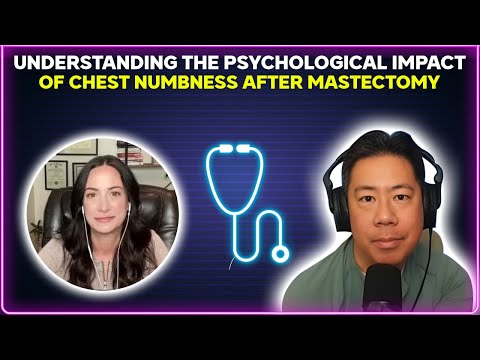
Join Kristen Casey, a clinical psychologist, as we delve into the emotional and psychological impact of chest numbness following mastectomy. Discover the importance of discussing this often-overlooked side effect with patients, explore potential solutions, and learn how health care providers can better prepare and support breast cancer survivors. Kristen shares her firsthand clinical experiences and expert advice in this engaging conversation.
Kristen Casey is a clinical psychologist.
She discusses the KevinMD article, “Patients with chest numbness following mastectomy may experience lower quality of life.”

Careers by KevinMD is your gateway to health care success. We connect you with real-time, exclusive resources like job boards, news updates, and salary insights, all tailored for health care professionals. With expertise in uniting top talent and leading employers across the nation’s largest health care hiring network, we’re your partner in shaping health care’s future. Fulfill your health care journey at KevinMD.com/careers.
VISIT SPONSOR → https://kevinmd.com/careers

Discovering disability insurance? Pattern understands your concerns. Over 20,000 doctors trust us for straightforward, affordable coverage. We handle everything from quotes to paperwork. Say goodbye to insurance stress – visit Pattern today at KevinMD.com/pattern.
VISIT SPONSOR → https://kevinmd.com/pattern
SUBSCRIBE TO THE PODCAST → https://kevinmd.com/podcast
RECOMMENDED BY KEVINMD → https://kevinmd.com/recommended
GET CME FOR THIS EPISODE → https://earnc.me/TfuCTF
Powered by CMEfy.

ADVERTISEMENT
Transcript
Kevin Pho: Hi, and welcome to the show. Subscribe at KevinMD.com/podcast and get CME for this episode by clicking on the CME link in the show notes. Today we welcome Kristen Casey. She’s a clinical psychologist, and today’s KevinMD article is titled “Patients with chest numbness following mastectomy may experience lower quality of life.” Kristen, welcome to the show.
Kristen Casey: Thank you so much for having me.
Kevin Pho: So we’ll get into the article in a little bit. First off, briefly share your story and journey.
Kristen Casey: Sure. I’m a clinical psychologist and a former emergency medical technician. I’ve worked in a variety of settings: inpatient, outpatient, primary care, residential, and hospitals. I mostly focus on health and medical psychology, helping clients navigate really tough medical diagnoses, or really helping them regain their sense of quality of life after treatments that they’ve had.
Kevin Pho: So tell us about your role as a clinical psychologist for these patients who are undergoing difficult medical journeys.
Kristen Casey: With any big, heavy medical diagnosis, there’s shock. There’s “How am I going to work through the rest of my life with this? How am I going to find my place in the world?” So a lot of it is deconstructing what your ideal life might be like, because life will look different after certain medical procedures. A lot of times I’m there as a support system for them if they don’t have support, and a lot of times we can teach clients how to look at themselves in the world in ways that are more ideal for their situations. Because, as you know, when you’re going through something really hard, especially when it comes to a medical diagnosis, things feel pretty bleak. So we really try to focus on enhancing quality of life.
Kevin Pho: So what are some common techniques that you would use in these situations?
Kristen Casey: It depends on the diagnosis, of course, but I’ve worked with a lot of people who have experienced cancer diagnoses or diabetes diagnoses, or really a diagnosis that they weren’t expecting. A lot of times we do a lot of process work. As clinical psychologists, we have the privilege and opportunity to get to know the depths of people’s minds, which I think is pretty amazing. We learn their biggest fears and their biggest doubts, and based on those fears and doubts, we can navigate treatment in a certain way.
A lot of times it is really coming to an acceptance phase, rather than agreeing with the situation. And a lot of it will be stress management techniques, like “How do I deal with anxiety relating to my next medical procedure?” or “How do I manage my stress in telling my family about all of this?” So we really spend a lot of time getting down to what the client’s deepest fear is, and every client will have different fears.
Kevin Pho: All right, let’s talk about your KevinMD article, titled “Patients with chest numbness following mastectomy may experience lower quality of life.” Tell us how this article came together.
Kristen Casey: I’m so passionate about this topic. I wanted to learn more about what my patients were going through on the physical side of things. As clinical psychologists, we work with emotions, the brain, and psychology, so we focus a lot on the emotions. But as I was learning more about what my clients were dealing with post-mastectomy, I noticed that a lot of them were really worried and really anxious about the fact that the way their body feels, the way they navigate the world, and the way they find their place in their own life is kind of disorienting for them.
So as I was looking, I was really looking for answers, to be honest with you. I was like, “Is there any way to regain sensation post-mastectomy?” And I came across Dr. Larsen. He’s a breast surgical oncologist with New York Breast Health, and he’s so kind and helpful. He really helped me understand the nature of what happens post-mastectomy. A lot of times we don’t realize, especially as psychologists, because we’re just not medical professionals, that sensation might be lost or limited after mastectomy. And if you think about sensation, it’s so important. It’s how we navigate the world and how we assess for danger and stuff like that. So that’s how it came about, and that’s how it started.
Kevin Pho: So when patients come to you post-mastectomy, how do they normally present? Do they present with these changes in sensation, like Dr. Larsen articulated? How do they come to you?
Kristen Casey: It’s so interesting, Kevin. When I normally see clients (and I still have a couple, I’ve had several former clients, and when I worked in the hospital I had quite a few), they will come to me and say, “I feel empty. I feel different. I just feel this sense of loss of identity.” And when we really get down to it and think about sensation, it was something that I hadn’t even considered either. I just hadn’t considered that sensation would be a navigating point for clients.
If you think about receiving a hug, or, for women, holding your newborn, you lose that sensation and you lose that connection point. It was really “How do we navigate this new experience for you?” But really, what we’re getting down to is a quality-of-life issue, so that’s what we focused on the most in therapy.
Kevin Pho: So when you talked to Dr. Larsen and he said that this was kind of an unsung yet important symptom status post-mastectomy, how did he address this issue? How does he normally approach something like this?
Kristen Casey: I don’t want to speak for him, and he’s so articulate with his words, but from what I understand from what he’s told me, when we’re focusing on cancer, it’s like, “Let’s get the cancer out,” right? If you have a breast cancer diagnosis, that’s the main concern. Most people are not concerned with sensation at that point. But a lot of the clients that I work with have not been informed or even aware that sensation could be lost. How he describes it is that when you go through mastectomy, there are options, technically, to regain that sensation that most clients aren’t aware of, and I wasn’t aware of either. He talked a lot about “Let’s get the cancer out, and then we can focus on quality-of-life issues after.”
I love the fact that we both have different scopes, and when we came together to talk about it, we had pretty different vantage points, but in a good way; we had the same goal. I wanted to learn more, and that’s how I learned from him when he talked about breast neurotization surgery. I’m not a clinical expert on the procedure, but from what he’s told me, when breast tissue is removed in a mastectomy, the nerves that supply sensation to the chest are removed with that tissue. This usually results in permanent numbness unless it is surgically repaired, and a lot of my clients didn’t know about procedures like that. So that’s what I’ve learned from him, and I can relay that to my clients, which has been a beautiful thing.
Kevin Pho: So after hearing Dr. Larsen’s perspective and learning from it, give us an example of how that’s changed your counseling and talking to these patients, these clients.
Kristen Casey: Totally. That’s a really good question. Whenever clients come to me, again, it depends on their goals for treatment. But specifically for the clients who are really concerned about the loss of sensation and how it affects their relationships, their quality of life, how they navigate the world, and how they have a loss of identity, a lot of times we focus on the process part. I sometimes will add in, “Hey, why don’t you talk with some other medical professionals? I’m learning, again, I’m not an expert, I’m learning about these other procedures, and I think it would be worth getting curious about.” So I feel like I have some more value to bring to my clients after talking with Dr. Larsen. It’s incredible.
A lot of times, at least from what my clients have told me, when they’re in the process of going through this really horrific experience, they are just so grateful to be alive, and I’m so grateful that they’re alive too. And I’m grateful that we can both share these moments post-surgery and just be able to be in the same room together. But as time goes on, they’re very much reminded of the impact, physically and psychologically. The sensation part, I’ve noticed, is one of the core parts of how we find meaning in life. Think about when you have a really deep conversation with a friend: Not only do you feel it psychologically, but you almost feel that warm, fuzzy feeling, and I’m kind of generalizing here. So you really can connect with people based on sensations, and that’s what we talk about most of the time.
Kevin Pho: Now, can you share a case study? It could be a hypothetical case study where you have moved the needle with one of your post-mastectomy clients in terms of helping them adjust and adapt to that diagnosis.
Kristen Casey: Sure. Just for purposes of anonymity, this isn’t based on client data. I’ve had several clients, but one in particular came to me post-mastectomy, and her kids and her family were really concerned about her. She was very depressed, very low, feeling like her chest had been almost empty or deleted, and it was a part of her identity. I think something important to note is that a lot of times people don’t want to talk about these things, because they feel like breast tissue is intimate in nature or sexual in nature. But for women, particularly, or people who were assigned female at birth, it is an identity for us, if you think about breastfeeding and stuff like that.
So she came to me very depressed, very low, and we focused a lot on how to engage in behavioral activation, one of the evidence-based treatments for depression for people who are experiencing low mood, and it just wasn’t working. As clinical psychologists, we always look at what’s working and what’s not; it’s measurement-based care. After a couple of weeks, we decided, “Hey, we have to change course.” So we did a little bit of acceptance and commitment therapy, which is based on values work. We did that, and we were starting to get somewhere, but there was something within me, Kevin, where it just didn’t feel right.
I asked, “How are you feeling about your body after this?” And she just broke down, and we started to have conversations about sensation. She said, “I feel so silly talking about it, because I’m cancer-free now, and I feel like I should be grateful.” But that was the key moment where we started to pivot in a really positive direction, because she was saying to me that just being able to talk about the lack of sensation had been helpful. So that alone was helpful.
And then after talking with Dr. Larsen, doing my research, and really just talking with other medical professionals who are in this field, I’ve gained so much information that I can relate to her, and I would be able to talk with my clients about this stuff, and it gives them hope. As a psychologist, and any other mental health professional might disagree with me, but if we’re able to maintain that instillation of hope, that’s the key for people, especially if they’re in a really depressed state after a cancer diagnosis, especially post-mastectomy.
Kevin Pho: We’re talking to Kristen Casey. She’s a clinical psychologist, and today’s KevinMD article is titled “Patients with chest numbness following mastectomy may experience lower quality of life.” Kristen, can you share a piece of advice for patients and their families who are unfortunately undergoing this relatively common procedure?
Kristen Casey: It will look different for everyone, but I think reasonable expectation management is helpful: What is my life going to look like? What are my limitations? What are my strengths? And most importantly, what are the elements in my life that I have control over? Because I think some people undergoing situations like this, especially with this procedure, feel a great sense of lack of control in their life. So there are strategies available: mindfulness techniques, diaphragmatic breathing, really grounding yourself in the present moment.
Even more important, Kevin, I think, is really looking at the landscape of your life and saying, “What am I looking for? Am I looking for connection? Am I looking for hope?” And you can find that within therapy, with a therapist, for people who have the opportunity for that. There might also be research articles out there as well. But really, the main thing is looking at the options for lack of sensation with breast neurotization surgery.
Kevin Pho: And my final question: Tell us some of the take-home messages that you want to leave with the KevinMD audience.
Kristen Casey: I’m a big fan of the podcast, but one thing is: Never stop learning, never stop growing, and never stop being curious, because there’s always more to learn and more to know. If you really think about it, even if you’re an expert in your field, like I consider myself an expert in psychology, I still have so much to learn and so much to know. It’s just endless. So as long as you keep an open mind, you’ll be able to help your patients.
Kevin Pho: Kristen, thank you so much for sharing your time and perspective, and thanks again for coming on the show.
Kristen Casey: Thank you.