Subscribe to The Podcast by KevinMD. Catch up on old episodes!
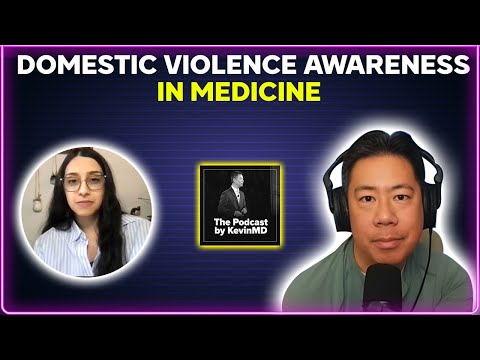
Join medical student Leana Pande. We’ll explore the vital role health care practitioners play in addressing intimate partner violence (IPV). Discover how education, training, patient-centered care, and risk assessment tools can empower health care providers to make a positive impact. Learn how to create a safe environment for patients to disclose their experiences and find out about crucial next steps and resources.
Leana Pande is a medical student.
She discusses the KevinMD article, “Understanding and addressing intimate partner violence in health care.”

Our presenting sponsor is Nuance, a Microsoft company.
Together, Microsoft and Nuance are leveraging their rich digital technology and advanced AI capabilities to tackle some of health care’s biggest challenges. AI-driven technology promises to revolutionize patient and provider experiences with clinical documentation that writes itself.
The Nuance Dragon Ambient eXperience, or DAX for short, is a voice-enabled solution that automatically captures patient encounters securely and accurately at the point of care. DAX Copilot combines proven conversational and ambient AI with the most advanced generative AI in a mobile application that integrates directly with your existing workflows.
Physicians who use DAX have reported a 50 percent decrease in documentation time and a 70 percent reduction in feelings of burnout, and 85 percent of patients say their physician is more personable and conversational.
Discover AI-powered clinical documentation that writes itself. Visit https://nuance.com/daxinaction to see a 12-minute DAX Copilot demo.
VISIT SPONSOR → https://nuance.com/daxinaction
SUBSCRIBE TO THE PODCAST → https://kevinmd.com/podcast
RECOMMENDED BY KEVINMD → https://kevinmd.com/recommended

ADVERTISEMENT
GET CME FOR THIS EPISODE → https://earnc.me/8L9fkG
Powered by CMEfy.
Transcript
Kevin Pho: Hi, and welcome to the show. Subscribe at KevinMD.com/podcast, get CME for this episode by clicking on the CME link in the show notes. Today we welcome Leana Pande. She’s a medical student, and she’s the co-author of the article “Understanding and addressing intimate partner violence in health care.” Leana, welcome to the show.
Leana Pande: Thank you for having me here.
Kevin Pho: So let’s start by briefly sharing your story and journey.
Leana Pande: Well, I’m a third-year medical student at the Touro College of Osteopathic Medicine. I grew up in a medically underserved community in northeastern Pennsylvania, so a lot of the reasons I wanted to become a physician were to help serve populations that aren’t necessarily getting the care they need.
So currently my role is as the co-chair of the domestic violence prevention committee with the American Medical Women’s Association, and it’s been a really interesting and educational process, because I’ve learned a lot about how we can help men and women in intimate partner violence, or IPV, settings and situations, and I’ve gotten to apply that information.
Kevin Pho: So we’re going to talk more about that, of course, in your KevinMD article, “Understanding and addressing intimate partner violence in health care.” So tell us what this article is about.
Leana Pande: It’s essentially about the virtual webinar conference that we put together in October. It was a multidisciplinary approach to how to approach intimate partner violence and how we can conceptualize it from the perspective of judges. We had lawyers, we had survivors themselves come and speak, and then anyone in the American Medical Women’s Association, and extending to other medical students and physicians, could come in and ask questions and interact with the speakers and learn a little bit more about not just how to identify intimate partner violence, but what do you do then in those situations, and how does someone who finds themselves in that position want to be best helped? Because sometimes they really just want medical care and they don’t necessarily want to be saved, so to speak.
Kevin Pho: So tell us the scope of the issue before getting into some of the things that we could learn from this webinar.
Leana Pande: As of right now it’s definitely a national issue that pertains to men and women. I believe it’s four in 10 women and three in 10 men in the United States who are affected by intimate partner violence to some degree. It was just Domestic Violence Awareness Month in October, and it was addressed by renewing certain legal actions in the White House in October also, which is when we held the conference. So it’s a very relevant topic today, and the only question becomes, are medical students, residents, physicians ready to deal with this when they see that in practice actually and not just conceptually?
Kevin Pho: Now, for the health care professionals and medical students who were at this conference, what are some of the key takeaways that they came away with?
Leana Pande: I think we definitely got a better sense of the scope of how many people can get involved. We had a keynote speaker, Dr. Horn, who’s really involved in the Indigenous community in Canada, who spoke a lot about how she feels problems that are systemic can be with upstream and downstream issues, and as physicians they have the opportunity to deal with problems upstream, so to speak, before that’s disseminated in the community.
So by discussing with lawyers, judges, and survivors themselves, as well as physicians who are really involved in child outreach and intimate partner outreach, we got a chance to see what they want themselves. For issues of human trafficking, sometimes it was as simple as they just want dental care, and they don’t necessarily want a legal case or a report to follow them, they just want to be treated. Some people felt that they just wanted to be presented with resources that they could take at a later time, because there was one survivor who spoke who said she got a phone number that she kept around with her for a long time, and then she only used it when she was ready.
Because the survivors themselves know best how their abuser can interact with their family and surroundings, in a way that they best know how to navigate the situation more than we can, meeting them in the last five to 10 minutes. So coming up with ways to screen and then provide resources that they can utilize on their own timeline was a big point that we made, in different forms, whether it’s, store this phone number in your phone as a different person rather than as, you know, shelter, or just letting them know they can come back at any time, and not pressuring them to make certain decisions.
Kevin Pho: I’m a primary care physician, and I wish that intimate partner violence could be addressed more thoroughly in the exam room. What are some of the reasons why they aren’t addressed as often as it should be?
Leana Pande: I think it’s to some degree willingness of the patient or the physician. One of the questions the committee is looking at right now is, well, you’re taught how to screen for, is someone safe in their home? But once, if they said no, do you know what resources are in the community to then help that patient? Are you able to or equipped to help someone who says, oh, the person who’s with me, I don’t feel safe with them and I need to find a way out? How confident are you in using the resources in your community? Are you aware of the resources in their community? And do those even exist to begin with?
Because like I said, where I’m from in northeastern Pennsylvania, I got a survivor from my hometown to speak, and she said there’s two different resources. If they don’t necessarily believe you, it’s very difficult then to continue to make a case, to get any kind of help, to get resources you need to kind of climb out of that situation.
Kevin Pho: Now, from this conference, what kind of questions should clinicians be asking in terms of approaching a topic like this?
Leana Pande: I think that varies based on the person you’re speaking to. We had a pediatrician from the SCAN program in Connecticut come speak, and she made some good points about how, because there’s a lot of mandated pediatric laws, you have a lot of opportunity for prevention if you’re speaking to someone who’s very young, and getting them out of harm’s way from being, so to speak, collateral damage of IPV.
And just kind of asking about how they’re feeling at home, asking about any injuries they may have, screening for how they feel today, trying to get a sense, ask them what’s their day-to-day like and see how that’s described, and just kind of seeing their overall, how did they behave, and their affect.
Of course, when it comes to adults, there’s a little bit more of a filter. Their willingness to be helped is depending on how safe they feel, and do they want a report out. So necessarily it’s sort of almost the same with mental health. People are willing to speak, but then they know that they have to perhaps censor themselves or change the way that they’re speaking because they don’t necessarily want that help.
Kevin Pho: Now, you talked a bit about this earlier, but go into more detail in terms of what kind of resources in general are available to patients that find themselves in intimate partner violence situations.
Leana Pande: This varies a little bit geographically from where you are. There’s all kinds of national helplines, and you can read things about the power wheel to kind of educate yourself, like, am I in an intimate partner violence situation? One of our survivors spoke a little bit about how she didn’t realize herself until she late in life became a nurse and was reading about IPV in nursing school, that she was in that situation herself.
So after educating yourself thoroughly using potentially online resources, you do need to kind of take a look at your surroundings and see, are there shelters around me that I can read into? Unfortunately this isn’t standardized from city to city, so I could give very broad answers, which is sort of what we’re trying to address. Reaching out to health care providers and emergency room staff especially, who are more equipped to know this information, to know the shelters and support system in your community. Because obviously that varies from cities like LA and New York City to small rural communities that might have fewer shelters and just resources and meal options and ways to help the community.
Kevin Pho: So you mentioned a tool called a power wheel. What is that?
Leana Pande: There’s a sort of a wheel, it’s on like every website related to intimate partner violence and the national one, it shows ways that abusers keep their victims in these relationships and kind of perpetuate that they should stay in these relationships. So it’s not always intuitive that if you’re in a relationship that you’re not being physically abused, there are other ways that you might be facing some difficulties.
Kevin Pho: And what would be some examples of that?
Leana Pande: Well, just putting down the individual, name calling, kind of negative comments like, oh, you don’t look great in that shirt today, oh, that’s fine. And then that person might be kind of stuck thinking about that shirt. It’s just kind of mental tactics to sort of keep an individual from thinking that they have power in their own life and agency to do things for themselves. It’s just kind of intimidation, emotional abuse. It could be economic abuse, like maybe you don’t have access to your own financial documents, so that would keep you where you are.
Kevin Pho: We’re talking to Leana Pande. She’s a medical student, and today’s KevinMD article is “Understanding and addressing intimate partner violence in health care.” Now, you attended this conference as a third-year medical student. How did this affect you?
Leana Pande: I attended and moderated one of the panels. It was really eye-opening, because going to the conference I knew what kinds of people would be speaking, I helped recruit the speakers myself. But when people tell the stories of what their life’s been like, having six children before they turn 20, being with someone they don’t feel safe with and is beating them every single day, it’s very powerful.
We also had an Indigenous speaker physician, Dr. Horn, who spoke a little bit about what that’s like in the Indigenous community, and she showed art that the individuals had made describing their experience. And some of it, it gives you chills just to see the kind of emotion that they can capture in their own paintings. And being an artist, I kind of honed in on that. I think looking into the art and the stories of these survivors was really moving.
Kevin Pho: So tell us what’s on the horizon in the coming years in terms of shedding more light on this issue.
Leana Pande: I think at least from the perspective of the committee, education and webinar opportunities to show, what is it exactly that you can do to take concrete steps to help patients who are facing situations of intimate partner violence? My co-chairs Courtney Chau and Dr. Shel Ajmani, we all work on trying to create, I don’t want to say content, but anything educational that could be used for students and practicing physicians to actually have a tangible sense of where to go when they’re having conversations with patients. Not just kind of getting stuck at, OK, well, do I know the resources in my area? Being able to properly screen and speak to people who are facing these situations. It’s more about competency and making sure that the physician is actually helping the patient in a way that they would be comfortable with.
Kevin Pho: And for those interested in learning more, can you share some resources to my clinician audience?
Leana Pande: Sure. They could reach out to us, the domestic violence prevention committee, on the American Medical Women’s Association website. There’s also the National Domestic Violence Hotline, thehotline.org. They have all kinds of general information on the topic.
Kevin Pho: And my final question, tell us some of your take-home messages that you’d like to leave with the KevinMD audience.
Leana Pande: I would say if you ever encounter an IPV survivor, or someone who’s currently going through the situation, meet them where they are. Try to give them tools that they can use when they feel mentally and physically able to do that, because it’s only going to be beneficial to them if they feel they can use the tools you’re giving them, and not if you’re kind of pulling them away, even though it feels like a very knee-jerk reaction is, we’ve got to get them out of the situation.
Kevin Pho: Leana, thank you so much for sharing your time and insight, and thanks again for coming on the show.
Leana Pande: Thank you.