Subscribe to The Podcast by KevinMD. Catch up on old episodes!
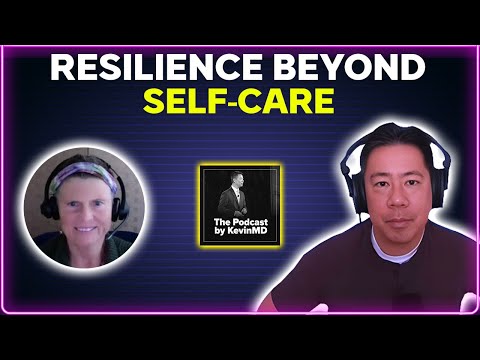
Join Beth Boynton, a nurse consultant, as we delve into the pressing issue of health care worker resilience. Discover the importance of empowering health care professionals, developing essential interpersonal skills, and the role of emotional intelligence in promoting safe nurse staffing and improved health care outcomes. Explore practical strategies and real-world examples, and learn how medical improv can play a vital role in nurturing resilience and healthier systems over time.
Beth Boynton is a nurse consultant.
She discusses the KevinMD article, “The complexity of resilience and the role of medical improv.”

Our presenting sponsor is Nuance, a Microsoft company.
Do you spend more time on administrative tasks like clinical documentation than you do with patients? You’re not alone. Clinicians report spending up to two hours on administrative tasks for each hour of care provided. Nuance, a Microsoft company, is committed to helping clinicians restore the balance with Dragon Ambient eXperience – or DAX for short. DAX is an AI-powered, voice-enabled solution that helps physicians cut documentation time in half. DAX Copilot combines proven conversational and ambient AI with the most advanced generative AI in a mobile application that integrates directly with your existing workflows. DAX Copilot can be easily enabled within the workflow of the Dragon Medical application to bring the power of ambient technology to more clinicians faster while leveraging the proven and powerful capabilities used by over 550,000 physicians.
Explore DAX Copilot today. Visit https://nuance.com/daxinaction to see a 12-minute DAX Copilot demo. Discover clinical documentation that writes itself and reclaim your work-life balance.
VISIT SPONSOR → https://nuance.com/daxinaction
SUBSCRIBE TO THE PODCAST → https://kevinmd.com/podcast
RECOMMENDED BY KEVINMD → https://kevinmd.com/recommended
GET CME FOR THIS EPISODE → https://earnc.me/QvernJ
Powered by CMEfy.

ADVERTISEMENT
Transcript
Kevin Pho: Hi, and welcome to the show. Subscribe at KevinMD.com/podcast, and get CME for this episode by clicking on the CME link in the show notes. Today we welcome back Beth Boynton. She’s a nurse consultant, and today’s KevinMD article is “The complexity of resilience and the role of medical improv.” Beth, welcome back to the show.
Beth Boynton: Hi Kevin, it’s great to be back with you, and hi everybody.
Kevin Pho: So go to KevinMD.com/podcast, you can search for Beth’s prior episodes to hear her story. But today let’s jump right into her most recent article, “The complexity of resilience and the role of medical improv.” So for those who didn’t get a chance to read it, tell us what your article is about.
Beth Boynton: Well, this article is about how complex resilience is for us in health care. We tend to oversimplify it, I think, and just think it’s like, get a thick skin and buck up. But it’s way more complicated, because it involves both individual and organizational behavior, our ability to respond to adverse events, to be flexible with our thoughts and our feelings and our behaviors. So all of that stuff is complex.
So it’s about how complicated and complex resilience is, and then how we can use medical improv, why that’s such a beautiful tool, teaching strategy, for building the wide assortment of skills that resilience requires, and to help make us as positive as possible change agents, and as leaders to be able to impact the system itself.
Kevin Pho: As medical professionals we often hear that we need to develop our resilience in order to combat burnout, and as you said, it’s not always so black and white, there are a lot of nuances. So tell us some of the underreported nuances of resilience, some of the complexities of resilience that we may not be aware of.
Beth Boynton: Sure. So let’s start with thinking about the underlying emotional intelligence. That means that we have to be aware of what our own limits are, and not only what they are in general, but what they are at any given moment in time. Because we know that health care work is stressful, almost relentlessly stressful. So we have to be aware, am I able to tolerate this amount of stress in this moment, or do I need some help, or do I need to take a break? Monitoring my response to that.
The other aspect of it, or one of the other aspects of it, is that we have to recognize that staff need the resources to be able to do their job. If we just say that you have to be more resilient to avoid burnout, that’s kind of like blaming the victim. It doesn’t take any organizational responsibility or leadership responsibility to provide staff with the resources that they need to do a good job consistently. So it’s a balance of both of those things, individual and organizational behaviors.
Kevin Pho: A lot of workers, they have to be resilient inherently to get to where they are, because that health care journey is very difficult for anybody working in our health care system. So how can they be more resilient?
Beth Boynton: I think that getting through medical school or getting through nursing school or PT school, I think you’re right, that does require a certain amount of resilience. If we ask our nurses, and I’ll speak to nurses because I am one, are nurses entering the field as resilient as they need to be? I don’t think so.
In fact, I just did a webinar with F.A. Davis, a book publisher, and it was a promotional for a book called Successful Nurse Communication, which is a textbook for nurses. And so much of the work about being resilient involves personal and professional boundaries. So in some ways we’ve got some of the strength and the wherewithal to buck up and pull through the rigorous coursework that we have to get through, so we’re resilient in that way. Do we necessarily have the emotional intelligence and work on personal and professional boundaries that is necessary to monitor our own behavior, to be able to say no, to be able to set limits and ask for help, and those kinds of things?
Especially I think since COVID, where we’re working in a culture, or like nursing students, I worry that they’re entering a culture where the workforce is traumatized. And so if that workforce is traumatized, how well is their resilience relative to what they’re facing?
Kevin Pho: So through that nursing lens and perspective, give us an example, paint a story where sometimes that underdeveloped emotional intelligence can impede the work that nurses are doing.
Beth Boynton: Yeah, I think probably the best example that comes to my mind would be to look at sentinel events, where we see that, and this has been going on for like 20 years, right, that the leading root causes of catastrophic sentinel events involve communication, leadership, and human factors. I think those three are consistently in the top root causes of sentinel events.
And so underlying those problems are things like, was a nurse able to prioritize appropriately and do the most urgent thing first? When I look at that, I also see, was the nurse able to say, hey, I need a break, like I said before, I need to stop, I need to take a deep breath? So that’s where that emotional intelligence comes in. So prioritization, or feeling rushed, those things are in those subcategories of sentinel events according to the Joint Commission. And those are those subtle kind of, how do I prioritize, how do I set limits, how do I ask for help, and am I in an environment where if I ask for help, help will be provided?
I remember one of my last, when I was working in direct care, one of my last stressful shifts was standing in the hall. I had one woman with dementia that was quite a bit overweight and she had a very unsteady gait, and she was trying to get up off the toilet, and I was yelling for help, because I didn’t want to hurt myself, I didn’t want her to get hurt. I’m standing in the doorway, I need help, and nobody’s coming. I can hear the alarms going off down in the dining room because somebody else is, you know, that kind of thing.
And to me that’s an example of, no matter how resilient Beth Boynton is, if I have to deal with that kind of stress day after day after day, it’s going to take a toll one way or another. I might be aggravated and bullying, I might just quiet quit, that’s a new term, I’ll just give up, I’m just going to go about my shift and do what I can, and if I can’t, oh well. So we know the suicide rates are going up, right, for doctors and nurses. The incidence of burnout that I last heard was like between 70 and 90 percent. And that’s in a system that we call health and care.
Kevin Pho: You mentioned the word boundaries a few times. Talk more about that.
Beth Boynton: OK. So when I think of boundaries, that involves the underlying emotional intelligence to have self-awareness and self-confidence, to know what I need when I need it, and to be able to separate that maybe from something that’s going on in the past versus going on in the present, and to be able to express that, to feel confident and respect myself so that I can ask for what I need in a respectful way.
The other aspect of emotional intelligence, around knowing about others: am I able to see my colleagues, wow, you look really stressed, Kevin, this issue I have can wait, so maybe you could take a deep breath, I’m going to take a deep breath and come back later, because what I have right now, it’s important and it can wait. So being aware of ourselves and each other can help to identify signs of burnout before they get so bad that we are quiet quitting or hurting ourselves or leaving the jobs or leaving the profession.
I mean, how sad. I had a conversation a couple of months ago with a young woman who had just finished a five-year internship and residency, and it was a highly specialized medical program, I won’t say what it was, just for anonymity. But she got out of that program and she didn’t want to even go into the field, and she was looking for an opportunity to do improv, medical improv, and could I help her find a job. And that was kind of the incentive for the conversation. But I just thought, how sad, to go through all that emotional and physical and financial commitment and get out of a program and not want anything to do with it.
Kevin Pho: Now let’s talk about some ways we can address this, and you mentioned a role of medical improv. So tell us more.
Beth Boynton: Yeah, medical improv is inherently inclusive, it builds skills, it’s engaging. The activities that you can use range from very simple to more complex. One of the things that my team and I are trying to do is, how can we offer affordable, effective, engaging programs that are short? Because if we’re going to do anything in health care, it has to be quick, it has to be efficient, it has to be affordable.
So we’re trying to come up with like 45-minute programs where we integrate content with activities online. So we might do a session on humor, because humor is one of the ways to help build resilience. A session on making connections, building relationships, we know that community helps us feel supported at work. So we’re creating a menu that focuses on different aspects of resilience, and that’s in the works.
Another thing that I think in medical improv, you and I have talked about simple activities like word-at-a-time story or sound ball. I’m in the middle of writing a book that offers, helps teach health care leaders and managers how to use these simple activities, so that they can take something really simple and facilitate a safe environment, like 10 minutes every two weeks or 10 minutes a month. Because that’s another thing, you can’t just, like, Nurses Week is meant to boost and appreciate nurses, and that may be, I will take away the word may, that’s a great thing for an organization to do. But if you just do that, and then the rest of the other weeks of the year this constant relentless pressure, it doesn’t last. My point being that resilience building has to be an ongoing practice.
Kevin Pho: So give us a success story that can really paint a picture of how medical improv can build that emotional intelligence. And it could be a hypothetical example, could be a real example, but give us a success story.
Beth Boynton: OK, I actually have two that come to mind, and they’re different enough, so if we have time I would like to share both of those. One is my team, which is Ellen Schnur, she’s a corporate trainer, and Jim Mecir, he’s a former Major League Baseball pitcher who was born with a club foot. So we all come in with different, so we did some workshops at Ball State University for faculty and students, and they were just short two-hour I think workshops that were focused on introducing faculty to how they can use the tool, and introducing students to the tool so they could develop the skills.
And we measured, I’m just going to look at my notes here, because we measured seven different things, and all of these are relevant to resilience: expressive skills, listening skills, being able to think on our feet, empathy for self and others, speaking up in teams and in groups, being present, and respect for self and others. So we measured those six things, and 75, excuse me, to 100 percent of everybody in both groups said that they experienced improvement in those seven things. So to me that’s an example of successful integration of how medical improv can be used.
Another thing is that I’ve been offering these free 90-minute sessions to help leaders understand what this “yes, and” philosophy is. And I know there’s an article that I wrote for you, Kevin, how “yes, and” is a leadership tool, something like that. And so in this 90-minute thing people get a little bit of experience, they get some of my story, a little bit of the history, the roots of improv that lie in social service.
So one of those that I did last month, there was an administrator from a nursing home in it, and his feedback was, oh, I didn’t think I was going to learn anything valuable about this, but I can use this right away. Because when we have experience of “yes, and,” that leads to great discussions on how we can have conversations with staff that validate them without necessarily accommodating a wish. Same with patients, we can teach staff how to have empowering conversations with patients even when patients may be wanting to do something that’s inappropriate. And so he said, oh, that was great, I’m going to use that right away, he was going into an investor meeting. The tool is helpful in so many ways that we can be using it all the time.
Kevin Pho: We’re talking to Beth Boynton. She’s a nurse consultant. Today’s KevinMD article is “The complexity of resilience and the role of medical improv.” Beth, let’s end as always with your take-home messages to the KevinMD audience.
Beth Boynton: Well, the take-home message is that with 70 to 90 percent of burnout, my message is to find a way to incorporate or integrate resilience building with staff. It doesn’t have to be a huge expense, but it does have to be something, and make it an ongoing practice.
Kevin Pho: Beth, once again, thank you so much for sharing your time and insight, and thanks again for coming back on the show.
Beth Boynton: Thank you.