Subscribe to The Podcast by KevinMD. Catch up on old episodes!
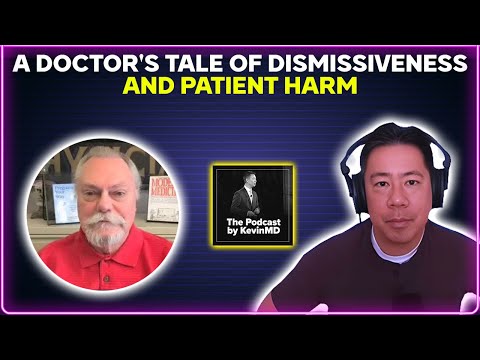
Join Alan Lindemann, an obstetrics-gynecology physician, who shares his insights and real-life experiences, shedding light on the issues surrounding patient care, medical decision-making, and the role of institutions and personal connections in shaping health care outcomes. Discover how the pursuit of quality care can sometimes be obstructed by self-interest and the need to protect reputations. Alan also proposes innovative ideas to enhance transparency and public involvement in health care quality assurance.
Alan Lindemann is an obstetrics-gynecology physician and can be reached at LindemannMD.com, doctales, and Pregnancy Your Way. Follow him on YouTube, Twitter @RuralDocAlan, Facebook, Pinterest, Instagram @ruraldocalan, and Substack. He is the author of Pregnancy Your Way: Choose a Safe and Happy Birth.
He discusses the KevinMD article, “A difficult case managed well.”

Our presenting sponsor is Nuance, a Microsoft company.
Together, Microsoft and Nuance are leveraging their rich digital technology and advanced AI capabilities to tackle some of health care’s biggest challenges. AI-driven technology promises to revolutionize patient and provider experiences with clinical documentation that writes itself.
The Nuance Dragon Ambient eXperience, or DAX for short, is a voice-enabled solution that automatically captures patient encounters securely and accurately at the point of care. DAX Copilot combines proven conversational and ambient AI with the most advanced generative AI in a mobile application that integrates directly with your existing workflows.
Physicians who use DAX have reported a 50 percent decrease in documentation time and a 70 percent reduction in feelings of burnout, and 85 percent of patients say their physician is more personable and conversational.
Discover AI-powered clinical documentation that writes itself. Visit https://nuance.com/daxinaction to see a 12-minute DAX Copilot demo.
VISIT SPONSOR → https://nuance.com/daxinaction
SUBSCRIBE TO THE PODCAST → https://kevinmd.com/podcast
RECOMMENDED BY KEVINMD → https://kevinmd.com/recommended

ADVERTISEMENT
GET CME FOR THIS EPISODE → https://earnc.me/LeUHMJ
Powered by CMEfy.
Transcript
Kevin Pho: Hi, and welcome to the show. Subscribe at KevinMD.com/podcast, and get CME for this episode by clicking on the CME link in the show notes. Today we welcome back Alan Lindemann. He’s an obstetrics-gynecology physician, he’s the author of the book “Pregnancy Your Way: Choose a Safe and Happy Birth.” Today’s KevinMD article is “A difficult case managed well.” Alan, welcome back to the show.
Alan Lindemann: Thank you much, Kevin, nice to be here.
Kevin Pho: So Alan’s been on multiple times. Go to KevinMD.com/podcast to hear his prior episodes and story. But today let’s talk about his most recent KevinMD article, titled “A difficult case managed well.” So Alan, tell us what this article is about.
Alan Lindemann: Well, Kevin, I started by toying with the idea of civil versus criminal as far as medical care goes. So I had originally chosen a patient from, it was a ProPublica, a 38-year-old woman of color who died 10 hours after her repeat C-section. I thought, well, that’s mostly civil, but it could be a little bit criminal, you know, like reckless endangerment, something like that. So my wife said, no, you can’t do that, nobody’s going to understand that.
So we just wound up doing the second piece, which is the difficult case managed well. And that, I think, you could make a criminal case for that.
So here’s the story. I returned from out of town, and that was on Sunday night, and I called to make sure that I didn’t have anybody in labor at the hospitals. And at one of the hospitals there was somebody, apparently she had called herself my patient and that’s what the nurses thought. But they said she says she’s term, but she’s small. She says her membranes are ruptured, but there’s no evidence of that.
The doctor on call had started Pitocin because of the diagnosis of term and ruptured membranes, but he didn’t go in to see her. Well, I went in to see her. She was small, and I didn’t think she had ruptured membranes, and she was not responding to the Pitocin. So I thought, OK, fine, we shut off the Pitocin, we’ll see you in the morning.
So I came back the next day, we did an ultrasound, which said she was about 24 weeks. So I sent her home. Of course, naturally, we weren’t going to induce her at 24 weeks.
But I was kind of wondering, why is she saying she’s term when she’s 24 weeks? Well, the nurses had actually coaxed this out of her. This is a pharmacy student, so she’s a lady, but she wanted to have the right boyfriend, and the boyfriend that she wanted, this would have been a term baby. So that was her goal.
Well, I sent her home. A couple hours later I got a phone call from one of the doctors there who said, you know, she’s only 24 weeks, don’t induce her. I said, well, I stopped the Pitocin, I didn’t start it, and I sent her home. I said, I don’t think you need to worry about this, you’re not going to find anybody stupid enough to induce her.
Well, I was wrong. So a few weeks later she found a group of doctors who induced her for three days, and then, because they couldn’t deliver her, did a C-section. So that would have been 26 weeks and 6 days.
So there’s all kinds of ramifications to that. In the first place, they called the baby 32 weeks, but still it was by no way term. And of course, what are you going to do with this baby? How much different is this life going to be because it was unnecessarily delivered at 26 weeks instead of at term? And of course I couldn’t tell you exactly what has happened with that child.
Well then there’s the insurance issues, the insurance fraud, because she didn’t need to be delivered. And there’s the three month extra bill in the hospital, and the unnecessary cesarean section. So there’s insurance fraud there that won’t quit.
Well anyway, this group of doctors managed to call this patient difficult case managed well, and they kept themselves out of trouble, they made the insurance pay, and everybody lived happily ever after except for the baby, and we don’t know what happened to that.
So as far as I’m concerned, this could have been a civil suit, but it also could have been a criminal suit. We have things which in medicine are very clearly criminal, like murder, the serial killers, and we have the sex offenders, which are also clearly criminal. But there are cases that are not so obvious, and this is one of them.
And it has to do with the way quality assurance works. These people were wanting not only to protect the doctors who were involved, but they wanted to protect themselves, because who wants to be practicing with a bunch of dingbats? It doesn’t look good for your whole clinic. So, the problems of quality assurance, and the way our monitoring systems do or don’t work.
Kevin Pho: Now, can you speculate some reasons why this other group of physicians wanted to induce this patient when the baby clearly was not at term?
Alan Lindemann: Well, again, she presents that way, she presents as though she’s at term with ruptured membranes. What I don’t know is why they couldn’t understand that she wasn’t term, that she was 26 weeks.
So I don’t know what they must have been thinking. But you realize three days would have included three batches of doctors, because you figure it’s a doc on deck for 24 hours, and it would have also included probably nine batches of nurses. So there was obviously something that was systemically not working there, and I couldn’t tell you what it was. I can say that that was a hospital I tended to stay away from when I was practicing there in that town.
Kevin Pho: And just to be clear, when you cared for this patient, you just had to order an ultrasound which clearly showed that she wasn’t at term, is that correct?
Alan Lindemann: Well, the first part is the examination and the history. In other words, the examination did not support her history, did not support that she was term, did not support that she had ruptured membranes. So then the ultrasound comes up and that confirms the examination.
So yeah, I don’t know why. Certainly there were people who understood what was happening, but then there was this whole group that didn’t understand.
Kevin Pho: And for those who aren’t familiar with obstetrics-gynecology, tell us the difference six weeks makes when it comes to the health of the infant.
Alan Lindemann: Well, of course, Kevin, it depends on which six weeks you’re talking about. But if you’re talking about 26 weeks and six days versus, say, 32 weeks, that’s quite a difference. You go from a difficult postpartum or postnatal course to one that is a fairly good one.
And the problem here is not whether the baby survives, because it probably can, but the point is how it survives, and that’s what you’re getting at. So this baby may have breathing trouble, like asthma, might have COPD, it might have chronic lung problems. It could have trouble thinking, it could have trouble with the rest of its nervous system, it could have cerebral palsy. So the problems with its life and its course are complex and many.
Kevin Pho: So what happened next in the story, when you discovered that this patient was induced by this other group? What did you do next, what was your reaction?
Alan Lindemann: Well, all I could do is nothing. I didn’t report it to the police, I didn’t go to the insurance company, mainly because it would have been one word, mine, versus five, six of them. So it wouldn’t have gone any place.
All you need to do for quality assurance, even if this went to the state medical association, the state board, all they would need to do is say, good case managed well. So it would have gone nowhere. Most big clinics do have representation on medical boards, and precisely for that reason, so that they manipulate the outcomes of these investigations.
Kevin Pho: And again, I’m going to ask you to speculate. In cases like this, was there anything intentional, was it just simply an oversight? What were some reasons why this type of medical decision making takes place?
Alan Lindemann: Well, I was thinking about that this morning again, and after 20 years I still think about this case, obviously. But I don’t think they set out intentionally to cause harm. In other words, this is not murder, this is not even attempted murder. You might make a case for reckless endangerment, probably would not get manslaughter to stick.
But what is happening here is a complete lack of reasonable and mature judgment. There’s no reason in the world they shouldn’t have been able to figure this out, just like I could figure it out, or the other doctors at the other hospital could figure it out. So what went wrong there, I couldn’t say, except that it didn’t really surprise me coming from this group.
Kevin Pho: And to your knowledge, were there any repercussions stemming from this case?
Alan Lindemann: No, I think they’ve all gone on to bigger and better things, living happily ever after. Except of course for the baby. And the mother, I think that’s the one thing that happened the right way, she did not get that child, she did not go home with that baby, she was not given custody of that child. So that part seemed to work OK. So somewhere along the line there was a recognition by somebody of some damage. But as far as I know, the baby was adopted or placed for adoption.
Kevin Pho: Now, through your career as an obstetrics-gynecology physician, how often do these instances happen?
Alan Lindemann: Well, this of course is an extreme, and that’s one of the reasons I started out doing it. Like I said, I wanted to do a mirror image, a civil with maybe possibly criminal, and then one that was mainly criminal and possibly maybe a little bit civil.
So the problem here is that this is a continuum, and it’s not black and white, it’s shades of gray. And you know that about medicine, there’s a lot of judgment calls.
But the fertile ground, or where most of these instances are going to wind up, or going to lie, is in the middle. In other words, for example, something that is fairly common, and I read about it on ProPublica and we’ve talked about this before, it had to do with two women, and they happened to be women of color. They went to labor and delivery. The one went three times complaining of not enough movement. When she went the fourth time, the baby was dead. And the doctor said, you should have come in sooner. So, insult to injury.
So those are examples of cases that are in the middle. In other words, it’s a civil thing, but it really should never have happened. And it brings up the problem, and it is a big problem that we have today, of dismissiveness.
And dismissiveness, for your audience, really starts with bias. And the bias is that you’re not really sick, the thing that you’re talking about doesn’t exist, you’re imagining this. And that’s basically what they told these women when they came in, you just don’t know how to monitor your baby.
So this is where I think most of these cases will be, is not totally civil and not criminal, but somewhere in the middle.
Kevin Pho: Now, for the physicians who are listening to you in this case, if they encounter a similar situation, what kind of advice do you have for them?
Alan Lindemann: Well, this is really, because in this video and in the one before, we talked about quality assurance that really doesn’t work. And it all depends on who is the offender and who are the judges.
If I were to take this case to the board, it probably would have turned out to be, good case managed well. So I wouldn’t have gotten anywhere. And I would say that there’s a great likelihood of this happening this way to other doctors.
The other thing is, if one of these doctors at this hospital had decided to call the police, the sheriff, the board, whatever, they probably would have lost their jobs. So there are very significant downsides to reporting, and that’s what most of us would be afraid of, is what would the repercussions be.
The other thing is, we understand, at least most of us do, that our feet are made of clay, we are all going to be vulnerable at one time or another. So it’s kind of a give and take, this is a favor for you but I’ll expect one in return. But you don’t want to be hanging out there by yourself, you don’t want to be pushing too far against odds.
Kevin Pho: We’re talking to Alan Lindemann. He’s an obstetrics-gynecology physician, author of the book “Pregnancy Your Way: Choose a Safe and Happy Birth.” Today’s KevinMD article is “A difficult case managed well.” Alan, we’ll end off as always with some of your take-home messages to the KevinMD audience.
Alan Lindemann: Well, thank you, Kevin, so much. We spent a lot of time talking about dismissiveness today, and dismissiveness is a real big problem. And I’ve written a little bit about what can patients do if they are dealt with dismissiveness.
And let’s just take the example of the moms who went to labor and delivery with their concerns about not enough movement and are told to go home, they’re imagining things. So what can that person do? Well, several things. Make sure your doctor knows. When you go to a clinic, you should have a phone number that you can call 24 hours a day, anytime, and get to talk to somebody. So try calling your doctor. If that doesn’t work, you can always try going to a different hospital.
But one thing that should happen when you go to see your doctor for the first time, and I’ve always done this, there’s something called a kick test. So I always explained this to moms, they can do it every day because it costs not a nickel. You lie on your left side, and it’s the second half hour after you’re done eating. For example, if you’re done eating at noon, start at 12:30 and go to 1:00. You should get 10 movements. And, this is one movement, that’s two movements, and I explain all of that to the patients.
Most of them can get 10 movements in 10 minutes, but it’s a nice way to quantitate, and a nice way so that you can actually explain that to your doctor, you can explain that to your nurses, and then they should listen to you. If they don’t listen to you after that, you really need to find somebody else.
Kevin Pho: Alan, once again, thank you so much for sharing your story, time, and insight, and thanks again for coming back on the show.
Alan Lindemann: Thank you so much, Kevin. It is my pleasure, I always enjoy being here.