Only 33 percent of patients who use herbs or supplements disclose their use to health care providers, often viewing them as natural and therefore harmless. Targeted history-taking is the ultimate line of defense for ruling in or out herbal/dietary supplement-induced liver injury (HILI) and broader supplement toxicity, including herb-drug interactions.
Clinicians must look beyond standard prescription lists and systematically audit everything a patient ingests. Asking a few high-yield questions during history-taking facilitates correct diagnosis, thereby saving time and energy.
The “food” vs. “supplement” semantic trap
The most common reason clinicians miss supplement-induced toxicity is simple: Patients do not consider what they take to be “medicine” or even “supplements.” As discussed in Article 1, regulatory frameworks differ dramatically across international borders. What one country classifies as a tightly regulated “dietary supplement” or “herbal medicine,” another treats as standard “food,” a “functional food or beverage,” or a “nutraceutical.”
Real physician voices, twice a week
Free, and one click to unsubscribe.
When a physician asks, “What supplements or over-the-counter medications are you taking?” patients often omit a vast array of high-risk ingestibles because they categorize them as daily nourishment or fitness and wellness foods. If you only ask for “supplements,” you will miss the protein powder containing hidden garcinia, the daily “wellness tea” containing hepatotoxic substances, or the imported “functional snack” packed with heavy metals.
Common examples missing from standard medication histories
- Functional beverages and herbal teas: “Detox” teas, daily matcha blends, or “immunity-boosting” botanical blends. Patients view these as routine drinks, yet concentrated green tea extracts (high-dose epigallocatechin gallate [EGCG]) and botanical blends, which are often unlisted or unverified, can lead to acute hepatocellular injury.
- Weight loss and meal replacements, sports, and bodybuilding protein supplements: Whey, soy, or plant-based protein powders frequently contain added adaptogens, such as ashwagandha, and metabolic boosters, such as garcinia cambogia. These botanicals are subject to economically motivated adulteration (EMA) and can be contaminated with heavy metals and unlisted botanicals or different plant parts. While direct causation has not been established, weight-loss supplements containing garcinia cambogia have been recalled by the Food and Drug Administration (FDA) a few times following multiple hepatotoxicity cases.
- Nutraceutical “superfood” powders: Greens powders, mushroom elixirs (reishi, cordyceps), and anti-inflammatory golden milk blends (turmeric/curcumin paired with piperine bio-enhancers).
- Fortified and functional foods: Energy bars, oils, vitamin-infused waters, or functional jellies purchased at international specialty markets that blur the line between snack and therapeutic dose.
The step-by-step clinical assessment and history-taking workflow
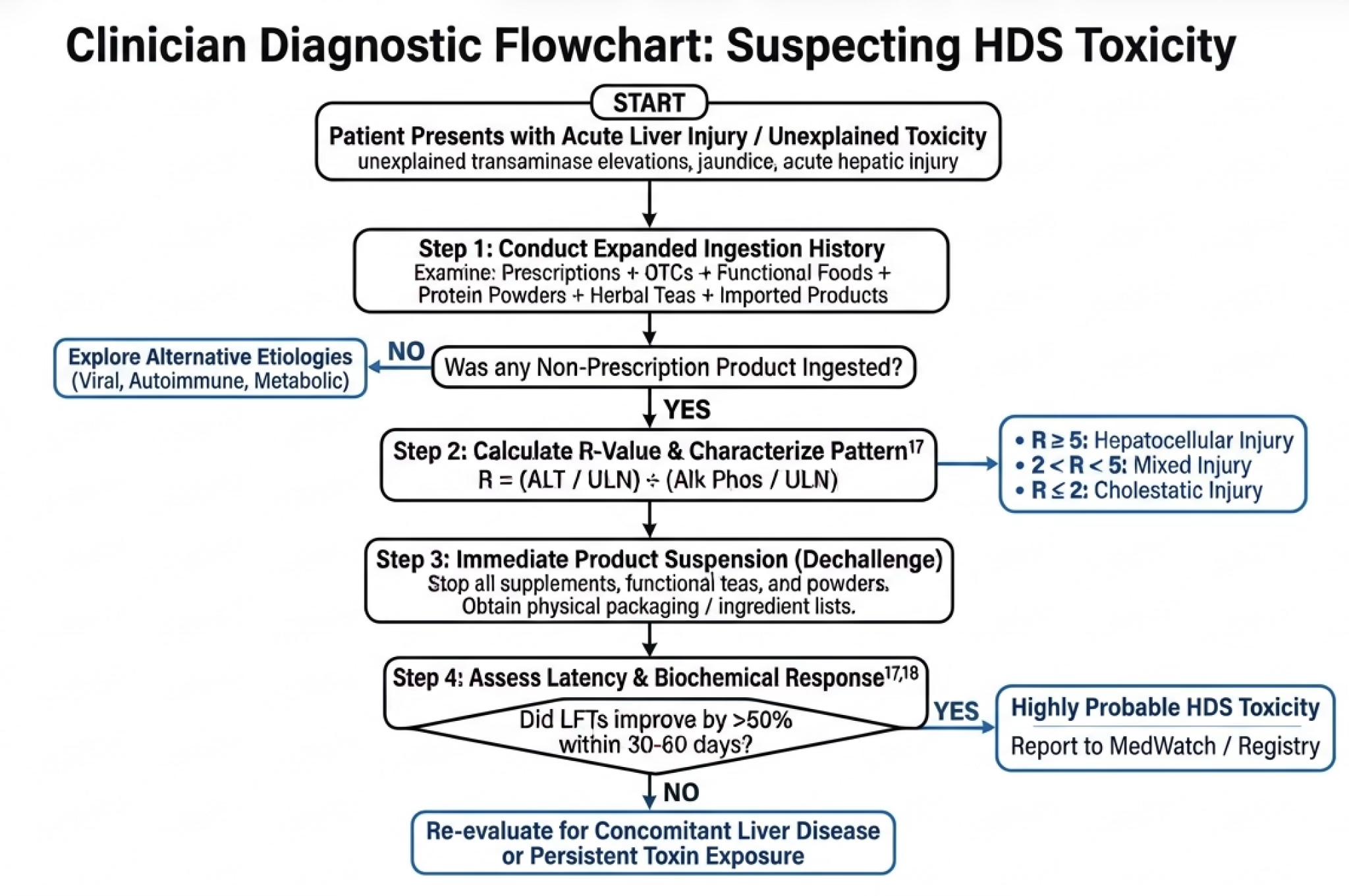
To systematically rule in or out supplement-induced toxicity, follow this structured four-step diagnostic sequence:
1. Broad ingestion inventory
Expand questioning beyond pharmaceuticals and vitamins. Ask patients directly about foods, drinks, powders, and international products:
- “Do you consume any energy drinks, protein or greens powders, or daily wellness teas?”
- “Do you take any traditional remedies, imported health foods, or functional snacks?”
- “Have you taken any foods, drinks, powders, teas, oils, or supplements over the last year?”
- “Have you ever experienced symptoms such as stomach pain, fatigue, dark urine, or yellowing of the skin or eyes while taking these supplements?”
- Instruct the patient or family members to bring physical containers or photos of the full ingredient and facts panels to the clinic.
2. High-risk ingredient screening
- High-risk botanicals: Check the label for documented hepatotoxic agents and ingredients with a high risk of adulteration. Look for green tea extract (concentrated EGCG), ashwagandha (Withania somnifera), garcinia cambogia, fo-ti (Polygonum multiflorum), kava (Piper methysticum), and high-dose turmeric formulations.
- Multi-ingredient formulas: Especially beware of weight-loss, bodybuilding, or “fat-burner” products, which account for the majority of severe supplement-induced liver injuries in North America.
3. Supply chain and label verification
- Inspect the physical label: Check for regulatory loopholes and traceability gaps. If the patient can’t provide physical packaging, search for the supplement’s brand or name and find a packaging image. Check the fine print below the Supplement Facts panel. Look at the country-of-origin phrasing. If the packaging only states “Distributed by” or “Made in,” origin transparency is zero.
- Proprietary blend check: See if active ingredients are hidden behind a total blend weight, masking toxic doses or unlisted fillers. While FDA regulations mandate that the total weight of the blend be stated and that sub-ingredients be listed in descending order of predominance by weight, manufacturers don’t have to disclose the specific quantitative dose of any individual component. For example, a patient taking an “energy blend” may unknowingly ingest massive, toxic doses of concentrated green tea extract (EGCG), synthetic caffeine, or garcinia cambogia. Because the label only lists a single combined milligram total, calculating exact daily phytochemical exposure or toxicological reconciliation is impossible.
- Instruct patients: Especially those with pre-existing liver disease, renal impairment, or complex medication regimens, to avoid products with proprietary blends entirely. Advise them to choose single-ingredient supplements or transparent formulas that list the exact milligram amount of every active ingredient.
- Evaluate order of predominance: Check which ingredients appear first (highest weight) versus last (lowest weight). If a high-risk botanical like green tea extract, kava, or garcinia appears as the first or second item in a large blend weight (>1,000 mg), treat it as a high-dose exposure.
- Identify unlisted “bio-enhancers”: Look for piperine (black pepper extract/BioPerine) at the bottom of a proprietary blend. Piperine inhibits intestinal P-glycoprotein and hepatic CYP3A4 to boost botanical absorption. When hidden in a proprietary blend with hepatotoxic herbs, it can dramatically amplify systemic toxic exposure.
4. Temporal mapping and dechallenge
- Latency: Establish causation using clinical timelines. Map the time between product initiation or dose increase and symptom onset or liver enzyme elevation, typically ranging from 5 days to 3 months.
- Dechallenge: Immediately suspend all nonessential supplements, functional beverages, and fortified food products.
- Monitoring: Track liver function tests (ALT, AST, bilirubin, and alkaline phosphatase) weekly. A drop in transaminases of more than 50 percent within 30 to 60 days strongly supports herbs and dietary supplements (HDS) causality.
Alisa Sano is a public health auditor.