“As a witness to so much sadness and pain, how do you keep from getting depressed?” As an internal medicine doctor, I have heard versions of this question for decades. And, despite a myriad of changes in my career, my answer has never wavered. And while there are many comedians and funny things, one particular evening more than any other reveals how humor is my personal wellspring, the one that keeps me evergreen.
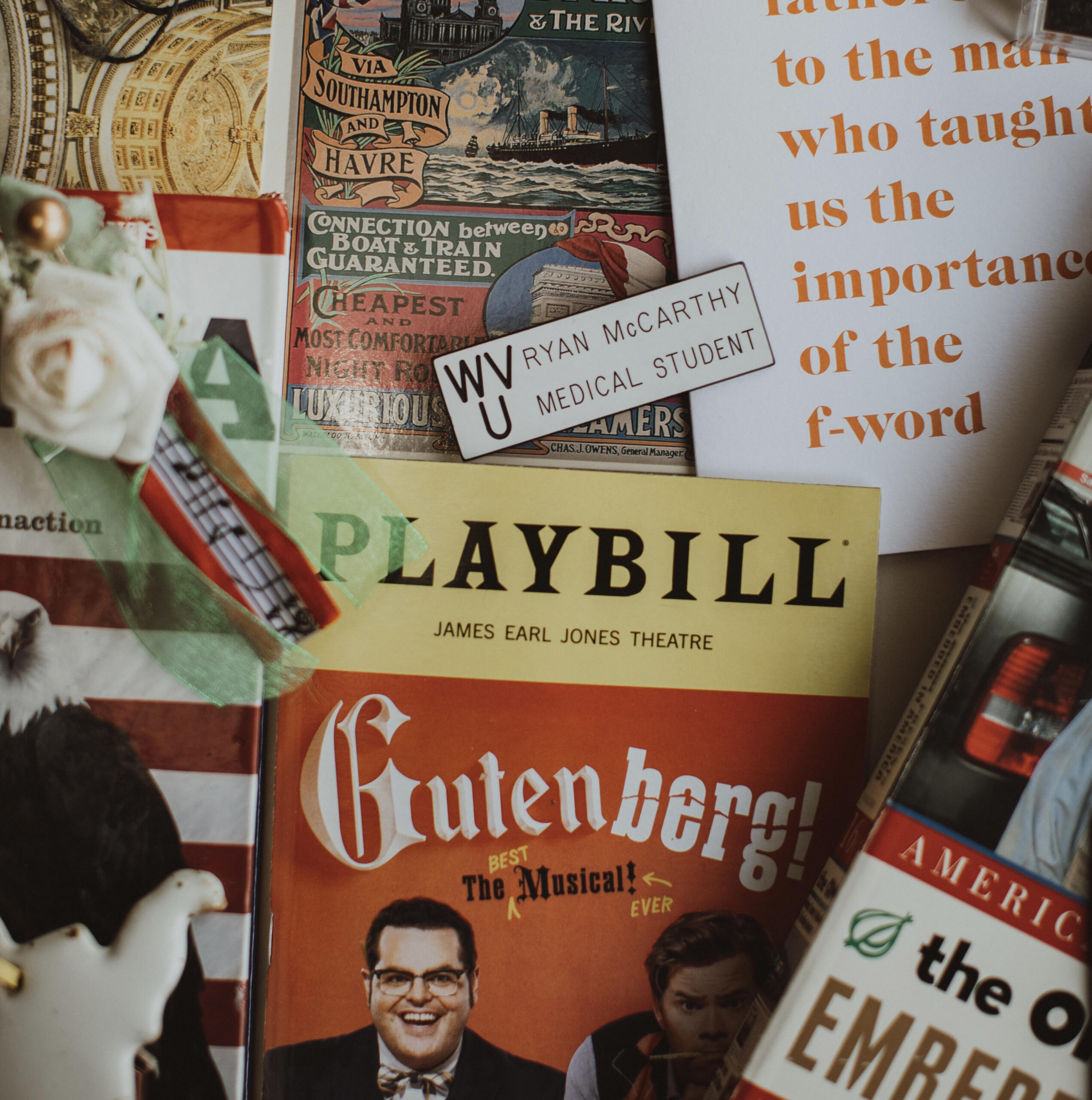
“There is a limited run of shows at Christmas, we should take the kids to see Gutenberg! The Musical!” And with these words, in November 2023, my wife Erica set our family on course to see Josh Gad and Andrew Rannells perform this two-man show. The kids were distracted, but she had my full attention. A decade prior, in November 2013, Josh Gad first twirled into my peripheral vision in Disney’s Frozen, a movie in which I shared a bucket of buttery popcorn with grandparents and kids in a crowded theater. Gad’s Olaf, a partially self-aware snowman, stole the show. “Imagine how much cooler I’ll be in summer!” was so insane and this bon vivant brought mirth to what was otherwise a dark and cold cartoon. As for the movie’s banger, “Let It Go,” I wonder if this singing snowman wrote it for Elsa with the hope, for everyone in Arendelle, she would get over herself.
I loved Gad’s 2011 performance in the original Broadway cast recording of The Book of Mormon, in the role of dimwitted missionary Elder Cunningham. Mormon was intellectual rigor soaked in profanity, the batshit kind that Matt Stone and Trey Parker pioneered with South Park, which debuted on Comedy Central in August 1997. Andrew Rannells also starred in Mormon, playing the straight-laced counterpoint to Gad, Elder Kevin Price, and earned a Tony nomination for his efforts. And while Mormon was crazy-funny, it merely hinted at what these artists could achieve if given free reign.
The unexpected brilliance of Gutenberg
As Gutenberg approached, I said to my kids, “I want to experience it all at once,” and remained ignorant of the characters and plot. And, despite my comedy-lover resume, as I sat in the sold-out James Earl Jones Theatre, one that vibrated with excitement, I was not prepared for what followed. When the lights dimmed, Gad and Rannells approached the stage’s edge, and introduced themselves as best friends Bud Davenport (Gad) and Doug Simon (Rannells). They explained that they wrote a musical together, noting “We did some research, Google!, and printed the first thing that came out.” They discovered that records of Johan Gutenberg’s life and work were “scant,” so they wrote a piece of “historical fiction, fiction that is true.” I laugh.
Real physician voices, twice a week
Free, and one click to unsubscribe.
When the curtain opens on act one we find ourselves in a “squalid and stinky bedroom” in the town of Schlimmer, Germany. We are confronted by a baby, recently dead because its illiterate mother gave it “jelly beans instead of medicine.” A pathetic doctor laments, “But only if you could read!” shrugs his shoulders, and exits. We are laughing hard. Schlimmer’s townspeople, including a racist flower girl and a variety of drunks, pour onto the street. Davenport and Simon play all of these characters, without costumes, donning a series of trucker hats: WOMAN, DOCTOR, DRUNK#1, FRIEND, DEAD BABY, and GUTENBERG. Rannells and Gad seamlessly speak and sing, often both sides of the same conversation. There are no props or sets, but I am all in. I cannot stop laughing.
We next meet Gutenberg, the town wine maker, and a young maiden, Helvetica Gumestieffel, who is smitten with him, “though he does not know it.”
“I love ewe,” says Gutenberg.
“Me!?” replies an enthralled Helvetica.
“No, ‘ewe,’ E-W-E, ‘ewe.’ As in, female lamb stew.”
This awkward exchange is followed by the riotously funny song “I Can’t Read” and Helvetica is embarrassed “Cause I am too obtuse. I’m too dumb to understand anything but this grape juice.” Enter Evil Monk, a clergyman who huffs and broods his way through “Haunted German Wood,” a tune in which he acknowledges a deal he made with Satan. Gad breathlessly employs a wide array of voices, so much so that, at one point, he gasps and says to the audience, “I need my inhaler!” He produces one from a pocket and, as the crowd roars, he takes a puff, and continues singing. A cheering, clapping theater drowns out whatever the final lyrics are. We are now laughing at malevolent preachers. And asthma.
When applause dies down, Gutenberg declares, “Schlimmer must read!… gonna take this press and make it print some words!” and builds a printing press late into the night, singing to a “boogie-woogie beat.” Meanwhile, Young Monk walks in the rain, reprising the “I can’t read” motif, a call-back that is both musically and literally funny. He bemoans his horrible job and expresses his pain at being stabbed in the face with a pencil, again!, one thrown by Evil Monk. We laugh at this too, the horrible people that we are.
The relentless pace of comedic genius
Songs and gags are set up and delivered so fast that it is difficult, impossible, to digest them all. Bootblack and Young Monk sing “Biscuits,” a ridiculous “charm song” that has no relevance to the show, but one that Bud and Doug hope a famous actor will sing “when our show goes on Broadway.”
“Maybe Timothee Chalamet,” say Bud.
“And that’s not how I thought you pronounced either of those words,” a deadpan Doug says to the audience who lose it once again.
We are sent “rocking to restrooms” when “Tomorrow Is Tonight” closes act one. The fact that the lyrics do not, actually, make sense does not negate how it cleverly channels the earnest “Tomorrow” from Annie and the immediacy of “Tonight” from West Side Story. A standing ovation leads us to intermission followed by whooping and cheering. I find myself laughing with complete strangers as I try to use a urinal as jokes and gags are shared in the toilet, which is, by itself, hilarious. I can hardly process the easter eggs and homages to countless other Broadway shows as I feebly wash my hands.
Act two starts “so early that the dirty streets are covered with yesterday’s vegetables.” Bootblack and Daughter compare their disturbing dreams and, in hers, “Gutenberg becomes an eagle and attacks a seagull.” In Bootblack’s dream ” the seagull had a knife,” an ominous development for Gutenberg and, somehow, birds holding daggers is completely normal. In “Words, Words, Words,” Gutenberg sings “Words are like wine from a better grape / I’m going to get drunk on words.” He dances with Helvetica and, while under the influence tells her “I love you. Y-O-U. Oh that’s right, you can’t read.”
Meanwhile, Evil Monk is “having way too much fun” taking confession from the racist flower girl before telling Helvetica, who is ashamed at being tricked into smashing Gutenberg’s printing press, that “The Bible says there are no second chances.”
“It does?”
“Yeah, at the end.”
This scene segues into “Monk With Me,” and Evil Monk whispers to the audience, “Maybe he doesn’t know the printing press has been destroyed!” as he tries to coax Gutenberg to the dark side. Gutenberg refuses and finally shouts, “Monk, you believe in God. And I believe in stuff. And God and stuff they don’t mix, like bugs and beautiful skin.”
“It’s better that the people can’t read!” Retorts Evil Monk. “Where do you think people go when they die?”
“Most people turn into dirt, but some turn into statues.”
Our pure-hearted Gutenberg is undaunted, “When I die, I want my statue to be me riding a dragon, and nursing a baby!”
Finding joy in the absurdity of it all
Evil Monk locks Helvetica in a castle, where, having betrayed Gutenberg, she (Rannells) sings “(Might as Well) Go to Hell”:
I’m in a tower with rats and some feces
And the man I adore is so close
And yet so far
If he were here
I would say “don’t release me”
My heart is one big scar
‘Cause I’m the stupid German wench
Who betrayed ‘ya, baby
Before the chorus, Gad dons a hat that says RATS and sings “might as well go to hell” in falsetto, alternating with Helvetica, who sings “Come and get me Satan!” I am crying. Helvetica continues:
So maybe I oughta drown
Or put my body in the ground
Cause I let everybody down
I’m just a crying clown
Wearing a painted frown
I hear a scary sound
It’s a three-headed hound!
Downed with a round brown crown
In hand!
This could easily have been the finale but the scene quickly transitioned to the next morning, the day of the town festival. Gutenberg, unaware that his printing press has been destroyed, laments to the racist flower girl, “It upsets me to see my townspeople acting this way, before you know it we could be in the middle of a second world war.” I am laughing as a melee ensues, one where the “townspeople collect wood and burn Gutenberg alive.”
The stage abruptly goes dark and, despite this somber turn, the audience tries, unsuccessfully, to stop laughing. After prolonged silence, Doug and Bud appear in individual spotlights and slowly narrate, “The cast join hands and address the audience.” They provide voices for a host of townspeople.
“Gutenberg’s dream of universal literacy is still not achieved.”
“Statistics tell us that more than half the people in this room can’t read.”
“And we’re not just talking about children and blind people.”
“That’s why the story of Gunteberg is an inspiration to us all.”
Laughter erupts and, even though Johann Gutenberg never invented the printing press, Bud and Doug share their belief that Gutenberg did not fail. “We have written ourselves into the end of this show because, like Gunteberg, we have dreams.” The piano play a soft and delicate melody. “We all want to eat dreams, don’t we?” Doug and Bud wrap us in harmony and the audience is silent and motionless for the very first time. This sweet and still moment is swept away as Doug and Bud invite the audience into a call-and-response singalong.
“We eat dreams. We eat dreams,” Doug and Bud.
“We eat them too,” audience.
We sang chorus after chorus, each one higher than the previous, and, momentarily, our singing seemed like it would go on forever. Our voices echoed off the rafters, fully satiated from this epic buffet of comic artistry. Gad and Rannells brought it all to an end with a bow and walked off a stage, one littered with discarded hats, and I tried to process the physical gags, clever lyrics, cartoon voices, and operatic singing, all performed by ridiculous characters doing ill-advised actions. I was so pummeled by this laughter orgasm that I did not, could not, contemplate anything other than the warm waves of dopamine that pulsated in my brain. Oxytocin oozed through my blood and left my hair standing on end. People around me appeared to be in the same haze, each of us silently asking each other with our eyebrows, was it good for you too?
I had no idea at that moment that Gutenberg had become a core memory, one that redefined comedy in my brain and body. I could not have thought, dreamed?, that these lyrics, songs, and memories of Gad and Rannells wearing DRUNK#1 and RATS hats would travel with me in the future days, weeks, and years of my life. I had no knowledge as I walked up the aisle of the James Earl Jones Theatre the magnitude of this gift. Gutenberg created so much joy inside my body that, to this day, I can tap into its effects in a way that no performance has done before, or since. On the hardest days, internal medicine makes me sad and tempts me to quit or harden my heart. And when it does, I take a trip back to Schlimmer, Germany, a squalid and smelly place, home to the funniest thing I ever saw.
This article is part of an ongoing series featuring the photography of Molly Humphreys. Find hundreds of her photos on Healthcare is Human social media.
Ryan McCarthy is an internal medicine physician.