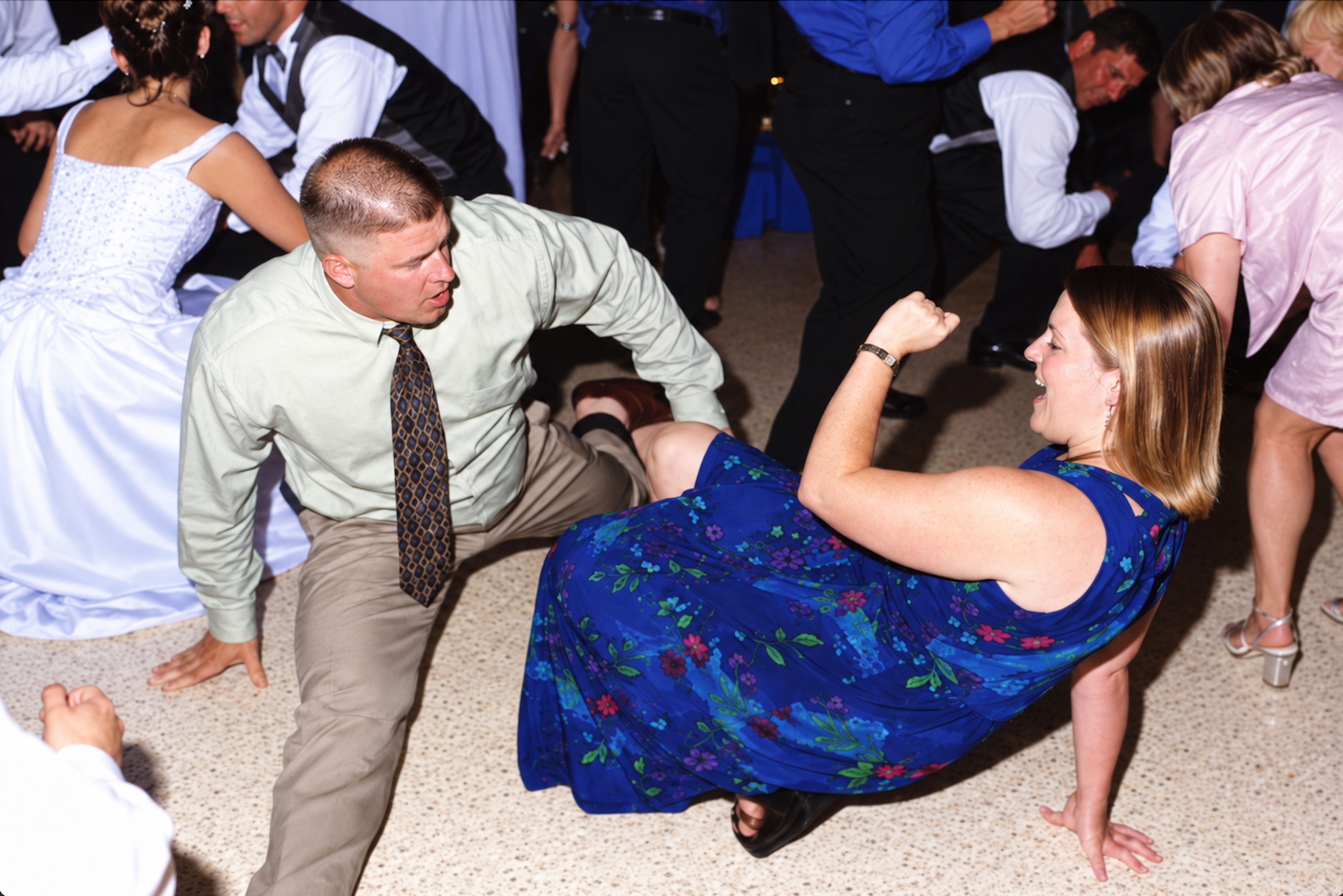
The author and his wife, at a time when getting off the floor required considerably less planning.
People ask what being an emergency physician is like, and they expect the blood, the saves, the codes, the worst nights. Those happen, and they matter, but I try not to carry those home. What I try to keep is the people. You meet everyone in this job: young, old, good, evil, happy, grieving; we see them all. And every so often, one of them dances right into your chest and stays.
You don’t get to sit down in the emergency department. Not really. You move, you chart, you move again, and then the shift is over and you couldn’t tell anyone what happened in the middle of it. So I remember the slow ones the way you remember a held breath.
I was working in a big community hospital, in a city that had spent a decade losing: factories, jobs, people, all of it. A busy place, usually. But that evening was blessedly quiet, and I got to do the thing the job almost never allows. I sat.
There was a couple in one of the rooms, both a whisker short of a hundred. Nothing serious, the kind of visit that’s really just a checkup with a bracelet on. So I pulled up a stool and I talked to them, the way you can’t when the board is full.
They’d met at a USO dance during the war. He told it proudly: She’d thought he looked good in his uniform.
She corrected him, gently, the way you correct someone you’ve been correcting happily for seventy years. It wasn’t the uniform, she said. It was that he could really dance.
I could have listened to them all night. But the phone rang. It was a firefighter I knew from the local crews, stuck on light duty with a turned ankle and working the 911 call-taker’s desk. He was calling the doctor’s line with a heads-up, not a true patient report. A father half a mile away had a child in the middle of an allergic reaction and no epinephrine in the house. When he was told the closest ambulance was ten minutes out, the man did the math and told the firefighter he was running our way instead of waiting.
The ambulance bay at this hospital opens right into the department. The public entrance, on the other hand, is two hundred yards the other way, through the minor-emergency area. So I went to the front, and I got there just as a man came through the entryway carrying the grayest child I have ever seen.
I took the kid out of his arms and ran.
There are two things I never do in the emergency department. I don’t run and I don’t yell. At that moment I did both, screaming for help as I bolted for the main ED. I laid the child in the first open bed, which happened to be next to the old couple’s room, and started CPR.
Someone rolled up a crash cart. It had epinephrine on it, but the wrong kind: the dilute version we use in cardiac arrest, ten times the volume of the concentrated dose that’s supposed to go into a muscle. The right concentration was locked in a machine down the hall. Minutes away. The child did not have minutes.
So I did the arithmetic out loud, to nobody, and used the code epi to inject the equivalent dose into the thigh (3 milliliters instead of the tiny volume we’d normally use) while a tech took over compressions and a nurse chased a vein. One and two, and one and two. I have counted that cadence over a thousand chests. I counted it over this one and said a silent prayer.

ADVERTISEMENT
The minute that followed was among the longest of my life. And then the gray went out of the child’s face like a tide going back out, and the small chest rose on its own, and it kept going. By the time the usual IM epinephrine arrived, the kid was already coming back. Fluids. Monitoring. High-fives all around. A whole room of people who had, for a moment, forgotten to breathe were breathing again. Our patient was already wondering aloud what all the fuss was about.
I went back to my workstation to start the calls to transfer the kid to a hospital with a pediatric ICU. I keep music going at my station, low, most of the day. But some days call for a victory song, and mine has always been the same gloriously undignified one. I turned it up. Notorious B.I.G. came pouring out of my phone, “Big Poppa,” far louder than a hospital has any business allowing.
And the old man came dancing out of his wife’s room.
He was pushing a hundred years old and he came out of that doorway like a teenager who’d heard his song come on at the club. Right up next to my tech, grinning, hips going, having the time of his life a full lifetime after that USO dance. His wife watched him from her bed with a look I don’t have the words for.
She’d told me he could dance. She was not exaggerating.
That’s the part I carry home. Not the sprint, not the save. Those fade. What stays is a man who danced for a girl at a USO hall in the middle of a world war, married her, loved her, and could still cut loose in a hospital hallway nearly three-quarters of a century later because the right song came on at the right ridiculous moment.
People ask why I stay.
He could really dance.
Howie Mell is a board-certified emergency medicine and emergency medical services (EMS) physician licensed in six states. Before he ever put on a white coat, he ran calls as a firefighter/paramedic in the Chicago suburbs, where he learned that medicine happens at the worst moment of someone’s life, and that showing up matters. He earned his MPH at the University of Illinois Chicago (UIC) School of Public Health and his MD at UIC Rockford, and completed his emergency medicine residency at Mayo Clinic.
He has served the American College of Emergency Physicians (ACEP) as a national spokesperson and as past president of its Illinois chapter. He is a frequent guest on emergency medicine podcasts and lectures on the specialty throughout the U.S. He practices in the Midwest, but home base is North Carolina.
A husband and dad of four, he writes about the front line: the patients, the systems, and the moments that never make the chart. Some of his patients never went home; he tries to tell their stories the way they deserve. His research publications are collected on Google Scholar, and he shares updates on LinkedIn, Instagram, and Facebook.