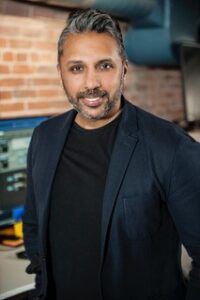
Danny Goel is a practicing orthopedic shoulder surgeon and the CEO and cofounder of PrecisionOS Technology, a Vancouver-based AI immersive medical education company he founded in 2017.
He earned his MD and a master's degree in cell physiology from the University of Manitoba, completed his orthopedic surgery residency at the University of Calgary, and pursued shoulder fellowships at Western University and Harvard Medical School. He later added advanced training in complex shoulder tendon transfers at the Mayo Clinic and an MBA from the Rotman School of Management at the University of Toronto.
A clinical professor in the arthroscopy division of the department of orthopedics at the University of British Columbia, Goel holds hospital privileges at Burnaby General and St. Paul's, and he is a Fellow of the Royal College of Physicians and Surgeons of Canada. His research focuses on surgical education and skill acquisition, using virtual reality to close the gap between traditional training and real-world surgical competence.
His scholarship spans immersive virtual reality and AI in orthopedic surgical training, shoulder and elbow arthroplasty outcomes, and cardiovascular physiology, with work appearing in JAMA Network Open, the Journal of Bone and Joint Surgery, and the Journal of Shoulder and Elbow Surgery. He shares updates on Instagram and LinkedIn.
Every conversation about the surgical backlog focuses on the same fix: more OR time, more staff, more beds. That’s necessary, but it treats the bottleneck as a capacity problem. A second bottleneck nobody’s pricing in is how long it takes to produce a surgeon who can operate independently, and that number is quietly getting longer. Cuts in one place always show up in another, and it’s often education that takes …
Read more…
In 2026, the surgical backlog has a training bottleneck


















