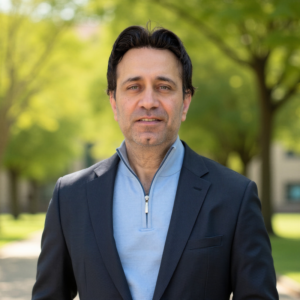
Sanjeev Sharma is chief medical officer of UpRight Science. He earned his undergraduate and medical degrees from Ontario's McMaster University and completed his postgraduate medical training at University of Toronto. He then spent nearly two decades as a physician specializing in emergency medicine at North York General Hospital, Trillium Health Partners, and the William Osler Health System. But he came to realize that business skills would be needed to make the kinds of changes he thought the combination of technology and medicine would require, so he returned to school and earned an MBA from Wilfrid Laurier University.
With his brother, Sunil, he founded Wellpoint, an occupational health services company. After a successful exit, he was a founder of Highmark, the company that developed the FDA-cleared Software as a Medical Device balance technology that UpRight Science is bringing to market. His goal is to use that technology's ability to collect neurological data to make balance a key physiological marker that guides medical treatment.
The company's work reaches beyond the clinical setting to StayUpRight!, a free app from UpRight Science that gives everyday users a window into their own balance health and a powerful introduction to what the company's medical technology makes possible. With fall-related deaths among adults 65 and older rising sharply over the past two decades, it is the mission of UpRight Science to flatten that curve with technology that is simple, scalable, and scientifically sound. He shares updates on LinkedIn.
Physicians routinely track measures that can reveal changes in a patient’s health long before those changes become symptomatic. Blood pressure, heart rate, weight, and other familiar measures have earned a place in clinical care because following them over time provides information that can guide intervention. For an aging population, balance deserves similar attention because it can reveal changes in functional health before they result in injury or loss of independence.
Balance …
Read more…
Balance as a vital sign: 4 reasons to track it routinely