A primary criticism of the Affordable Care Act is that it creates incentives for employers to hire fewer full-time employees. One of the House’s attempts to repeal the ACA even referenced it as the “job-killing healthcare law.” It’s true that…
A primary criticism of the Affordable Care Act is that it creates incentives for employers to hire fewer full-time employees. One of the House’s attempts to repeal the ACA even referenced it as the “job-killing healthcare law.” It’s true that there are some provisions in the ACA that employers may exploit in order to minimize the cost of doing business.
At the same time, it’s also true that the ACA protects …
Two decades ago, a decision was made by Medicare policymakers that carotid endarterectomies would not be allowed. Their claim was too many were being done costing Medicare money. The following year, data revealed a sharp rise in debilitating strokes, so…
Two decades ago, a decision was made by Medicare policymakers that carotid endarterectomies would not be allowed. Their claim was too many were being done costing Medicare money. The following year, data revealed a sharp rise in debilitating strokes, so wisely, surgical criteria was developed recommencing the use of this quality-of-life saving operation.
For years, there have been other misjudgments against Medicare patients that are only now becoming apparent. Let me clarify …
Certain medical stories are irresistible to the popular press: ICD-10 external cause codes that are ridiculous (W61.43XD, pecked by a turkey, subsequent encounter) or medical practices using their electronic health records in a way that increases their revenue. A recent…
Certain medical stories are irresistible to the popular press: ICD-10 external cause codes that are ridiculous (W61.43XD, pecked by a turkey, subsequent encounter) or medical practices using their electronic health records in a way that increases their revenue.
Recently, another installment was published from the research team of the Oregon Health Insurance Experiment. The major finding -- Medicaid coverage results in a 40% increase in emergency department (ER) use. Many of the health care pundits quickly sifted through…
Recently, another installment was published from the research team of the Oregon Health Insurance Experiment. The major finding — Medicaid coverage results in a 40% increase in emergency department (ER) use. Many of the health care pundits quickly sifted through the scientific results to support their opinions.
While the Affordable Care Act, or Obamacare, has been criticized by its opposition as “socialized medicine,” it relies heavily on private health insurance. On the other end of the political spectrum is the idea that a government-run single payer system,…
While the Affordable Care Act, or Obamacare, has been criticized by its opposition as “socialized medicine,” it relies heavily on private health insurance. On the other end of the political spectrum is the idea that a government-run single payer system, similar to Canada’s, is the best way to deliver health care. (This is sometimes shorthanded in the U.S. as “Medicare for All.”) However, this system has been believed politically impossible …
There is a dark cloud of discouragement, dejection, disheartenment, and all other synonyms of despair, hanging over the medical profession. It’s not that all physicians live in constant gloom and doom, although quite a few do, particularly those still in…
There is a dark cloud of discouragement, dejection, disheartenment, and all other synonyms of despair, hanging over the medical profession. It’s not that all physicians live in constant gloom and doom, although quite a few do, particularly those still in private practice, but the profession itself seems to be losing its luster.
Some doctors seem content to pragmatically adapt to the new and duller definition of their old profession, but in …
Here we go again. There is yet another round of evidence of how the physician workforce hole we’ve dug for ourselves keeps getting deeper, but there has been still no substantive payment reform on the government side (Medicare/Medicaid) or the…
Here we go again. There is yet another round of evidence of how the physician workforce hole we’ve dug for ourselves keeps getting deeper, but there has been still no substantive payment reform on the government side (Medicare/Medicaid) or the private payer side.
One recent study appeared in Academic Medicine. Clese Erikson and colleagues surveyed a random sample of 4th-year medical students in 2010. Only 13% of the students stated they …
The interpretation of results of a policy study lies in the political inclination of the beholder. If one likes the results they are “ground breaking.” If they are not in line with our world view there are “nuances” of hypothesis…
The interpretation of results of a policy study lies in the political inclination of the beholder.
If one likes the results they are “ground breaking.” If they are not in line with our world view there are “nuances” of hypothesis testing that detractors have overlooked, it’s too “premature” to draw conclusions and “further research” is needed. Statisticians, like lawyers, can be recruited to argue any point of view to meaningless insignificance.
Whatever the problems with the roll out of Healthcare.gov, the fact is that the government take-over of health care has been happening for more than a century. If we want a truly free market for health care, we have to…
Whatever the problems with the roll out of Healthcare.gov, the fact is that the government take-over of health care has been happening for more than a century. If we want a truly free market for health care, we have to think in broader and bolder terms than simply rolling back the ACA. With that in mind, here is a short list of patient-focused ways to get the government out of …
A study from Science found that those on Medicaid in Oregon made 40% more visits to the emergency department. The Oregon Health Insurance Experiment included about 90,000 low-income people and assigned 30,000 of them to Medicaid by lottery. It's essentially…
The Oregon Health Insurance Experiment included about 90,000 low-income people and assigned 30,000 of them to Medicaid by lottery. It’s essentially a naturally-occurring randomized controlled trial.
The result seems to have caught the public policy experts by off guard:
“I suspect that the finding will be surprising to many in the
This week in the New York Times, Drs. Scott Gottlieb and Ezekiel Emanuel make the case that there will not be a physician shortage as a result of the Affordable Care Act (ACA). Both have extensive experience in policy and…
This week in the New York Times, Drs. Scott Gottlieb and Ezekiel Emanuel make the case that there will not be a physician shortage as a result of the Affordable Care Act (ACA). Both have extensive experience in policy and have held respected positions in government.
Based on a projected need of nearly 90,000 more physicians by 2020, I have difficulty seeing how a shortage will not occur. The …
At a time when Republicans and Democrats, House and Senate, can't seem to agree on anything, Medicare physician payment reform is the exception to the rule. Recently, the House Ways and Means and Senate Finance committees reported out nearly identical…
At a time when Republicans and Democrats, House and Senate, can’t seem to agree on anything, Medicare physician payment reform is the exception to the rule. Recently, the House Ways and Means and Senate Finance committees reported out nearly identical bills to repeal the Medicare SGR formula and begin to move Medicare more rapidly toward paying physicians based on quality improvement activities — the closest Congress has ever gotten to …
As a pain physician, I would like to personally explain to President Barack Obama, Kathleen Sebelius, senior citizens and any disabled American suffering in pain, the devastating effects that will result from the drastic Medicare cuts in chronic pain care…
As a pain physician, I would like to personally explain to President Barack Obama, Kathleen Sebelius, senior citizens and any disabled American suffering in pain, the devastating effects that will result from the drastic Medicare cuts in chronic pain care that are scheduled to take effect January 1, 2014. These cuts will severely, drastically and unfairly cut access to chronic pain care for senior citizens and other Medicare beneficiaries and …
If we in the U.S. ever hope to get a grip on Medicare costs, our society will first have to navigate a steep learning curve. That’s the lesson to take from three recent publications. Despite the fact that Medicare is…
If we in the U.S. ever hope to get a grip on Medicare costs, our society will first have to navigate a steep learning curve. That’s the lesson to take from three recent publications.
Despite the fact that Medicare is expected to represent 18% of the federal budget in 2020 (up from 15% in 2010), and that the Medicare Part A trust fund is projected to have insufficient funds to cover …
Is Obamacare even partly responsible for the slowdown in health care costs? That is silly. First, Obamacare is not a health care reform law; it is a health insurance reform law. No one on either side of the debate has…
First, Obamacare is not a health care reform law; it is a health insurance reform law. No one on either side of the debate has ever argued anything different.
Does the law have some limited cost containment features in it?
Yes. But these are either pilot projects or are years from being fully implemented.
Imagine you, like most traditional medical students, went to college for four years to earn an undergraduate degree. Like many, you might also have obtained a graduate degree or worked for a period of time. You then spend time and…
Imagine you, like most traditional medical students, went to college for four years to earn an undergraduate degree. Like many, you might also have obtained a graduate degree or worked for a period of time. You then spend time and money fulfilling extracurricular activities, taking the Medical College Admission Test (MCAT), applying to schools and traveling for interviews. If you are part of the lucky minority — roughly 40 percent …
A guest column by the American Medical Association, exclusive to KevinMD.com. Last week’s release of the final 2014 Medicare payment rule serves as an urgent reminder to Congress that there are just 28 days before physicians who care for Medicare…
Last week’s release of the final 2014 Medicare payment rule serves as an urgent reminder to Congress that there are just 28 days before physicians who care for Medicare patients will face a steep 24 percent cut caused by the short-sighted, fatally flawed Medicare payment formula — the SGR.
Recently I was asked to intervene on behalf of a patient who, trapped by circumstance, was paying off an enormous bill for a lithotripsy procedure. What I uncovered wasn’t news, but it drove home how egregious the current system can…
Recently I was asked to intervene on behalf of a patient who, trapped by circumstance, was paying off an enormous bill for a lithotripsy procedure. What I uncovered wasn’t news, but it drove home how egregious the current system can be, why it so badly needs to be fixed, and how the Affordable Care Act (ACA) helps move us in the right direction.
The patient had health insurance through her husband’s …
The sustainable growth rate (SGR) formula was enacted into law in 1997 to tie Medicare payment for services to physicians to the overall status of the economy. Basically, if the U.S. gross domestic product (GDP) does well, doctors get more…
The sustainable growth rate (SGR) formula was enacted into law in 1997 to tie Medicare payment for services to physicians to the overall status of the economy. Basically, if the U.S. gross domestic product (GDP) does well, doctors get more money, and if it does poorly, doctors get less money for the same service. A decade of tinkering with legislation for circumventing the application of the SGR formula, preferably a few days …
In an earlier post, I presented some data on which kind of physicians in the United States are most and least likely to see new patients who receive Medicaid, the state/federal program to pay healthcare costs for low income people.…
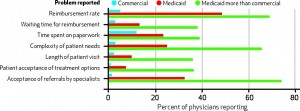
In an earlier post, I presented some data on which kind of physicians in the United States are most and least likely to see new patients who receive Medicaid, the state/federal program to pay healthcare costs for low income people. Now a recent study lays out some reasons why many physicians are so reluctant to see such patients.
Not surprisingly, it starts with low reimbursement rates. Medicaid pays about 61% …

 A guest column by the