Listen and followApple PodcastsSpotifyYouTubeMore apps · Browse all episodes
“Ehlers-Danlos syndrome patients take an average of 10 years to be diagnosed.
In that time, the pain from microtrauma and joint instability can become unbearable. “Just exercising more” can backfire, causing injury and disability and creating a cycle of added stress from chronic illness. But the biggest challenge is when our physicians are our opposition. It’s been more than 20 years since the first time I tried to convince a doctor to believe me. I was just a child, and the trauma of repeated dismissal still haunts me at every new appointment.
Thankfully, I am a physician myself now, and I am no longer powerless. I can advocate for myself AND my patients in ways most people cannot. I can navigate the system and find specialists independently. But I shouldn’t have to, and neither should our patients.
And none of us should fear what our doctors say about us when they leave the room.”
Sarah Cohen Solomon and Linda Bluestein are physicians.
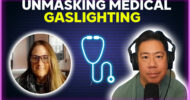
They share their stories and discuss the KevinMD article, “What a lifetime of gaslighting by other doctors feels like.”
Did you enjoy today’s episode?
Rate and review the show so more audiences can find The Podcast by KevinMD.
Subscribe on your favorite podcast app to get notified when a new episode comes out.
Click here to earn 1.0 AMA PRA Category 1 CME for this episode.
Also available in Category 1 CME bundles.
Powered by CMEfy – a seamless way for busy clinician learners to discover Internet Point-of-Care Learning opportunities that reward AMA PRA Category 1 Credit(s)™. Learn more at about.cmefy.com/cme-info
Do you know someone who might enjoy this episode? Share this episode with anyone who wants to hear health care stories filled with information, insight, and inspiration.

Hosted by Kevin Pho, MD, The Podcast by KevinMD shares the stories of the many who intersect with our health care system but are rarely heard from.


Transcript
Kevin Pho: Hi, and welcome to the show, where we share the stories of the many who intersect with our health care system but are rarely heard from. My name is Kevin Pho, founder and editor of KevinMD. Rate and review the show at KevinMD.com/rate. Subscribe at KevinMD.com/follow. Today on the show, we have Sarah Cohen Solomon and Linda Bluestein. They are both physicians, and they both wrote the KevinMD article “What a lifetime of gaslighting by other doctors feels like.” Sarah and Linda, welcome to the show.
Linda Bluestein: Thank you so much.
Kevin Pho: So we’ll get into the article in a little bit, but we’re going to ask each of you to just briefly share your story and journey to where you are today. Sarah, why don’t you go first?
Sarah Cohen Solomon: Thank you. Thank you so much for having me. So for me, the journey to understanding my diagnosis started quite young, as is often the case. I was the kid who always got injured really easily from things that seemed quite minor, and then the recovery time was always very extended. But I was always a very optimistic, happy, and active child, so it didn’t really line up.
So when I started complaining of fatigue, and specifically, for me, it started with foot and ankle pain, followed by knee pain, followed by back pain, around the age of 10 and progressing as I became an adolescent, my mom, who is an amazing advocate and overall human being, realized this was really out of character for me. And so she started trying to find answers, and when she wasn’t satisfied that the doctors were really taking me seriously, she worked harder and harder to try to figure it out.
And so, over time, while this was ultimately effective, and I owe her so much for finally finding the right physicians, it took a full decade before we were able to find the Ehlers-Danlos diagnosis. And that really happened coincidentally, because of a family friend who had recently had their own patient who was an Ehlers-Danlos patient, just coincidentally. But during that interim, we really ran into doctor after doctor who labeled me as a hypochondriac or seeking attention or just overly stress-related, and that was really harmful and very, very shaming.
So by the time we got a diagnosis, when I was 20 years old, it was really life-changing to have that validation and then to be believed, really for the first time. However, it was so startling to then find that even with that diagnosis, physicians would continue to dismiss me and my pain and all of the other comorbidities that I was experiencing. Ehlers-Danlos often comes with many GI difficulties, headaches, nausea, dizziness; you name it, we can have it. And those of us who, as doctors like to call it, are pan-positive for symptoms are very often dismissed.
So this dismissal followed me into medical school, when I then started seeing it from the other side of the curtain, as it were, and seeing supervisors and colleagues treating patients this way. So by the time I became a physician myself, it was really important to me to raise my voice as someone who had these dual perspectives, as both patient and physician, to try to help this harm be reduced as much as I could.
Real physician voices, twice a week
Free, and one click to unsubscribe.
Kevin Pho: And Sarah, give us an example or story of your journey as a patient and your experience with Ehlers-Danlos. How does that influence you specifically in the exam room? Give us an example of that.
Sarah Cohen Solomon: Well, for me, it’s very important, first and foremost, to go in with an open mind. So if my patient tells me that they’re experiencing a symptom, I don’t start by saying, “I’m not sure if I believe you.” I start by saying, “Tell me more,” and assume that they’re doing the best they can. And it’s very important to be able to say, “I don’t know the answer, but I’m going to go try to look it up.” The internet is pretty amazing these days. We don’t really have an excuse for not learning more or reaching out to someone else who might be a specialist, for example. So having been turned away so many times, I’m very sensitive to the fear of not being believed and being dependent on a physician who you can’t really trust. So I try to make sure that I listen fully and empathize as best I can.
And that doesn’t mean just doing everything that the patient requests. A lot of people think it’s one or the other. So if someone comes in demanding a battery of tests, you don’t have to do it in order to look like you believe them, but you do have to have a thorough conversation and start from a position of building rapport and building a bond, so that they trust you and so that you can have an honest relationship and build from it, instead of starting with a brick wall in between. That’s really, really key.
Kevin Pho: And we’re going to hear more about your story when you talk about your article. But first, Linda, we had you on the show over a year ago, but for those who didn’t listen to our episode together, just briefly share your story and journey to where you are today.
Linda Bluestein: Sure. So, similarly to Sarah, I had a lifelong history of medical problems, which no one had ever tied together. And it wasn’t until I was actually in my 40s that I did receive my EDS diagnosis. And I didn’t know what gaslighting was until many, many years after I had experienced a lot of gaslighting as a patient, and a lot of psychological distress and difficulties with various mundane tasks. When someone kind of treats you a certain way, right in front of other colleagues at times, it’s very, very harmful. But I had no idea what that was. I had no idea that there was a word for it or anything like that until many, many years later.
And so I opened my practice in 2017, taking care of people with EDS and related disorders, doing integrative pain management. I did work as an anesthesiologist in the operating room for many, many years, but then my own EDS made it impossible for me to continue doing that job. And so I made a career pivot, and now I take care of people with EDS, and now I have a much better understanding, from seeing both sides, of what actually happened to me as well as what has happened to them in other visits.
And I had written an article in the past for KevinMD and knew that it was incredibly well received, and I also really enjoyed getting to chat with you on the podcast. Both Sarah and I belong to a group on Facebook for physicians who are interested in EDS. And so I had reached out on that thread. There was a thread where people were talking about how hard it is, even for us as physicians, to get care. And I said, “Somebody needs to write about this on the KevinMD website, because that’s a fabulous place to reach a lot of physicians and a lot of other groups of people as well. Is there anyone who would like to write an article with me?” And Sarah immediately replied, “I do. I’d be happy to share my story.”
So Sarah immediately started writing, and she’s a fantastic writer. So I was very happy to, basically, I was more of an editor, and together we really tried to help shape her story in a way that we thought would be really meaningful and reach a lot of people.
Kevin Pho: All right, so let’s talk about that article. It’s titled “What a lifetime of gaslighting by other doctors feels like.” So Sarah, for those who didn’t get a chance to read that article on KevinMD, just walk my audience through it and share the story of why you decided to write it.
Sarah Cohen Solomon: Sure. Well, it opens with me having a very recent encounter with a new primary care doctor shortly after I’d had a shoulder injury, and being immediately dismissed and frankly belittled by that physician: “The shoulder doesn’t look so bad. I don’t really believe that anything big happened.” And as it happened, I’d actually subluxed it. It was partially dislocated at the time, but because of my overall range of motion, he didn’t catch that. And this had happened so many times, I was so frustrated. I got into the car, and I was just distraught at not being given the help that I knew that I needed, because I was in a new community without my usual resources. And it was really coincidental that Linda posted looking for a co-author, I think, just a few days after I experienced this. So the whole story really poured right out of the depths of my soul. I’d been waiting so long to write about this gaslighting experience.
The article explains that when I was a medical student, I had had my diagnosis for a while, but I was discriminated against for being disabled as a medical student. And so I was frustrated by what I was seeing in colleagues and superiors, in how they were. You’d open up a chart and you’d see this long list: “Oh, you’ve got this chronic pain. You’ve got this fatigue. You’ve got all of these things” that get grouped into functional complaints, as it were. And I don’t like that term, but that’s what it’s usually called. And then the physician will roll their eyes and say, “Oh, man, I don’t want to see this patient.” And off we would go, and I’d be shadowing, and it’d be uncomfortable. And I hated it. I felt really, really powerless, and really felt shame for the physician I was supposed to be learning from, knowing how the patient on the other side of the exam table must be feeling at that moment, since I had been in that place so many times. But because I was so at risk as a medical student, I felt I really couldn’t do or say anything.
So several years ago, during medical school, I wrote an article, sort of from the perspective of just being a caretaker for my twin sister, who also has this diagnosis, and how upsetting it was as a medical student to see this kind of cycle of mistrust and gaslighting occur. But I was really too frightened to write in my own voice. So finally, I realized I was after residency. I was no longer beholden to the supervisor evaluations, and I could finally share: “No, this was my experience. This was me following around physicians, listening to them complain about patients and really belittle patients behind their back, and really extend the culture to their learners of not believing patients, not really listening, and not giving them the time.”
And now that I’m on the other side, I’m in a position to do something about it, and being able to take that narrative back has been very, very powerful and really cathartic for me, as this was very, very harmful for me in my own health care journey and in my educational journey. So I’m really very grateful to be on the other side of this. And it’s worth saying that along that journey, there were magnificent supporters who I owe so much, because they did believe me and gave me the strength and the support to keep going despite all of these roadblocks. So it’s not all doom and gloom, but it is very pervasive. And that’s what this article sought to convey: just how many patients experience this. This is not a unique experience.
Kevin Pho: So Sarah, what are some examples during your medical education journey, either as a medical student, resident, or attending? Just give us an example of some of the words that you would hear other physicians say when they see other EDS patients.
Sarah Cohen Solomon: Right. Well, I’ll put a little trigger warning, because I do think that it can be very, very harmful, but the worst thing you can be called is a drug seeker, and that can go in your chart permanently, and anybody after that who sees it is going to treat you like a drug seeker as well. It has been implied to me as a patient, but I have seen the word used directly at my twin sister while I was present for one of her appointments, and it was horrifying. And really, I mean, the depths of pain of having to explain how much pain you’re in and being told, “Not only do I not believe you, but I believe that you are an addict,” is really indescribable.
And then you’d end up on this seesaw of “Well, if I put on my makeup today and try to be polite and pleasant enough, they’ll probably say that, as a patient, I look too well to be in as much pain and distress as I say I’m in. But if I don’t put on my happy face, then I’m going to look too anxious.” And God forbid you use the phrase “11 out of 10 pain.” Oh boy, now you’re really a hypochondriac. So it becomes this tremendously fine balance. It feels like walking a tightrope over lava. If you have one false step, you’re dismissed immediately.
So that was always how I felt as a patient. But I watched it time and time again as a student and as a resident. Fortunately, as I progress in my career, I’m in more and more of a position not to let that be the case. As a matter of fact, similarly to Linda, I am about to begin a position at PRISM, which is another specialty Ehlers-Danlos clinic, in Silver Spring, Maryland. So I’ll be their first pediatrician, where I’m actually going to be able to set the tone that I wish I had had as a kid myself, working with an incredible team that takes these conditions very seriously and understands how many other comorbidities are involved: POTS, dysautonomia, chronic GI issues, all sorts of things. So it’s a really exciting opportunity to use the experiences and the perspective that I have and really put it to good use. I’m very excited about it.
Kevin Pho: And Linda, as you were telling your story, you mentioned that you also had episodes of gaslighting about your diagnosis from other clinicians as well. Tell us a little bit about those stories.
Linda Bluestein: Probably the worst one was when I had fallen off of a bike, and I had my knee scoped a few weeks later, and I returned to work just a couple of days after my surgery because, of course, as physicians, we’re expected to heal at superhuman rates. Other people might take several weeks off, but we expect ourselves, and our colleagues expect us, to be back to work immediately. So I did return to work. I was in the operating room, going from room to room, and I was in a lot of pain, and I ran into my surgeon in the doctors’ lounge. He’s all upbeat and asks me how I’m doing, I think thinking that I’m going to say I’m doing great. And I said, “My knee actually really hurts.” And we’re in the doctors’ lounge, and there are quite a few people in there. It’s morning. People are coming in to get a cup of coffee or whatever. And we’re in the surgical lounge, and he yells at me very, very loudly, “I looked inside your knee. There is nothing wrong with your knee.” And, of course, I just shriveled up, and that was so damaging to me.
And it wasn’t until years later that I realized: Yes, you did scope my knee. You couldn’t see inside all of the tendons and ligaments and things that the MRI had shown were damaged. And I had a very severe femoral bone bruise, and it wasn’t until much later that I realized a femoral bone bruise is painful, and that was enough of an explanation for my pain. Because I think oftentimes what happens is, I don’t know why we do this, but I think some of us, and I think I’m one of these people, want our physician to kind of validate our experience for us. And unfortunately, that isn’t always going to happen, and I wish that I wasn’t one of those people who really wanted that. But I did. And so when he’s telling me, no, I’m wrong for being in pain, that was very, very harmful.
And I had trained at the Mayo Clinic, and as an anesthesiologist, I had done specialty rotations in the pain clinic. And I think the other thing that was so hard with what was happening to me when I was in my 40s was that when I was working in the pain clinic, it was us versus them. I was part of the medical team, and then the patients are the them. I didn’t ever think I was going to become one of them. So when I went back to Mayo as a patient and returned there to be evaluated, I felt like a failure. [Remark removed by the editor.]
I think it’s really hard until you’ve lived that experience to understand, maybe. But the piece of compassion, I don’t know how much of it is burnout and all of the other problems that are going on in health care right now. But I think if we’re not able to have compassion for the patient and believe the patient, we need to be doing our own check-in and realizing, “Maybe I need to be taking care of myself and figuring out why I am in a place where I currently cannot give my patient the empathy that they deserve.” Because I think that’s happening a lot, and I think it’s a diffuse problem, and a huge part of this is not specific to EDS. I mean, EDS just happens to be a condition that involves every bodily system, chronic pain, all these things that you cannot see on imaging or lab testing. So we end up getting disbelieved. And so it’s a great example of where health care is failing us right now.
Sarah Cohen Solomon: I agree completely. If I could just add one thing, I think it’s important to recognize that most physicians go into this wanting to do good for the world. I don’t think we’re all bad people, right? But I think that we are up against so many barriers, including the way we are trained. We’ve got time constraints. We’ve got insurance. We’re being pulled in so many directions. And then you add to that a culture and an educational system in which you have 15 minutes to evaluate someone who might be very complicated. So the easiest thing to do is just to say, “There are too many things going on here. I’m going to just label you in this category and dismiss.”
And I don’t think it’s intentional most of the time. I don’t think doctors realize that we’re doing this and causing this kind of harm. I think, instead, many of these physicians really just think that they’re doing their due diligence to avoid contributing to the opiate epidemic, for example, and just want to be reassuring, but instead, it’s dismissive and harmful in a different way. So it’s important to recognize just how many barriers there are in every direction.
Kevin Pho: So Linda, if you were to replay that encounter you had with the surgeon again, what would you do differently?
Linda Bluestein: I would definitely stand up for myself rather than cowering. I would question him. I would say, “Well, there were other things going on in my knee, so isn’t it possible that that could be why my knee is sore? And could you please give me some guidance on how I can make the situation better, rather than just making me doubt myself?” I mean, that’s basically what happened: He made me doubt myself. And so I definitely would have tried to have more of a conversation with him and had more confidence in myself and in my own body, and in the messages that my body was trying to tell me, which was, “Slow down. Stop. Elevate your leg.” But we’re expected to be superhuman.
And Sarah, I’m really glad that you said that, because I work with medical students, and they are kind and compassionate, and they want to do so much good in the world. Somewhere along the way in our training, a transformation happens to a large percentage of people, or along the path of their career, where I think, like you said, we have so many barriers, and it just becomes harder and harder to deliver the care that we want to deliver. I think most physicians, yes, they care about their patients, and they want the same thing as the patient wants. But I think that, like in that encounter that I had in the doctors’ lounge, that doctor was so frustrated because he didn’t know how to help me. And so I think we end up getting frustrated, and that gets in the way of ensuring that our common goal of the patient doing better is something that we are together working on.
Kevin Pho: We’re talking to Sarah Cohen Solomon and Linda Bluestein. They are both physicians, and they co-wrote a KevinMD article, “What a lifetime of gaslighting by other doctors feels like.” And now I’m going to ask both of you for some of your take-home messages. So Linda, why don’t you go first?
Linda Bluestein: I think Sarah said a very important thing a while back when she said keeping an open mind. So often we hear somebody come in and they have complaints. I wrote another article for KevinMD starting out with somebody with 12 different complaints, and no, this isn’t 12 different patients. This is one person with 12 complaints. And so often we think, “Well, that can’t possibly be. There’s nothing that I learned in medical school that will explain all 12 of those symptoms.” And so I think if we can start with keeping a more open mind, that would be very, very helpful, because if you think about it, connective tissue is everywhere in your body. If you have a connective tissue disorder, you can explain a huge percentage of the problems that people have. And of course, people are also entitled to have more than one condition, so there may be more than one thing going on. So I think, first and foremost, keeping an open mind.
And then secondly, for physicians who are really struggling to be compassionate and empathetic, I think it’s, again, trying to figure out how they can maybe take better care of themselves. Is there something that they can do for themselves so that they can then be there for their patients in their clinical practice? And really assess and be honest with yourself about where you are in your career and how you are or are not able to serve your patients and relate to your patients. Are you doing it the way you want to do it, or do you really just kind of feel stuck, and you don’t know how to improve the situation? Maybe you’re not in the right practice model. Maybe you need to take a break, or, like I said, get more help at home or something, so that you can practice the way you want to.
Because I think most physicians, if they’re not practicing the way that they want to, feel guilty about it, because I really don’t know people that went into medicine for the wrong reason. I mean, the people that I know went into medicine because they wanted to serve and care for people. So I think that can be very helpful, to just kind of assess where you’re at personally.
Kevin Pho: And Sarah, we’ll end with your take-home messages to the KevinMD audience.
Sarah Cohen Solomon: First of all, I agree with everything Linda said completely. I think the number one thing that I would advise our colleagues is to remember the power of being able to say, “I don’t know, but I’m going to learn.” We’re all very hesitant to be humble about our own knowledge, because we’ve worked really hard to know as much as we do and be the experts that we are. So humbling ourselves is very hard, especially with our limited time. That having been said, if you say, “I don’t know, but I will go and learn, and I will connect you as best I can to other resources,” as a patient, I have loved doctors most who, even if they’re not an expert yet themselves, are willing to be open-minded and say, “I’m here to support you, and I believe you.” That has been far more powerful than already having all the answers. So taking that deep breath and being willing to be vulnerable yourself to do that is enormous.
And I think, while you do that, remember that evidence-based medicine often lags behind. We don’t know everything yet. So if we doggedly adhere to saying, “Oh, I practice evidence-based medicine and only evidence-based medicine,” well, that means that there might be evidence in a decade, or 20 years or 30 years from now, that doesn’t exist yet. And that doesn’t mean the disease doesn’t already exist. It just means the evidence on what to do about it hasn’t happened yet.
Sixty years ago, we thought endometriosis was hysteria, quite literally. It was 500 years of calling it hysteria because of ancient stereotypes about women having pain, until all of a sudden they understood that there was ectopic tissue. Asthma used to be called an anxiety attack. We know that science advances, but we know so much more now that we forget that there’s still so much. So being able to humble ourselves and say, “I’m going to do the absolute best I can. I’m going to start from a place of believing you and assuming that you are not suffering for the sake of suffering or secondary gain.” It’s so much more harmful to dismiss someone who is in real pain than to go back and say, “Actually, we need to do something differently.” It’s just so important to stay humble and start from an open mind.
Kevin Pho: Sarah, Linda, thank you both for sharing your stories, time, and insight, and thanks again for being on the show.
Sarah Cohen Solomon: Thank you so much for having us.
Listen and followApple PodcastsSpotifyYouTubeMore apps · Browse all episodes