Subscribe to The Podcast by KevinMD. Catch up on old episodes!
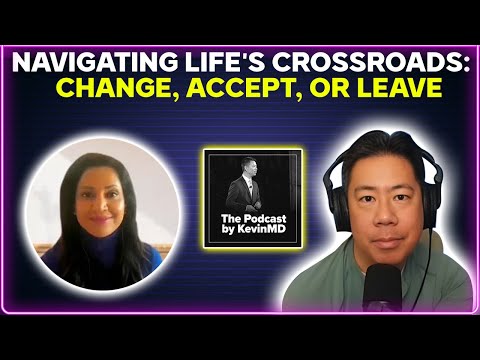
Join Deepti Gandhi, a family physician. We delve into the powerful mantra of “change, accept, or leave” and explore real-life scenarios where individuals are faced with this choice. Discover practical strategies, personal stories, and expert insights to help you navigate life’s challenges effectively.
Deepti Gandhi is a family physician.
She discusses the KevinMD article, “Change, accept or leave: wisdom for physicians who feel stuck.”

Our presenting sponsor is Nuance, a Microsoft company.
Do you spend more time on administrative tasks like clinical documentation than you do with patients? You’re not alone. Clinicians report spending up to two hours on administrative tasks for each hour of care provided. Nuance, a Microsoft company, is committed to helping clinicians restore the balance with Dragon Ambient eXperience – or DAX for short. DAX is an AI-powered, voice-enabled solution that helps physicians cut documentation time in half. DAX Copilot combines proven conversational and ambient AI with the most advanced generative AI in a mobile application that integrates directly with your existing workflows. DAX Copilot can be easily enabled within the workflow of the Dragon Medical application to bring the power of ambient technology to more clinicians faster while leveraging the proven and powerful capabilities used by over 550,000 physicians.
Explore DAX Copilot today. Visit https://nuance.com/daxinaction to see a 12-minute DAX Copilot demo. Discover clinical documentation that writes itself and reclaim your work-life balance.
VISIT SPONSOR → https://nuance.com/daxinaction
SUBSCRIBE TO THE PODCAST → https://kevinmd.com/podcast
RECOMMENDED BY KEVINMD → https://kevinmd.com/recommended
GET CME FOR THIS EPISODE → https://earnc.me/X9JpRF
Powered by CMEfy.

ADVERTISEMENT
Transcript
Kevin Pho: Hi, and welcome to the show. Subscribe at KevinMD.com/podcast, and get CME for this episode by clicking on the CME link in the show notes. Today we welcome Deepti Gandhi. She’s a family physician. Today’s KevinMD article is titled “Change, accept or leave: wisdom for physicians who feel stuck.” Deepti, welcome to the show.
Deepti Gandhi: Thank you for having me, Kevin. I’m a fan of your mission and your work.
Kevin Pho: So before we get into your article, just briefly share your story and journey to where you are today.
Deepti Gandhi: Absolutely. So I am a board-certified family medicine physician. I’m also a certified physician coach, and now a certified menopause specialist through NAMS, now known as the Menopause Society. I’m a mom of two teens, I’m a dog mom, and I just consider myself a curious observer of life.
Kevin Pho: So you mentioned that you’re also a menopause coach. What exactly is that?
Deepti Gandhi: Yeah, so I’m actually a certified menopause specialist. That’s something that’s not well known; it’s new. So basically, I don’t know about you or any of our colleagues who are listening, but I didn’t learn anything about midlife women’s health, menopause or perimenopause in my training. And I keep thinking, did I fall asleep, did I miss that lecture? And I really don’t think so. Also, the WHI study came out in 2002, and as we know, it just changed everything. We were led to believe that HRT, and especially estrogen, was kryptonite and dangerous. Now, thank goodness, we are looking at the newer research and revisiting all of the data from that study, and so luckily we have more science and can share it.
What happened was, a few years ago I started having my patients complain about symptoms, and I felt that I didn’t know enough. I didn’t feel like I could offer effective care, and so I would refer them to places, and they weren’t very happy. It got me really curious, and so I started doing a deep dive, taking trainings on my own. I would study at night and on the weekends and take courses, and it just led me on this path, and I’ve become very passionate about it. I really find that there’s a need. A lot of women in this next phase of life are just not getting adequate care and don’t have answers, and I wanted to be a part of a change, and that’s what I’m doing now.
Kevin Pho: What are some of the most common reasons women come to you about menopause?
Deepti Gandhi: Well, there’s a statistic out there that it takes women about five to seven visits with a physician or provider before they are even validated or get any help, and that’s really concerning and heartbreaking to me. When they come in, typically they’re telling me all of the different symptoms they’re having that are related, anywhere from brain fog to achiness to GSM. There are so many symptoms. I think we don’t even know how many there are, but I know that there are definitely over 85 symptoms in my last reading.
I think a lot of the time in midlife we blame it on stress, or it was just a bad day at work, or my kids, or something like that. But women just haven’t been educated, and physicians also haven’t received education on what the symptoms are. In fact, they get sent to multiple different specialists without a lot of answers. There’s a lot of testing, and in the end many of them tell me they were told everything’s fine, you’re too young, and if you’re still having your periods you’re fine. And they just don’t feel like themselves.
And I think by the time we’re in our third, fourth, fifth decade of life or more, you know yourself. So one of the things that I say is that my number one job is to listen to my patients, to listen to them and to believe them. And then obviously I use an evidence-based, scientific approach along with a holistic approach to help them.
Kevin Pho: All right, so your KevinMD article is titled “Change, accept or leave: wisdom for physicians who feel stuck.” Tell us how your article came together.
Deepti Gandhi: Yeah, so it’s really been inspired by my coaching clients. I coach physician clients, and much of the time when they come in, they’re bringing up an obstacle or a place in their life where they feel stuck. So it’s something that I offer, because it’s a wisdom that I came across many years ago when I was feeling stuck and disillusioned and burned out, and I think I kind of self-coached myself out of that place. It’s basically from a quote, and I’m going to read the quote to you, because that’s where I derive “change, accept or leave” from, and I love quotes: “Leave the situation, change the situation, or accept it. All else is madness.”
So to me, what it really reminds me of is that we have choices in life. A lot of the time we feel stuck, and we can get really bogged down with why is this happening, I can’t believe this is happening, and you just get into that ruminating thinking process. It helps me shift my mindset from what the problems may be to what the solutions might be, right? It shifts you from dwelling in the negative spiral to a more creative mindset, from lack to more abundance and curiosity. So I feel like it does that.
The other aspect that I really appreciate is that it reminds me that we are ultimately the architects, or creators, of our own life. We have a hand in what happens to us. We get to choose how to react and respond, and how to design, hopefully, a life that aligns with our values. And though we may not like the choices that we have, we usually have some choice, and that’s something that I offer my clients.
Kevin Pho: Now, when physicians come to you, do they literally say “I feel stuck”? What are some scenarios that may manifest themselves that way?
Deepti Gandhi: Absolutely, that’s a great question. Some of them come to me with this kind of scenario: They’re in a job, they’ve been working there for a while, they initially had a lot of zeal and enjoyed it, and now they’re starting to feel unhappy. They may not like how it’s being managed, or certain rules and regulations that they’re made to follow by admin, for example. They feel that they’re trying to bring up things but maybe no one’s really listening, or they’re being told that certain changes are going to be made but they don’t see that happening. And they have this fear: Can I go on like this? But I’m scared to leave, what will happen?
And I think too, for physicians, it’s kind of a long and narrow road for us. There’s not usually a lot of room to veer off the path, to take a break or maybe explore, which is all really necessary for our personal growth.
Kevin Pho: So if a physician comes to you with a story like that, just take us into your room and explain some of the first things that you would suggest they do.
Deepti Gandhi: I feel like self-reflection is really important, right? So the fact that this physician is taking the time to give themselves coaching, number one, I want to appreciate them for doing that, because they’re very busy, and that’s not something that was typically integrated into what we were taught, at least when I was training.
That being said, typically what I like to do is bring them back to their values: what aligns, what gives you that spark? Sometimes I have different exercises and tools that we use to come back to that. I often recommend gratitude journaling, just because that was a transformational wellness tool in my life. At one point in my life I might have thought, “Oh, that’s so woo-woo, who has time for that?” But it ultimately leads to clarity. When you sit down and think of what’s working for you, you end up realizing what isn’t working for you, and it becomes very clear, right? And it leads to self-awareness, which we know is the key to all transformation.
Kevin Pho: Do you feel like there’s still a stigma for physicians who seek out coaching? I talk to a lot of physician coaches on this podcast, and I know that coaching has certainly grown in popularity over the past few years. Are you finding that there’s still a bit of a stigma for physicians or other clinicians who seek out coaching?
Deepti Gandhi: I do. I think a lot of the time physicians don’t even know what coaching is, and I don’t know if you’ve noticed that with your guests too. So there’s a little bit of education that’s needed. But what I notice as well is that younger generations, maybe at the medical school level or even premeds, are quite open to it. I’ve personally noticed a hunger for coaching, mentorship, and openness to therapy and different wellness tools, if we call them that. So I think it just needs some education, and I find it’s really helpful when it comes from people in a leadership role. And we do have literature now that supports it, so I often share that.
Kevin Pho: So tell us a success story. It doesn’t have to be a real client, it could be a hypothetical client, where they come to you feeling stuck and you move the needle for them.
Deepti Gandhi: Oh, thank you, I’d love to. One example that I had was a physician who was probably into her second decade of practicing, who had created a practice with a colleague, had a family, and was in her midlife, let’s say. She really loved her patient interaction and loves what she does, but was really butting heads with her partner, her physician colleague, in terms of what direction he wanted their practice to go in and what direction she wanted to go in. It even ended up bringing up some pain and trauma from her childhood.
So we worked together, and she had these realizations. The success was really her coming back to her values and asking, wait, what really matters to me, and reprioritizing her life. As I say, I like to help my clients go from being unfulfilled to joyfully empowered, and to feel like they are the architect: They get to design the life that they desire now, with the tools that they have now. And I always remind them that they’re whole, capable and resourceful. It ended up being that she needed to do a little therapy to work out some childhood trauma while she was working with me, and she ended up having those really challenging conversations with her colleague and setting boundaries. And she’s so much happier. She’s so much happier, and that’s obviously very rewarding for me to see.
Kevin Pho: We’re talking to Deepti Gandhi. She’s a family physician. Today’s KevinMD article is titled “Change, accept or leave: wisdom for physicians who feel stuck.” Deepti, let’s end with some take-home messages that you would like to leave with the KevinMD audience.
Deepti Gandhi: Absolutely. My number one take-home message for our colleagues is, like I said before on our show today, that our career journey is often so long and narrow and arduous, and there’s just not a lot of time to contemplate and take breaks. I think taking that time is essential for your own personal growth and evolution, and ultimately, hopefully, your happiness. And I would say gratitude journaling is an easy way to start, and there are science-proven health benefits to it.
The second take-home I would add is, if you feel like you’re in a transition, you’re unfulfilled, you’re burning out, you’re stuck, consider coaching. It really has led to many aha moments in my own life.
Kevin Pho: Deepti, thank you so much for sharing your time and insight, and thanks again for coming on the show.
Deepti Gandhi: Thank you so much, Kevin. I appreciate it.