


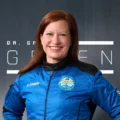
When I traveled to space aboard Blue Origin’s New Shepard in May 2025, I fulfilled a dream that had begun nearly forty years earlier at Space Camp. I became the first woman physician commercial astronaut, an achievement that still feels extraordinary to me.
You might think that after reaching my highest goal, I would leave my previous professional life behind. After all, I retired from clinical medicine in 2024 and have largely wound down my own expert witness practice. Why would I continue teaching physicians and other clinicians how to build expert witness businesses?
The answer is simple: Helping others achieve their dreams remains one of the most fulfilling things I do. I continue to serve on the U.S. Space & Rocket Center Education Foundation board of directors, I speak worldwide about achieving impossible dreams, and I’ve started a new professional chapter consulting and advising space biotech companies how to launch research to space and land results successfully back on Earth. I’ve done what most other goal-directed high-achievers do: After my spaceflight, I got new goals!
The beauty of a mosaic career
I’ve always enjoyed entrepreneurial ventures, exploring new opportunities, and discovering unexpected ways to put my skills and interests to work. Recently, I encountered the term mosaic career, and it immediately resonated with me. Rather than following a single linear professional path (which I’d always imagined my medical career would be), a mosaic career is built from different experiences, roles, and interests that collectively create something greater than the individual pieces. My own mosaic includes medicine, medical education, expert witness work, entrepreneurship, exploration, public speaking, and now commercial spaceflight.
Real physician voices, twice a week
Free, and one click to unsubscribe.
From the outside, these pursuits might seem unrelated. I knew that one step led to the next: I’d stacked new skills, built new businesses, and grown as a professional and person along the way. One of the most moving experiences of going to space was, as soon as I unstrapped from my harness and floated in microgravity above the Earth, that everything I had done to get to that point made sense. All my efforts had added up to the correct sum of their parts, and I was exactly where I should be, and had envisioned myself experiencing for decades beforehand. It was the most fulfilling moment of my life.
The critical thinking skills I developed as a physician, the ability to communicate complex ideas as an educator, the business skills I acquired as an entrepreneur, and the resilience I developed through years of challenges and setbacks had all helped prepare me to achieve my greatest dream.
Expert witness work is about much more than testifying
When I began teaching physicians how to become expert witnesses, I knew from personal experience how rewarding this work could be. What I didn’t fully anticipate was the variety of professional opportunities my students would discover and create for themselves, leveraging their unique skills, training, and expertise: their own mosaics.
Some have built successful expert witness practices. Others have established businesses performing medical reviews for state medical boards, conducting independent medical examinations, or working as life care planners. These activities are different facets of the same gem: applying medical knowledge, clinical judgment, and critical thinking to understand what happens when medical outcomes are not what patients or physicians hoped they would be.
Sometimes something goes wrong because a medical error occurred. Sometimes an adverse outcome happens even when everyone involved provided appropriate care. Physicians have an important role in helping attorneys, judges, juries, and the public understand the complexities of medicine. Our clinical experience can help communicate standards of care, causation, outcomes, and the realities of medical decision-making in the medicolegal field and beyond. We can also help ensure that legal and financial decisions involving medical care are informed by sound clinical reasoning rather than assumptions or hindsight.
This work matters to patients, physicians, and the broader public. And it offers clinicians an opportunity to continue contributing their expertise in meaningful ways, often outside traditional clinical practice, in exchange for additional income.
The greatest barrier is believing you’re not ready
After years of mentoring physicians and other aspiring expert witnesses, I’ve noticed a recurring pattern. The biggest obstacle isn’t necessarily a lack of expertise, credentials, or opportunity. It’s that people quit before they start.
They tell themselves they’ll become an expert witness after another five years of practice. After earning another credential. After becoming a department chair. After retiring. After reaching some imagined point when they’ll finally feel qualified. Often this perception of qualification comes from outside sources, which we then try to use as evidence that we are ready to begin. But you’ll never reach the point where you feel ready to start something new that feels like a big challenge, if you’re looking outside yourself for conviction. There will always be another credential you could earn, another milestone to reach, or another reason to wait.
Of course, expert witness work requires appropriate qualifications, relevant clinical expertise, objectivity, and a commitment to ethical practice. But many physicians who already possess the necessary expertise don’t recognize the value of what they have to offer. They worry about how others will perceive the work, rather than focusing on the valuable need for physicians to truly serve as authorities society needs to help direct the future of medicine. They’re waiting for confidence to come before taking action. I’ve learned that it often works the other way around.
Confidence is created through action. That idea shaped my own journey to space, and it is at the heart of my new memoir.
Becoming an astronaut before going to space
People often ask how I persevered for nearly forty years, especially when my path included so many setbacks. The answer isn’t that I always believed I would get to space. I didn’t. Even just a few weeks before I was manifested on my flight, I felt like I was still taking action toward my goals, but with no guarantee it would ever work. But I chose to just keep going, moving forward, looking upward and onward.
There were plenty of times when the possibility of going to space seemed remote, even absurd. Recovering from surgeries, injuries, being sued in a medical malpractice case, and more: Everything felt like it threatened my career, my sense of identity and purpose, and made me question if life would ever feel “normal” ever again.
But I made a choice to continue pursuing that dream and, perhaps more importantly, to become the person I wanted to be along the way. It wasn’t easy, but I learned to use the lows to help direct my action toward achieving new highs. I focused on what I could control, and how I could learn, explore, take risks, contribute to the space community, and develop the qualities I associated with being an astronaut, whether or not I ever crossed the boundary of space.
Commercial spaceflight has opened extraordinary opportunities for people from widely different backgrounds to experience space. Unlike the traditional NASA astronaut career path, which prepares individuals through specialized selection and training for professional space missions, my journey was shaped primarily by the life I had already lived. Meeting fellow commercial astronauts from different countries, professions, and walks of life has been one of the unexpected pleasures of this experience. Their stories reinforce something I now believe even more strongly: There is no single path to an extraordinary goal. My crew chose the name “Pathfinders” for just that reason: All of us had different paths that led us to space. But no one got there by accident. We had all focused on our goals and found new ways to achieve them throughout our lives. Our flight was the sum of all our efforts.
Why I continue to teach
Although I’ve stepped away from clinical medicine and largely completed my own expert witness career, I continue to find enormous joy in seeing my students succeed. Some have developed five- and six-figure side businesses. Others have found new professional identities, greater financial flexibility, or renewed enthusiasm for using their medical expertise. But the income is only part of the story. What excites me most is watching someone move from “I don’t know if I can do this” to “I did it (and I’m so glad I didn’t wait any longer)!”
Through Expert Witness Startup School, I share my own experiences, but I also learn from the experiences of my students. Their successes create examples that help other clinicians recognize possibilities they might never have considered. Even though my life has been extraordinary, my journey to expert witness work is very common: 1) get called out of the blue to review a legal case, 2) realize I knew the medicine but had no idea how to run an expert witness business (from billing to invoicing to organizing the workflow), 3) learn everything I could to be successful, and finally 4) teach others how to avoid learning the hard way through trial and error. This is one of the most rewarding aspects of teaching: the opportunity to help someone else see a future they didn’t think was possible.
Your next chapter doesn’t require abandoning the last one
A physician can become an expert witness, an entrepreneur, an educator, a consultant, an advocate, or something that doesn’t yet have an official title. It’s like inventing a new ice cream flavor, where you get to customize the mix-ins and make it uniquely yours! New challenges become accomplishments that complement one another, creating a professional and personal life that is richer than any single career path might have allowed.
The first step is allowing yourself to believe that something new is possible. That belief opens the door to a shift in identity. And once you begin to see yourself differently, you begin to recognize opportunities you might previously have overlooked. You may not achieve every goal you pursue. I certainly haven’t.
But the process of pursuing those goals can change who you become, regardless of the outcome. For me, the greatest gift of my journey to space wasn’t simply reaching space. It was discovering how much I could become along the way. I still teach expert witness work because I want other physicians to experience that same sense of possibility, whether their next dream involves a new business, a new professional role, or something entirely outside medicine.
Action is the antidote to anxiety. You don’t have to know every step. You don’t have to feel completely ready. And you certainly don’t have to know exactly where your journey will lead, but having a “North Star” of a goal can help you find the path that leads you to success. You just have to be willing to take the first step.
Raise your hand before you’re ready. Then keep going. Onward and upward.
Gretchen Green is a diagnostic radiologist and commercial astronaut whose clinical background spans more than 20 years in women’s imaging and breast cancer diagnostics, more than 200 medical malpractice cases as an expert witness, and direct participation in AI-powered breast imaging clinical trials. She founded The Expert Resource to help physicians build trusted, impactful expert witness businesses with confidence and improve patient care. She now advises space biotech, pharma, and health tech companies on how to launch medical research missions and return results to Earth with reduced risk and accelerated patient and physician acceptance.
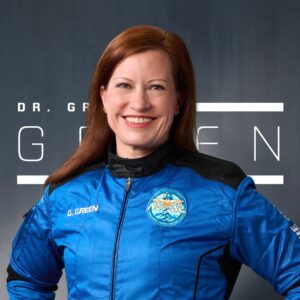
On May 31, 2025, Dr. Green became the first woman physician commercial astronaut on the 12th Blue Origin human spaceflight. She brings 40 years of dedication to space exploration: She first attended Space Camp in 1986, worked as a Space Camp crew trainer, and served as chair of the Space Camp Alumni Association. She now serves on the board of the U.S. Space & Rocket Center Education Foundation. She is the author of Raise Your Hand (Before You’re Ready): A Memoir of Creating Confidence, Taking Chances, and Reaching for Space.
At 16, she bicycled across the U.S. to end world hunger; in 2022, she reached the North Pole. Dr. Green completed medical training at Harvard, Yale, and Brown, earning degrees in neuroscience, the history of medicine, and medicine from Brown University. She is also a proud graduate of the Illinois Mathematics and Science Academy. Dr. Green retired from practicing medicine in 2024 as a Fellow of the American College of Radiology and Fellow of the American Association for Women Radiologists, and now teaches, coaches, and speaks full time to help others pursue their highest purpose and personal excellence. She shares her work on her website, Doximity, and Instagram.