“Everything we do before a pandemic will seem alarmist. Everything we do after will seem inadequate.”
– Michael Leavitt
Why are we writing this?
The COVID-19 pandemic has reached a point where containment is no longer possible. The COVID-19 threat is real, and rapidly getting worse. Many of you are very nervous; some are unsure of the validity of the information you are reading. As physician leaders, we felt it was important to craft a resource you can rely on as being scientifically accurate and one which contains as much actionable information and guidance as possible.
Accurate, actionable information during an epidemic can save lives. Physicians are on the front line of this epidemic. Not only are we treating the sick, but we are also cringing at the misinformation spread through both traditional broadcast and social media. Evidence matters. Unfortunately, evidence is often slow, methodical, and boring and has a tough time against clicky headlines and exaggeration. We believe that an accurate representation of the current COVID-19 pandemic followed by a set of actionable steps you, your loved ones, politicians, and local officials can utilize is of paramount importance and ultimately could save tens of thousands of lives.
COVID-19 isn’t just the flu?
COVID-19 has been described by some as “just a cold,” or just like the common flu. COVID-19 is not a common flu. COVID-19 is an order of magnitude worse than the flu. The fatality rate is approximately ten times worse than the flu.
The flu spreads from September through April in the U.S., and June through August in the Southern Hemisphere. Yes, it does cause severe illness in many, but it does so over a longer time course. Time is a variable that is working against us during this COVID-19 outbreak. COVID-19 victims will be presenting to a hospital in need of critical care at a rate that is far higher than occurs with the flu.
In addition, these patients will require hospital treatment over the course of a few weeks rather than the 3-4 months of a typical flu season. The health care system in the USA is not ready to handle tens of thousands or hundreds of thousands of people over a short time frame. In Italy, the health care system buckled under the strain, and the health care teams are now forced to make horrible life and death decisions.

There are only 2,177 cases: Why is everyone so worried?
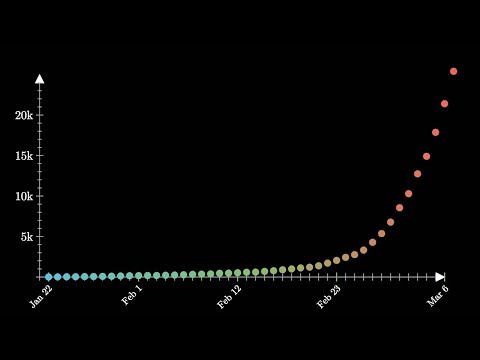
If only a snapshot in time had relevance, then perhaps stating that only there are “only” 2,177 cases (March 14, 2020) would be relevant and somewhat comforting. Italy has over 15,000 cases today; they only had a few hundred cases a week ago. Stating that we only have 1,600 cases today is absolutely irrelevant in the face of a pandemic virus spreading under exponential conditions. We will help put the term exponential spread into context down below.
Immunologically naive populations
Viruses have been circulating around the globe for millennia. One family of viruses that have been circulating are referred to as Coronaviruses. About a quarter of common colds are caused by Coronaviruses. Our bodies form antibodies to foreign invaders, such as bacteria or viruses. If we have antibodies from a previous exposure, then we can rapidly ramp up the production of those antibodies if we are infected by that same virus at a later date. This is why you only get Chicken Pox and the Measles once. The first episode generates protective antibodies so you can’t get infected a second time. For other infections, previous exposures do not make you immune to future infections, but it does make subsequent exposures milder.
COVID-19 is a severe respiratory illness caused by the virus named SARS-CoV2. It is a novel virus, which means that no one in the world has antibodies to it because no one has ever been infected by it before. As such, when the COVID-19 virus invades our body, we do not have antibodies. We do not have a template to utilize from a previous exposure to rapidly create a defense against the virus. Because no one has antibodies, everyone is at risk for catching the virus, becoming ill, and spreading the virus so that it can infect those around you.
Exponential spread

ADVERTISEMENT
Exponential math is very hard to grasp. Every person with the COVID-19 virus infects approximately two people. Some less, some more. The infection rate doubles every six days. That means that if 50,000 people have the virus today, then in 6 days, 100,000 people will have it. In another 12 days it’s 400,000 and less than two weeks later it’s over a million people. We have 330 million people in the US. The experts expect that 40-70% of people will be infected. Exponential growth does not take that long to get to those scary high numbers. Every six days, we delay the number of infections double. This YouTube video does a great job of explaining this.
Is it time to panic? No.
This document is trying to help you to understand the situation at hand and not to terrify you. We want to make sure you understand the facts and understand what is at stake. This is a Pearl Harbor moment for our country. We are facing a real threat, and we need to face it with all of our resources. When people decry the seriousness of this moment they are steering our country off a cliff, we need everyone to understand that this is important and if we work together to slow the spread, we will get through this as we are learning from Singapore, Hong Kong, South Korea, and China.
The effectiveness of our health care system to deal with a sudden tsunami of respiratory illness is what is at risk. If our health care system buckles under the strain of tens of thousands of patients, then we could be looking at a catastrophe.
Personal risk vs. systemic risk
When we talk about risk, there are many different elements to consider. Naturally, we are concerned about ourselves and our loved ones. This is an example of personal risk. By and large, your personal risk is low. The overall fatality rate for COVID-19 appears to be around 0.6%-1%. The lower bound (0.6%) comes from the South Korea data. As we will discuss later, certain populations with certain diseases carry an increased risk of a serious life-threatening infection.
What we as physicians are most concerned about is systemic risk. Complex systems, such as our health care system, function because all the moving pieces fit together and interact with one another in such a way that the system functions under normal loads, lower than normal loads, and slightly higher than normal loads but may break down under the very high loads we anticipate with COVID-19. We have watched in horror at what is taking place in Italy where their health care system is failing. The health care system was overwhelmed by a flood of people requiring critical medical care, all arriving too close together in time. Italy does not have enough ICU beds, ventilators (mechanical breathing machines), and medications to manage all the patients that needed it. Physicians in Italy are judging who gets an ICU bed and critical care and who does not because there is not enough supply to take care of everyone. We do not want to see this happen here. This should be very clear:
This will happen here, and it will happen soon – possibly in one to two weeks – if we do not take very bold steps at this time.
Who’s at risk?
The bottom line is, we are all at risk. The elderly and those with medical issues such as hypertension and diabetes appear to be at higher risk of a severe disease course and death. Children may be spared the consequences of severe disease, though they can be asymptomatic to minimally-symptomatic carriers of the virus – placing those who are vulnerable at higher risk.
South Korea, which has reported the lowest coronavirus death rates, has a COVID-19 death rate more than eight times higher than that of the flu. Mortality rate reported in South Korea increases by age brackets from 0.4% in the age group 50-59 to 8.23% in those above 80 years old.
If our health care system fails, then we will all suffer. If the hospital is choked with COVID-19 patients, people with appendicitis, heart attacks, broken ankles, and so on will not be able to be treated. This is the picture of systemic risk. Everyone is at risk if there is a systemic failure of our health care system, not just those with COVID-19.
The challenge is this: By following the appropriate recommended social isolation measures, you will be saving lives of not just those at increased risk who are infected, but also those who need other critical health care services, including potentially yourself. You will be saving the lives of people you will never meet.
Who should follow our suggested social isolation measures? EVERYONE. If you do not need to go out for a mission-critical purpose, do not. Again, you WILL be saving the lives of at-risk members of your own family, as well as people you will never have the pleasure of meeting.
What should we do? The importance of social isolation.
Containment of COVID-19 is no longer possible. The virus is already in the country and is currently spreading. We need to slow the spread. Mitigation is the best current strategy. It involves strict social isolation. If 50% of the U.S. population becomes infected, 5% of infected people will need a ventilator in an ICU, and if we have only a limited number of ventilators available in the country, you can quickly see the issue at hand.
This is an extremely time-sensitive and serious issue that needs to be addressed now. We can’t simply manufacture the number of ventilators necessary. We need to slow the spread and decrease the overall rate at which people will be coming to the hospital.
We use the description: We must flatten the curve. That means that we need to slow the rate of infection so that the number of people who need hospital services remains in the range that our health care system can supply. In mitigation, we are no longer trying to contain the virus; we are merely trying to slow the rate of infection to keep the health care system from collapsing.
Who should follow our suggested social isolation measures? EVERYONE. If you do not need to go out for a mission-critical purpose, do not. Again, you WILL be saving the lives of at-risk members of your own family, as well as people you will never have the pleasure of meeting.
All of you can save lives starting now.
The actions you take starting today will save the lives of people you will never meet.
Support the #CancelEverything and #SocialDistancingWorks movements.
Mitigation measures for COVID-19
- Support your schools’ decisions to close: Proactive school closings save more lives than reactive school closings. Your schools should close now … before infections are present. Closed schools do not mean playdates for children – this counteracts the social distancing the school closures are meant to create in the first place.
- 6 feet: The COVID-19 virus spreads through droplets. They can move 6 feet before gravity brings them to earth. Stay 6 feet away from people if you need to go outside.
- Meticulous hand washing: Wash thoroughly and wash often. Alcohol-based hand sanitizer works well if your hands are otherwise clean.
- Do not touch your face. This is hard. This is a learned skill: Practice often.
- Clean doorknobs, toilets, cellphones, countertops, refrigerator handles, and so on many times each day. The virus could live on certain surfaces for 4-72 hours.
- If you can work from home, work from home.
- No tournaments, no sports events, no soccer, baseball, dance, volleyball, softball, gymnastics, concerts, martial arts, etc. We don’t care how much they claim they will clean the equipment.
- Cancel vacation travel. We know you planned this for a long time. You will be saving many lives by doing so … perhaps someone you know.
- Cancel weddings/ bar/bat mitzvahs, birthday parties, and so on. Help other people live so they can celebrate future events too.
- If you are over 60 years old, you should stay home. You should only go out if there is a critical need.
- If you have parents/grandparents in a nursing home, you should consider moving them home for now.
- Do not congregate in a restaurant, bar, etc. Again, you will save the lives of people you will never meet.
- If you feel sick, stay home. It doesn’t matter if you don’t feel too sick. Going to work will put countless other people at risk of suffering or dying.
- Cancel all business travel. Your life and the lives of others are more important.
- Expect supply chain issues: Work with your doctor to try to get a three month supply of medication.
- Many grocery stores have order ahead options with either pick up or delivery. There are online grocery delivery services available in many areas. Wash your hands thoroughly after unpacking groceries.
Howard J. Luks (@hjluks) is an orthopedic surgeon. Joel Topf (@Kidney_Boy) is a nephrologist. Ethan J. Weiss (@ethanjweiss) is a cardiologist. Carrie Diulus (@Cadiulus) is an orthopedic surgeon. Nancy Yen Shipley (@_NancyMD) is an orthopedic surgeon. Eric Levi (@DrEricLevi) is an otolaryngologist.
Image credit: Shutterstock.com
Trusted clinician commentary on COVID-19 coronavirus from the KevinMD community.
- A COVID-19 coronavirus update from concerned physicians
- A plea from an emergency physician on the front lines
- The idiot’s guide to coronavirus from an emergency physician
- An ER physician’s advice to the general public: How to flatten the curve
- COVID-19: Why I’m very concerned
- A previously healthy clinician, now critically ill with COVID-19
- I’m an infectious disease doctor and I’m in quarantine
- An infectious disease doctor answers your COVID-19 and coronavirus questions
- A physician’s chilling COVID-19 diagnostic journey