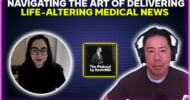
Listen and followApple PodcastsSpotifyYouTubeMore apps · Browse all episodes
“My take on the Task Force statement is that clinical judgment should rule as to whether or not screening is indicated for glaucoma. Family history, race, diabetes, and other risk factors should be considered for such screening, especially in the face of potential asymptomatic damage. How often have doctors said, ‘If you had only come in sooner …’
To the Task Force, I pose the following question: If your mother, father, brother, sister, or child had known risk factors for glaucoma, wouldn’t you want your loved one evaluated before signs and symptoms develop?”
Paul Pender is an ophthalmologist and can be reached at his self-titled site, Dr. Paul Pender. He is the author of Rebuilding Trust in Healthcare: A Doctor’s Prescription for a Post-Pandemic America.
He shares his story and discusses his KevinMD article, “Open-angle glaucoma: To screen or not to screen?”

This episode is sponsored by the American College of Lifestyle Medicine (ACLM).
Chronic disease is a global emergency. If you’re interested in evidence-based lifestyle change to address the root causes of chronic disease and restore health, rather than the less effective approach of merely managing symptoms—it’s time you heard about the American College of Lifestyle Medicine (ACLM).
Experience ACLM’s annual lifestyle medicine conference, #LM2022, while you earn CME/CE and connect with leading lifestyle medicine experts.
Become an ACLM member before the conference and save up to 22 percent off registration.
Go to lifestylemedicine.org/membership to learn more.
Did you enjoy today’s episode?
Rate and review the show so more audiences can find The Podcast by KevinMD.
Subscribe on your favorite podcast app to get notified when a new episode comes out.
Click here to earn 1.0 AMA PRA Category 1 CME for this episode.
Also available in Category 1 CME bundles.
Powered by CMEfy – a seamless way for busy clinician learners to discover Internet Point-of-Care Learning opportunities that reward AMA PRA Category 1 Credit(s)™. Learn more at about.cmefy.com/cme-info
Do you know someone who might enjoy this episode? Share this episode with anyone who wants to hear health care stories filled with information, insight, and inspiration.

Hosted by Kevin Pho, MD, The Podcast by KevinMD shares the stories of the many who intersect with our health care system but are rarely heard from.


Transcript
Kevin Pho: Hi, and welcome to the show, where we share the stories of the many who intersect with our health care system but are rarely heard from. My name is Kevin Pho, founder and editor of KevinMD. Rate and review the show at kevinmd.com/rate. Subscribe at kevinmd.com/follow.
Today we welcome back on the show Paul Pender. He’s an ophthalmologist, and his book is titled Rebuilding Trust in Health Care: A Doctor’s Prescription for a Post-Pandemic America. His most recent KevinMD article is titled “Open-angle glaucoma: To screen or not to screen?” Paul, welcome back to the show.
Paul Pender: Thank you so much for having me, Kevin.
Kevin Pho: Now, you’ve been on multiple times, and for those interested in hearing more about Paul and his story, just go to kevinmd.com/podcast to look up old episodes. But I want to get straight into your most recent article, “Open-angle glaucoma: To screen or not to screen?” Before talking about that, for those non-clinicians listening to this, let’s talk a little bit about what open-angle glaucoma is.
Real physician voices, twice a week
Free, and one click to unsubscribe.
Paul Pender: OK. Well, we know that open-angle glaucoma is the cause of blindness in the world population second only to cataract, and so in this country, it is a very important source of visual disability.
The condition causes damage to the optic nerve and vision, and it is due to a slow buildup of pressure inside the eye. There’s fluid being made inside the eye continuously, and it has to find a way to sort of escape. It doesn’t leave by way of tears; it’s absorbed internally.
I was prompted to write the article because the U.S. Preventive Health Service issued a statement that was essentially the same as it was in 2013, which said that there’s really no benefit to screening in the general population for primary care. And I thought, “Well, what about the populations at risk, such as Blacks, Hispanics, and those who have a genetic or familial inheritance pattern for glaucoma? Why shouldn’t they be screened?” So the article went into some detail about why I think we should screen for open-angle glaucoma in high-risk populations.
Kevin Pho: When you’re practicing ophthalmology, how do people normally present to you with the signs and symptoms of open-angle glaucoma?
Paul Pender: They may not present at all, and that’s the point. They may come in for a routine eye exam. You measure their eye pressure, you look at their optic nerve, and you suspect that there could be a problem. You start digging more into the history: “Oh, yeah, they had a father, an uncle, someone else who’s had damage to their vision that was only picked up late in the game.”
So oftentimes a patient will come in who’s just there because they’re over 40 and they’re coming in for a regular eye exam. Maybe they started needing reading glasses, buying them over the counter, and finding that somehow it’s just not quite right, and they think, “Maybe I should get my eyes checked.”
It goes beyond just a simple measure of intraocular pressure. There are other ways of determining whether the optic nerve is relatively healthy, comparatively. These other tests that we find are very helpful in diagnosing glaucoma may be considered excessive for the purposes of general screening, but I still feel like those diabetics, those people who have a racial preference for this particular disease, should be screened.
Kevin Pho: And how does one normally screen for open-angle glaucoma?
Paul Pender: OK. I think you begin by getting a good history and doing your full eye exam. You also will look at things like the intraocular pressure. You look at the essential area where that fluid has to leave the eye, in what we call the anterior chamber angle.
You also will look to see if there are any other clues as to why the pressure may be high, such as flaking of material off the lens capsule, which is something that we see fairly often in certain populations, and that tends to create sludge in the drainage system of the eye. So anyone who has other clinical findings, including things like iris transillumination. By shining a light with a slit lamp through the pupil and getting some background reflections through the iris, you can see where pigment has been dispersed. Some of those patients who only come in for their eye exam because they have high nearsightedness, you find that they have pigment dispersion, and that might be a precursor to glaucoma.
Once you suspect that, you do the kind of testing that’s necessary, including visual fields, the peripheral vision. You look at the ganglion cell nerve thickness. There are pretty sophisticated tests that can be used in order to really confirm the diagnosis. But you have to start with the assumption that a lot of the patients don’t have any symptoms at all.
Kevin Pho: When one picks up early signs and symptoms of open-angle glaucoma, what’s normally the next step that you would take to prevent its progression?
Paul Pender: I think what you do is you want to repeat some of your tests to see whether the eye pressure was just a periodic abnormal value or whether this is consistent. You bring the patient back to do some of these additional tests that may be necessary.
But if you confirm the diagnosis, the patient often has a couple of choices. One is to get started on ocular medication, eye drops that will help reduce the intraocular pressure. Oftentimes the most popular drug is a generic that’s used just once a day. But there’s also evidence that a special type of laser treatment into the tissues that actually helps improve the drainage of that fluid can also be equally effective as medication.
One of the other points that I think should be raised by this article that was posted in JAMA Network is that the task force recognized that, yes, this is a real problem, but they couldn’t, by their charge, discuss the costs of screening. They were just talking about what the evidence of harms versus benefit is. And I think that, yes, if you start getting into some of these tests, that will become an expense, and that often is covered by insurance and not just through vision care plans for glasses.
But the other part that should be brought up is that in subsequent articles that JAMA Network published, they said that Blacks and Hispanics are less likely to be able to afford their medications, and so there’s a problem with adherence to therapy even if you do diagnose it.
So I think what we’re facing, really, is that if you don’t diagnose it and you wait until signs and symptoms appear, as the task force has basically said, the damage is already done. And so I think that it really behooves those of us who see a wide variety of patients of various races and what have you just to have an index of suspicion that these are people who probably should be evaluated by ophthalmologists, because they’re at higher risk, to see if they have glaucoma.
Kevin Pho: Now, if open-angle glaucoma is picked up too late in the game, talk about some of the permanent repercussions that may have on patients.
Paul Pender: Well, I raised the classic example of Kirby Puckett, the former All-Star outfielder who had to give up his professional career early because he couldn’t track fly balls. His peripheral vision was compromised by his glaucoma, and he didn’t know he had it until late in the game.
So to your question about what sorts of things can happen to the vision, it may not be the central acuity for reading or for looking and doing fine tasks early on, but the peripheral vision, what we rely upon for navigating spaces and avoiding pillars and posts, and to drive safely. Peripheral vision is really necessary, and so the impact of damage from glaucoma can be devastating to someone’s lifestyle.
Kevin Pho: So in the primary care setting, how does one screen for glaucoma? I know that whenever I go to an optometrist, they always do that puff of smoke into the eye to measure intraocular pressures. So is this something that we should refer to an optometrist? Is it something that could be done in a primary care setting?
Paul Pender: Well, if I can actually refer to my notes, the task force says, “The American Academy of Ophthalmology recommends that decisions regarding when to initiate eye evaluations and the frequency of periodic exams be based on the risks but does not provide specific guidance.” End quote.
However, just going to the American Academy of Ophthalmology website, the list of risk factors is right there: being over 40; having family members with glaucoma; having African, Hispanic, or Asian heritage; having a history of high eye pressure; having an ocular injury, maybe not just superficial foreign bodies, but things like a baseball injury to the eye or a soccer ball injury; being extremely farsighted or nearsighted, and these are patients who wear thick glasses who also have some compromise to their anatomy; and then just diabetes, high blood pressure, and those with poor circulation.
Certainly in the primary care setting, you see a lot of people with those conditions, diabetes, high blood pressure, and poor blood circulation, and they should probably be evaluated. Add on top of that if they’re of Black or Hispanic extraction, and you’re going to have higher-risk populations that I feel should be screened.
Kevin Pho: Now, if you were writing the screening guidelines for open-angle glaucoma, what exactly would you recommend?
Paul Pender: OK. I think that after taking a full history, like you do for all of your primary care patients, if there’s any evidence of the high risk factors that I mentioned before, then I think that patient should be evaluated. Optometrists can certainly check intraocular pressure, and they may have the sophisticated equipment to be able to look at that as a possible diagnosis. I think ophthalmologists in general have the equipment, the education, and the training to be able to make the call.
And so I think that in a primary care setting, first you have to suspect that this patient might be at higher risk and therefore make that referral. We don’t expect primary care doctors to measure intraocular pressure. That’s not in their purview. But we do believe that once the patient falls into one of these high-risk categories, they should be referred.
Kevin Pho: We’re talking to Paul Pender, a regular guest on KevinMD. He’s an ophthalmologist, and his book is titled Rebuilding Trust in Health Care: A Doctor’s Prescription for a Post-Pandemic America. His latest KevinMD article that we’re talking about today on the show is “Open-angle glaucoma: To screen or not to screen?” Paul, what are some of your take-home messages that you want to leave with the KevinMD audience?
Paul Pender: I think the first thing is, when you start considering the overall policy, this decision that was made by the task force was really made by academicians, and there wasn’t a single ophthalmologist on the panel. And so I think that there’s maybe some myopia on the part of the task force.
And finally, I think that when you consider screenings for other medical conditions like colon cancer, what I was reading is that the statistics are that 40 percent of those screenings without previous symptoms may show precancerous polyps, but only 0.4 percent find actual evidence of cancer in the colon. So you say, is screening for open-angle glaucoma worth it? I think it is, especially in the high-risk populations.
What you’re saying is that by the time signs and symptoms develop, there’s already enough damage to affect someone’s lifestyle, their ability to function, to navigate properly, to drive. And so to me, anyone who might have these predispositions, either by race or by their medical conditions, ought to be evaluated.
Kevin Pho: Paul, thank you so much again for sharing your time and insight. Thanks again for coming back on the show.
Paul Pender: Thanks a lot for having me on.
Listen and followApple PodcastsSpotifyYouTubeMore apps · Browse all episodes