



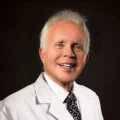













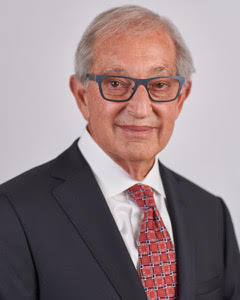
Alan P. Feren, MD, is a retired surgeon, independent physician, health care consultant, and patient advocate with more than 50 years in clinical practice, system leadership, and health care innovation. He has published 18 essays on KevinMD since April 2025, one of them with patient advocate Joyce Griggs, and has been a guest on The Podcast by KevinMD nine times. His argument is that a visit is not finished when the chart is closed. A patient can carry a plan home only if the clinician’s reasoning goes along, and he calls the method he has built around that idea Care-Full Medicine.
This spotlight is part of a series on subscribers to the KevinMD enhanced author page.
Feren published five essays in 2025 and 13 so far in 2026. The 2025 essays cover medical gaslighting, patient agency and self-advocacy, and patients’ use of AI. The 2026 essays assemble one method, the Care-Full Clinical Sequence, from the pieces: listening, examination, differential diagnosis, shared and understandable reasoning, treatment planning, feasibility and treatment burden, and follow-through. Three of the 18 essays address artificial intelligence directly. He writes from both sides of the exam table, describing a missed colonoscopy follow-up and a wound infection after his fifth spinal surgery. His nine episodes usually follow an essay, and he ends each with take-home messages for clinicians and patients. He also offers patient advocacy consultations through mypersonaladvocate.net.
Alan P. Feren at a glance
18essays on KevinMD
9podcast episodes
April 2025writing on KevinMD since
12questions answered below
Questions Alan P. Feren answers
- Does medical gaslighting mean the doctor meant to dismiss the patient?
- What should a patient do when a doctor dismisses their symptoms?
- What is unfinishedness in medicine?
- Why does “nothing concerning” fail to reassure patients, and what should clinicians say instead?
- What does “call if things get worse” actually mean?
- How is trust in medicine restored?
- Who is directing a patient’s care when five doctors are involved?
- Does care end when the visit ends?
- How should physicians use AI without losing clinical judgment?
- How should patients use AI for their own health questions?
- Can a photograph of a wound replace an examination?
- What does it take for patients to lead their own care?
Does medical gaslighting mean the doctor meant to dismiss the patient?
Not usually, Feren argues. In “Medical gaslighting has emerged as a troubling issue for both patients and health care providers,” April 2025, he reports that ECRI (the Emergency Care Research Institute) ranked the dismissal of patient, family, and caregiver concerns as its number one patient safety concern for 2025, and he writes that “Intentionality is not always present.” In “How system strain contributes to medical gaslighting in health care,” January 2026, he traces most such encounters to “communication breakdown under system strain” and writes that “What patients experience as dismissal, clinicians often experience as efficiency.” The KevinMD record on medical errors collects what physicians say about diagnostic error.
What should a patient do when a doctor dismisses their symptoms?
Preparation and a request for the clinician’s reasoning come first, Feren says. In “How to handle medical gaslighting,” December 2025, he tells patients to hand over a written list of symptoms at the start of the visit, to ask “What serious conditions have we ruled in or out?” and to bring an advocate. He cites a 2015 Journal of Pain study in which 77 percent of both men and women felt clinicians discounted or dismissed their pain, with women twice as likely to report it. A second opinion is a patient’s right, he writes, and a clinician who is secure in the work “will not be threatened by it.”
What is unfinishedness in medicine?
It is the state in which a technically appropriate visit still leaves the patient adrift, Feren says. In “Unfinishedness in medicine: When a good visit feels incomplete,” March 2026, he writes that “I call this state unfinishedness” and defines it as a clinical encounter that “reaches administrative closure without reaching human closure.” Clinicians are trained to close encounters, he adds, and “A finished visit feels safer than an open one.” The cost falls on the patient, who leaves without a story to hold or a plan to follow. Unfinishedness, he writes, “does not shout. It erodes.”
Why does “nothing concerning” fail to reassure patients, and what should clinicians say instead?
Because the phrase leaves the clinician’s reasoning behind, Feren argues. In “How clinical reassurance impacts patient communication,” April 2026, he writes that outside the exam room the phrase “becomes a signal that shapes how patients interpret symptoms” and can quietly raise the threshold for coming back. In “Clinical communication skills: the power of structured language,” March 2026, he offers five disciplines of language: name what is most likely, name what has been reasonably excluded, name what remains possible, define what would change the treatment plan, and clarify the follow-up pathway. “Language makes clinical reasoning visible,” he writes, and none of it requires a longer appointment. In his April 2025 essay he cites a review of 23,000 malpractice claims in which communication failures contributed to more than 7,000 cases and nearly 2,000 preventable deaths.
What does “call if things get worse” actually mean?
Nothing, until someone defines what worse means, Feren argues. In “Shared responsibility in patient care needs boundaries,” April 2026, he follows a patient with intermittent abdominal pain who waits because the threshold for calling was never defined. His rewrite of the instruction names concerning signs such as constant pain lasting more than 48 hours, pain that wakes the patient at night, unexplained weight loss, and worsening fatigue, plus a check-in at four weeks if nothing changes. He writes that “Without that clarity, responsibility becomes risk,” and that the fix is “the difference between assigning responsibility and sharing it.”
How is trust in medicine restored?
By method more than by empathy, Feren argues. In “Trust in medicine is restored by method, not empathy,” June 2026, he writes that “Trust is built when the method of care becomes visible,” and he introduces the Care-Full Clinical Sequence as a way to make it so. He adds feasibility and treatment burden as a required step, because “A treatment plan is not complete simply because it is medically reasonable.” A plan can be correct on paper and impossible in a patient’s life, for example when the patient cannot afford the medication or is caring for a spouse. In “Explaining clinical reasoning to patients in five questions,” August 2026, he adds follow-through as the seventh step.
Who is directing a patient’s care when five doctors are involved?
Often no one, Feren argues. In “Fragmented care needs clinical direction, not more data,” May 2026, he writes that patients assume someone is directing their care, but the captain-of-the-ship role “has become diffuse in modern medicine.” Each clinician may be right, he says, yet the patient is left to reconcile the interpretations, which are clinical judgments made outside the clinical setting. His diagnosis is a shortage of “active clinical direction,” not of data, since electronic records “do not direct care.” The KevinMD record on the electronic health record collects what physicians say about what the record did to the visit.
Does care end when the visit ends?
It must not, Feren argues, and the clinic’s clock is not the patient’s. In “The clinic closes at 5. Illness does not.” August 2026, he writes that “Medicine runs on two clocks”: administrative time, which governs appointment slots and inbox queues, and biological time, which governs symptoms and recovery. A portal message with a two business day response window is a reasonable administrative standard but may be too slow for a medication reaction, so “time should be part of the treatment plan.” In “The 15-minute appointment is not the boundary of care,” September 2026, he writes that many visits need more time now, and that care “must not be allowed to disappear between encounters.”
How should physicians use AI without losing clinical judgment?
By keeping their own thinking first, Feren argues. In “Actual Intelligence: the skill AI cannot replace,” June 2026, he cites the American Medical Association’s 2026 Physician Survey, in which 81 percent of physicians used AI in their practices, up from 38 percent in 2023, and 88 percent worried about the erosion of clinical skills. His rule is “Actual Intelligence first, Artificial Intelligence second,” because the danger is plausibility more than error. In “Clinical authorship: the missing principle in medical AI,” July 2026, he traces AI through three points in one encounter, before, during, and after the visit, and writes that “Authorship is knowing, before you sign, whether it’s true.” The KevinMD record on artificial intelligence collects what physicians say about who is responsible when AI is wrong.
How should patients use AI for their own health questions?
As preparation for the visit, not a substitute for it, Feren says. In “AI in your health care: a double-edged digital disruptor,” September 2025, he lists what AI does well for patients, such as translating medical jargon and generating better questions, and what it cannot do, such as replace an exam or a lab test. His best practices include giving full context, knowing the red flags that always need care, and telling the tool to “Demand probabilities, not certainties.” The KevinMD record on artificial intelligence collects what physicians say about patients who arrive with an AI answer.
Can a photograph of a wound replace an examination?
No, Feren says. In “Remote wound monitoring works only with a clinical loop,” September 2026, he writes that “a photograph is not a diagnosis,” drawing on a wound infection after his fifth spinal surgery more than 20 years ago, when photographs his wife took showed the edges separating and an infectious disease physician then examined it and obtained a culture. He cites a study of 523 surgeons in which wound photographs raised specificity and confidence but lowered sensitivity for surgical-site infection, and a randomized trial of 492 patients in which smartphone follow-up did not significantly shorten the time to diagnosis but did raise the odds of diagnosis within seven days.
What does it take for patients to lead their own care?
Agency, advocacy, responsibility, and partnership, Feren writes, with a partnership he describes as “the 50-50 model I advocate for.” In “Why agency and partnership are vital in modern health care,” July 2025, he tells of a colonoscopy follow-up that never came: he called, was told to find a new gastroenterologist because the original had retired, and asked for a blood count that showed an iron deficiency anemia. In “Why health self-advocacy is an essential life skill,” October 2025, written with Joyce Griggs, he lays out eight pillars of self-advocacy.
Real physician voices, twice a week
Free, and one click to unsubscribe.
Questions on this page · All spotlights
Alan P. Feren on The Podcast by KevinMD: He first came on the show in November 2025 with Griggs to discuss agency and partnership, and he has returned eight times: self-advocacy skills in January 2026, medical gaslighting in February 2026, unfinishedness in April 2026, where he tells of his mother-in-law, diagnosed with very early chronic lymphocytic leukemia, who heard only the word cancer and died within a year, structured language in May 2026, defined thresholds in July 2026, fragmented care in September 2026, trust in September 2026 again, and clinical authorship in October 2026. His take-home messages are practical. In February 2026 it was that “partnership is really what I have been pushing for.” In April 2026 he told physicians to “make your clinical reasoning transparent and visible to patients.” In July 2026 it was that “patients can’t act on a threshold that was never defined.” In October 2026 he said “you are the author of this patient’s clinical encounter and their story.”
About the KevinMD enhanced author page: This spotlight exists because Feren’s author page is an enhanced author page: his photo, biography, affiliations, and links on one page that ranks for his name and that ChatGPT, Perplexity, and Google’s AI read when someone asks who he is. The same branded attribution appears at the end of every article he has published, so each essay listed below points back to a page he controls. Subscribers get four things the free track does not:
Publish in 1 to 3 days. Free-track articles wait 5+ weeks, and the wait keeps growing. Subscribers skip the line.
Get a guaranteed podcast slot. Free slots fill within hours and the waiting list runs into the hundreds. Subscribers are guaranteed a spot.
Control your Google and AI identity. Your KevinMD author page is one of the highest-ranking results for your name. Make it represent you, in your words.
Get listed in Experts by KevinMD. Subscribers appear in the Experts by KevinMD directory, searchable by specialty and topic.
Enhanced author page
Upgrade your author page
The enhanced author page is $99/month or $999/year.
Cancel anytime for any reason, and your author page will revert to the standard attribution.
Have questions before you subscribe? Contact Kevin.
Everything Alan P. Feren has written for KevinMD:
- “Medical gaslighting has emerged as a troubling issue for both patients and health care providers.” April 2025
- “Why agency and partnership are vital in modern health care.” July 2025
- “AI in your health care: a double-edged digital disruptor.” September 2025
- “Why health self-advocacy is an essential life skill.” October 2025
- “How to handle medical gaslighting.” December 2025
- “How system strain contributes to medical gaslighting in health care.” January 2026
- “Unfinishedness in medicine: When a good visit feels incomplete.” March 2026
- “Clinical communication skills: the power of structured language.” March 2026
- “How clinical reassurance impacts patient communication.” April 2026
- “Shared responsibility in patient care needs boundaries.” April 2026
- “Fragmented care needs clinical direction, not more data.” May 2026
- “Trust in medicine is restored by method, not empathy.” June 2026
- “Actual Intelligence: the skill AI cannot replace.” June 2026
- “Clinical authorship: the missing principle in medical AI.” July 2026
- “The clinic closes at 5. Illness does not..” August 2026
- “Explaining clinical reasoning to patients in five questions.” August 2026
- “Remote wound monitoring works only with a clinical loop.” September 2026
- “The 15-minute appointment is not the boundary of care.” September 2026
Alan P. Feren on The Podcast by KevinMD:
- “Redefining health care through agency and partnership.” November 2025
- “Navigating the medical system requires specific life skills.” January 2026
- “Systemic strain creates the perfect environment for medical gaslighting.” February 2026
- “His mother-in-law heard ‘cancer,’ went home, and was dead within a year.” April 2026
- “Patients don’t need certainty, they need your reasoning out loud.” May 2026
- “Why your treatment plan falls apart after you leave the doctor.” July 2026
- “When you have five doctors and no one is directing your care.” September 2026
- “Why patients stop trusting doctors who listened to them.” September 2026
- “A diagnosis no one authored can follow your patient from visit to visit.” October 2026