Physicians writing on KevinMD about the diseases they treat and the people who have them: cancer and its screening arguments, pain and the drugs that treat it, diabetes and the obesity argument, mental illness and who gets treated for it, and the decisions at the end of a life. Five maintained records draw on this archive: Cancer: what physicians say, in their own words, Opioids: what physicians and pain patients say, in their own words, End of life: what physicians say, in their own words, Diabetes and obesity: what physicians say, in their own words, and Mental health: what psychiatrists and physicians say, in their own words.
In May, a published report indicated that changes indicative of Alzheimer’s disease (AD) were detected at age 24 via a blood test, which is increasingly available. These changes may begin earlier, but these were the study’s youngest participants. There are no medical treatments for these early manifestations, and aside from providing knowledge of a possible future and potentially causing anxiety, what value does the test hold? Unless a person has …
Read more…
Early Alzheimer’s blood test: Is it useful?
I still remember the feeling of relief standing by my uncle’s bedside. The monitors were humming with steady rhythms; the surgical team was congratulating themselves on a textbook procedure. By all clinical metrics, he was a success story. The intervention worked. The pathology was addressed. He was “stable.”
We celebrated his discharge as a victory lap. We trusted that the packet of papers in his hand (filled with appointments, medication schedules, …
Read more…
The patient carryover crisis: Why discharge education fails
The National Academy of Medicine defines diagnostic error as “the failure to (a) establish an accurate and timely explanation of the patient’s health problem(s) or (b) communicate that explanation to the patient.” Office-based practices are the predominant setting for malpractice claims related to diagnostic error.
Yes, office-based care settings.
Fast-paced, high-acuity emergency departments (EDs) have fewer malpractice claims related to diagnostic error than physician offices, according to recent research. Furthermore, 53 …
Read more…
Why diagnostic error is high in offices
Last winter, a senior nurse in our psychiatric unit told me, “The dashboard says we’re low-risk. But during night shifts, I don’t even feel safe walking to the bathroom.”
The monthly quality report on her desk said the same thing it had said for nearly a year: “Violence incidents: no significant difference among the three wards (p > .05).”
On paper, her ward looked normal. At the bedside, it was anything but.
Her …
Read more…
Medical statistics errors: How bad data hurts clinicians
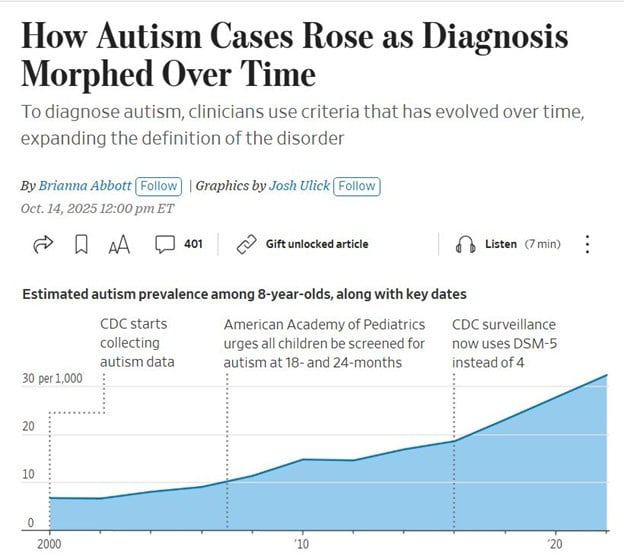
A recent Wall Street Journal graphic traces the rise in autism prevalence among eight-year-olds from 2000 to 2020. The slope is unmistakable, upward, steady, and steep. But it’s not a crisis. It’s a reckoning.
Each inflection point on that chart marks a milestone in institutional clarity:
- 2000: The CDC begins formal autism surveillance.
- 2007: The American Academy of Pediatrics urges universal screening at …
Read more…
Autism prevalence surveillance: a reckoning, not a crisis
Take a look in your medicine cabinet. What you see isn’t a sign of weakness; it’s a testament to one of the greatest partnerships in modern life: the one between your body and medical science. From the vaccine you got as a kid to the pill that keeps your blood pressure in check, these interventions aren’t just treating sickness. They are part of who you are. In a world still …
Read more…
Our relationship with medicine: a triumph
Primary care innovation has always been framed around access, autonomy, burnout, and patient experience. Direct primary care (DPC) in particular is often positioned as a solution for physicians exhausted by fee-for-service complexity and for patients who want a more personal relationship with their doctor.
This article focuses on how the broader economic landscape has shifted in ways that directly affect DPC, especially in light of the rapidly evolving national discussion around …
Read more…
Is direct primary care sustainable in a downturn?
Most people exercise to improve cardiovascular fitness, metabolic health, or mood, but regular physical activity also plays a significant role in sexual and urinary function. As a urologist, I routinely see how movement influences two intimate yet essential systems: the reproductive system and the lower urinary tract.
When patients present with urinary leakage, erectile changes, or reduced libido, they often expect a prescription or procedure. Yet for many, measurable improvement begins …
Read more…
How movement improves pelvic floor function
“The FDA has issued a nationwide recall of lisdexamfetamine capsules.”
That sentence in Newsweek magazine should have triggered alerts, guidance, and coordinated response. Instead, the silence from pediatric leadership has been deafening. Newsweek turned to the FDA and the American Academy of Family Physicians. Where are the leadership of the American Academy of Pediatrics (AAP) and the Society for Developmental and Behavioral Pediatrics? Silent. Why?
The recall that should have sparked action
In …
Read more…
Pediatric leadership silence on FDA ADHD recall
Some cases linger in our memory because of the humanity at their center. The case of Charlie Gard, which unfolded in England in 2017, is one of those. It took place within the National Health Service and under a legal framework in which courts decide a child’s treatment when parents and clinicians cannot agree. Before it became a global controversy, before it drew international headlines, it began as something far …
Read more…
The ethical conflict of the Charlie Gard case
Introduction
Tay-Sachs disease is a devastating genetic disorder that primarily affects individuals of Ashkenazi Jewish descent, though it is also found among Cajuns in Louisiana and French-Canadians. This fatal condition typically manifests within the first six months of life and leads to progressive neurological deterioration, often resulting in death by age five. As medical science advances, the question arises: Should genetic testing for Tay-Sachs be mandatory for all individuals of reproductive …
Read more…
The ethics of mandatory Tay-Sachs testing
Children often surprise us with the seriousness they bring to a clinic visit. Every so often, when the room feels tense, I turn to a simple question and ask what their favorite toy is. Caregivers smile, and children lean forward with the kind of excitement that only play can spark. In a moment, the atmosphere changes. The room feels lighter, the conversation easier, and the visit begins to unfold with …
Read more…
Why toys matter in the exam room
All clinical trials are fueled, in part, by optimism. A trial currently underway in California is fueled by the optimism of one patient in particular, Kayvon Goodarzy.
Despite decades of effort, there has been an abject lack of new approved therapies for glioblastoma (GBM). The standard of care for this deadly brain tumor has been chemotherapy and radiation, to less-than-ideal results. But that might be changing, and it’s all thanks …
Read more…
Glioblastoma immunotherapy trial: a new breakthrough
When the American Academy of Child and Adolescent Psychiatry released its October 2025 policy statement expanding what counts as valid, evidence-supported autism treatment, it marked a turning point that has been needed for years. For more than a decade, insurance companies pushed a narrow, outdated narrative that applied behavior analysis was the only evidence-based intervention for autism. That narrative was not accurate. It shaped policy, and it left families with …
Read more…
New autism treatment guidelines expand options for families
It happens almost every clinic day. A patient walks in, sits down for their vital signs, and their blood pressure reads higher than expected. Sometimes much higher. Moments later, when I retake it myself after we’ve talked for a few minutes, it’s 20 or 30 points lower.
“But, doctor, I check it at home and it’s never this high!”
They are right. This is the phenomenon of white coat hypertension, blood pressure …
Read more…
Is white coat hypertension harmless?
Halfway through a teletherapy session, you notice your therapist pause mid-sentence. They’ve just heard the soft clatter of your keyboard, or seen your eyes flick sideways to a second screen. You’re technically “there” on video, but a work email just popped up, laundry is buzzing, someone’s messaging you, and suddenly the session is sharing space with three other tabs in your brain.
On the therapist’s end, it can feel like talking …
Read more…
Gen Z, ADHD, and divided attention in therapy
I found a lump at age 32, just four months after a clear clinical breast exam. No family history. No genetic markers. I noticed the golf-ball-sized mass one day while putting on my bra.
It turned out to be stage 3C, with spread to 14 lymph nodes, as advanced as it gets without being terminal. I went through a year of aggressive treatments: bilateral mastectomy, chemo, radiation, reconstruction, and hormone therapy.
My …
Read more…
Early-onset breast cancer: a survivor’s story



















