Physicians writing on KevinMD about their own money and the business of practice: student loans and forgiveness, disability and life insurance, index funds and retirement accounts, whether to hire an advisor, financial independence and retiring early, side income and real estate, contracts and negotiation, selling a practice to private equity, and leaving insurance for direct primary care. Three maintained records draw on this archive: Physician personal finance: what physicians say about their own money, in their own words, Private equity and corporate medicine: what physicians say, in their own words, and Direct primary care: what physicians say, in their own words.
Introduction
In a recent episode of the Wealth Planning for the Modern Physician podcast, host David Mandell, JD, MBA, welcomed Dr. Michael Ast, an orthopedic surgeon specializing in adult reconstruction and joint replacement surgery. Beyond being an accomplished clinician at the Hospital of Special Surgery in New York, Dr. Ast also lectures often on business and career issues, and is especially passionate about teaching younger physicians how to build their practices …
Read more…
How new physicians can build their career
Doctors, I like to think, are fairly intelligent people. We worked hard in school, extremely hard in residency, and continue to refine our skills decades into practice. In addition to being intellectual, we are often experts in our fields. We enjoy more respect and higher salaries than most professions. Our work can be humbling and challenging, and it exposes us to the flawed nature of humans. Despite deeply understanding that …
Read more…
Why doctors make bad financial decisions
I have been representing physicians for over 30 years, and I am still amazed by the attitude of most young physicians going into their first attending position. These are smart, accomplished, fully qualified physicians who have received some of the best clinical training in the world. And yet, many of these highly trained individuals in a field with massive shortages seem reluctant to acknowledge even the slightest modicum of self-worth.
Bear …
Read more…
First physician employment agreement mistakes
As a physician, you are no stranger to complexity. From the first days of medical school to the years of long shifts in residency, you make high-stakes decisions every day. Yet many doctors tell us they feel too busy, or under-resourced, to give their money the same level of care.
That is where a Personal CFO helps. Just as a hospital relies on a chief financial officer to align budgets, risks, …
Read more…
Why physicians need a personal CFO and how tax mitigation fits in
In Season 1 of the Wealth Planning for the Modern Physician podcast, host David Mandell, JD, MBA, sat down with Dr. Desmond “Desi” McGuire, a respected ophthalmologist and founder of Retina Associates of Orange County. Their conversation traced Dr. McGuire’s path from childhood influences and early career choices to building a thriving practice and navigating the financial ups and downs of medical entrepreneurship. For physicians seeking guidance on balancing clinical …
Read more…
Building a practice and avoiding business pitfalls
After seventeen years of marriage, I found myself divorced, co-parenting, and facing two of life’s most daunting transitions at once: reentering the dating world and buying a new home. The reasons were many: parenting stressors, mid-life transitions, childhood wounds, and outside influences. There was no doubt that my career as a full-time, call-taking anesthesiologist also played a role. While the brutal 24-hour calls and 80-hour weeks were mostly behind me, …
Read more…
Why can’t finding a doctor job be like Zillow?
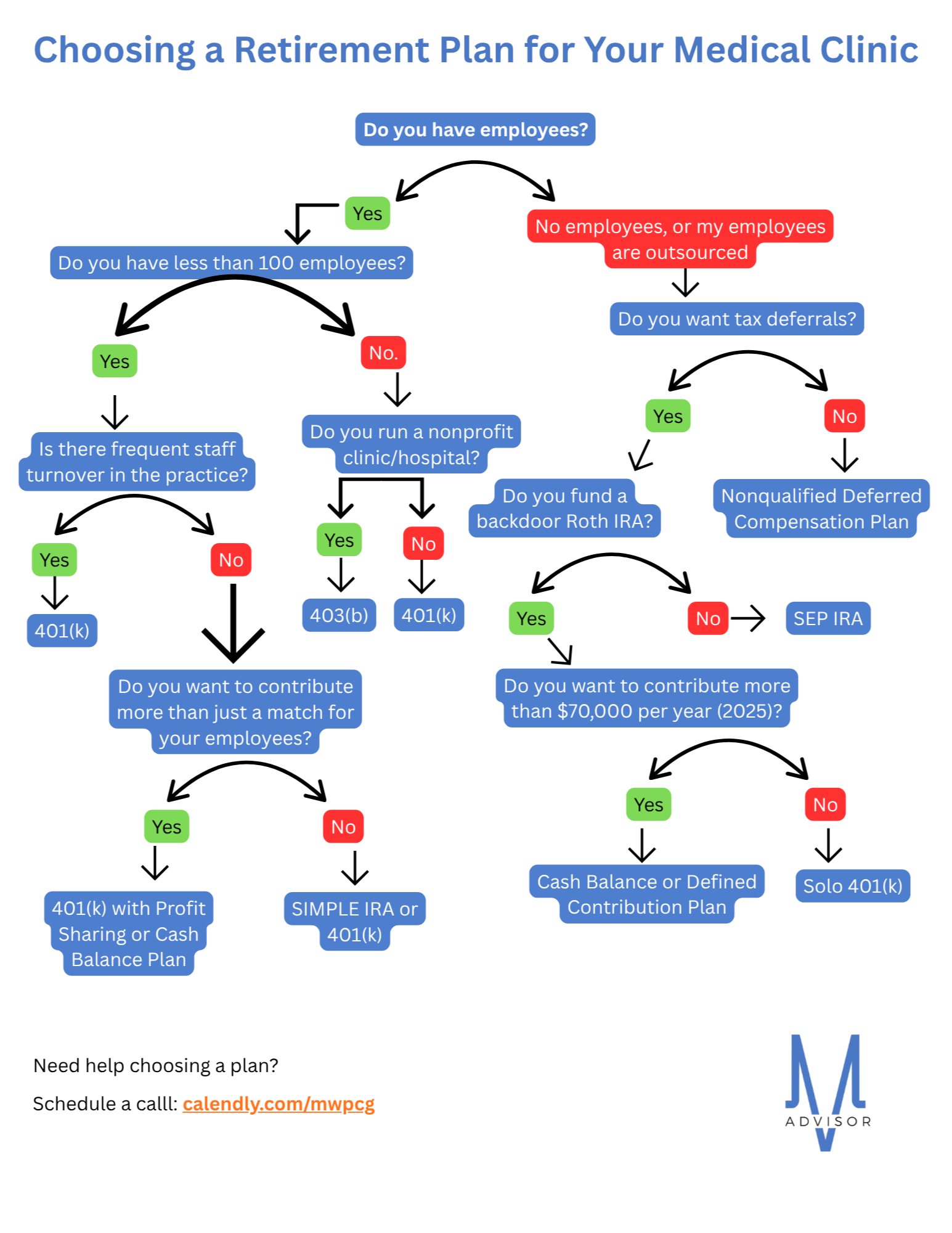
Physicians who are also business owners have two jobs: treating patients and running their business. Hiring and keeping employees is one of the job descriptions of the latter. It is no surprise that choosing and maintaining employee benefits is not at the top of an exciting to-do list. Even if hospital systems are not your direct competition, they are often competing for …
Read more…
Choosing a retirement plan for your medical clinic
Physicians dedicate years of training to caring for patients, often at the expense of their own financial well-being. While most doctors are well-versed in diagnosing illness, far fewer have the tools to diagnose the emotional and behavioral challenges that affect their relationship with money. In a recent episode of my podcast, I sat down with orthopedic surgeon Greg Gilot, MD, and financial therapist Erika Wasserman to explore the emerging field …
Read more…
What is financial therapy for physicians?
You spent years learning how to save lives, diagnose complex cases, and manage high-pressure situations. But nowhere in medical school did they teach you how to create a retirement plan, minimize taxes, or structure an investment portfolio.
Yet many doctors try to manage their own finances, thinking, “I am smart and disciplined; I can figure this out.” The truth? Being your own certified financial planner (CFP) often ends up costing more …
Read more…
Why physicians should not be their own financial planner
A physician’s financial journey isn’t always linear, and the journey can’t always be predicted in a how-to book. While the hospital-employed physician normally gravitates toward a path filled with benefits and retirement plans, the equity owner physician, or physician practice owner—both terms used interchangeably—has a much different pathway. Let’s dive into the equity owner physician a bit further.
Why choose ownership?
Like the term “business owner,” equity ownership physician is a generic …
Read more…
Physician practice ownership: risks, rewards, and reality
Don’t let a lawsuit undo decades of hard work. Here’s how to keep your wealth safe!
According to the American Medical Association, approximately one-third of all physicians will face a malpractice lawsuit, and just under 2 percent of physicians will face a lawsuit each year. While the volume of lawsuits seems high, roughly half of these lawsuits are considered frivolous. These statistics should prompt any physician to add asset protection measures …
Read more…
Smart asset protection strategies every doctor needs
Like many of my fellow physicians, I suspect I’m two things: a child of immigrants and a child of a physician. That combination gave me a unique window into two fundamental systems, health care and global economics, long before I studied either formally. I saw the sacrifices and hard choices required to navigate both, often simultaneously, with no geographic boundary ever limiting our responsibilities.
Many vivid memories from childhood have stayed …
Read more…
Why taxing remittances harms families and global health care
Lately, I have seen a few instances where physicians have been tricked by a term in their physician employment agreement that clearly does not mean what the physician thinks it means.
The most recent example came when I was negotiating a physician employment agreement, and the physician suggested verbiage concerning her scheduling. The physician suggested that we ask for language that the employer would develop a clinical schedule “after consultation with …
Read more…
A physician employment agreement term that often tricks physicians
Most people don’t read their medical bills—they panic over them. After all, receiving a multi-page statement full of confusing codes, unexplained charges, and unclear payment instructions isn’t just frustrating—it’s intimidating. I’ve worked with countless individuals who feel helpless in the face of these documents, unsure of what they owe, why they owe it, or whether the charges are even correct.
This confusion isn’t just common—it’s systemic. As a patient advocate and …
Read more…
Decoding your medical bill: What those charges really mean
Many of the physicians we work with are highly disciplined, generous with their time, and deeply committed to their profession. They spend years in training, work demanding hours, and carry an enormous sense of responsibility. Yet even with strong incomes and responsible habits, many still feel uncertain about their long-term financial picture.
The problem is not how much they earn. It is that income alone is not a strategy.
Physicians face unique …
Read more…
5 blind spots that stall physician wealth
As an early career physician, transitioning from residency or fellowship into attendinghood, or even just contemplating a job change, can feel both exciting and overwhelming. There’s the thrill of stepping into your first “real” job, finally earning a salary that reflects the years you’ve invested. But alongside that excitement often comes anxiety: About finding the right fit, navigating unfamiliar systems, and negotiating a contract you may not fully understand.
Amid all …
Read more…
The most overlooked skill in medicine: contract negotiation
When graduating residents and fellows begin their careers as attending doctors, there is a wealth of financial advice out there. Grow into your salary slowly. Don’t buy a house right away. Get disability insurance. Plan ahead for the tax bomb that always takes attendings by surprise during that half-trainee/half-attending year.
Today, we won’t discuss any of those. We’ll focus instead on a business lesson that you must unlearn …
Read more…
The business lesson new doctors must unlearn



















